The history of the creation of football.
The modern football is the result of thousands of years of evolution, originating from rudimentary natural materials such as animal hides and pig bladders in ancient civilizations in China (Cuju dating back to 206 BC) and Rome. From a simple tool for folk games, the ball has become a high-tech product, closely linked to the professional development of modern football. Two important milestones shaping this transition are 1862, when Richard Lindon invented an inflatable rubber inner bladder, and 1872, when the English Football Association (FA) issued official standards for size and weight.
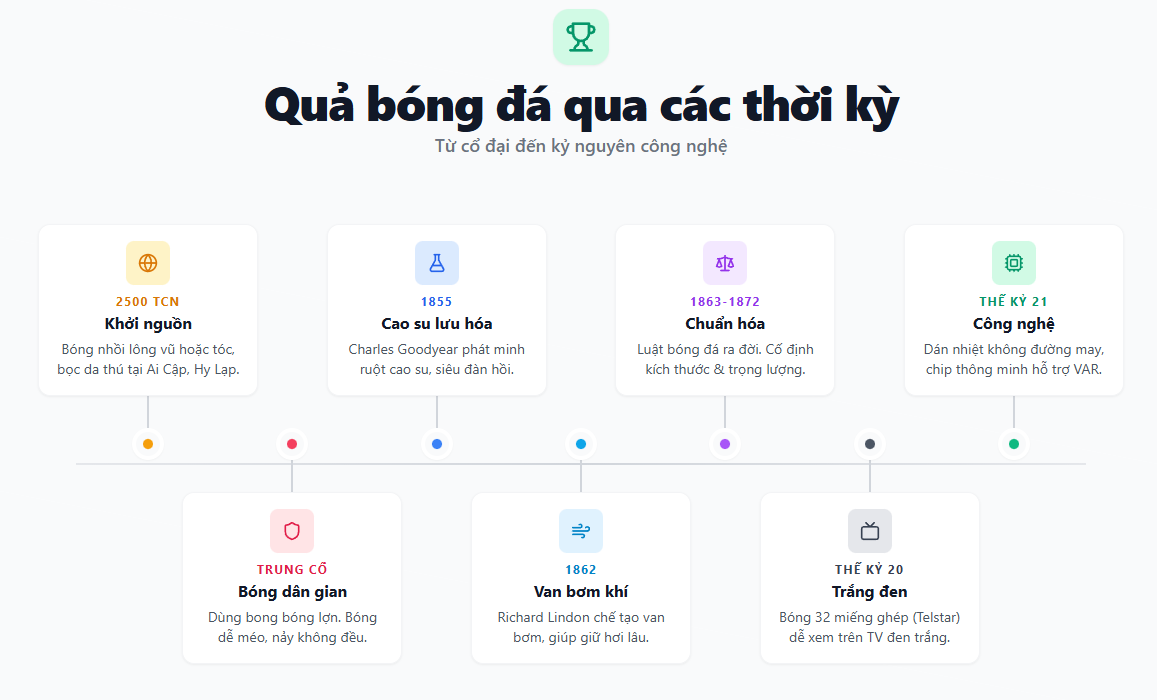
During the ancient period (from approximately 2500 BC to the 19th century), many civilizations developed ball games, notably Episkyros in Greece, Harpastum in Rome, and especially Cuju in Han Dynasty China. At that time, the ball was often covered in leather and stuffed with feathers or hair, representing the initial steps in shaping the structure and function of football.
During the Middle Ages, folk football in England was popular with balls made from inflated pig bladders, wrapped in leather for durability. However, due to limitations in materials and techniques, the balls were often misshapen, easily damaged, and difficult to control, affecting the quality of play.
The real revolution took place between 1855 and 1862. In 1855, Charles Goodyear invented the vulcanized rubber inner tube, opening a new direction for football design. By 1862, Richard Lindon further improved it by creating a rubber inner tube with an air valve, allowing the ball to achieve a perfect spherical shape, become lighter, more durable, and suitable for large-scale competition.
The standardization process began in 1863, when the English Football Association (FA) was founded and the official rules of football were established. By 1872, the FA stipulated that the ball must be spherical, with a circumference of 68–70 cm and a weight of 368–425 grams, marking the transition from an informal game to a professional sport with a clear system of rules.
Throughout the 20th century, the ball continued to be improved to suit modern playing conditions. White was widely adopted to enhance visibility under stadium lights and in bad weather. In 1970, Adidas introduced the Telstar ball at the World Cup , with a 32-panel construction consisting of 20 white hexagons and 12 black pentagons. This design quickly became a classic icon of world football.
Entering the 21st century, footballs are manufactured from high-quality composite materials, offering water resistance and durability. Heat-bonding technology has gradually replaced traditional stitching methods, and sensors and electronic chips have been integrated to assist referees in determining offside and other crucial situations, as exemplified by the 2022 World Cup. From a simple handcrafted object, the ball has become a symbol of the fusion of history, science, and modern sports technology.
Standard size of a soccer ball
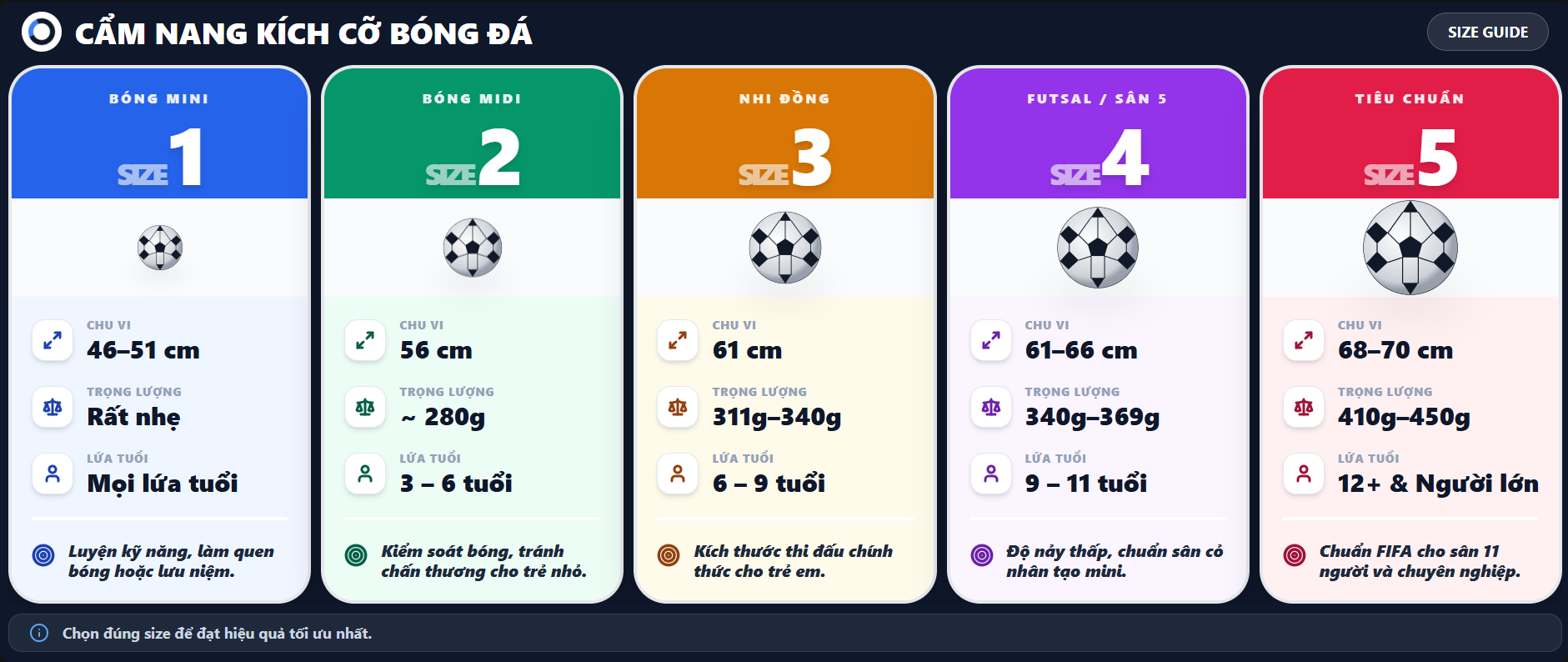
| Size | Perimeter | Weight | Suitable age | Purpose & Notes |
|---|---|---|---|---|
| Size 1 (Mini ball) | 46–51 cm (18–20 inches) | Very light | All ages | For practicing basic skills, getting familiar with the ball, or as a souvenir. Not for use in competitions. |
| Size 2 (Midi Ball) | Approximately 56 cm (22 inches) | ~280g | Children aged 3-6 years old | Practicing ball control skills helps children avoid injuries caused by heavy balls. |
| Size 3 | Approximately 61 cm (24 inches) | 311g – 340g | Children aged 6-9 years old | The smallest size is officially used in children's matches. |
| Size 4 | 61–66 cm (25–26 inches) | 340g – 369g | Children aged 9-11 years old | Artificial turf (5-a-side) is popular for Futsal due to its low bounce. |
| Size 5 (Standard) | 68–70 cm (27–28 inches) | 410g – 450g | Players over 12 years old and adults | FIFA standards for professional play, natural grass pitches, 11-a-side and 7/9-a-side pitches. |
Additional technical specifications (for standard FIFA Size 5):
- Pressure: Must be between 0.6 and 1.1 atmospheres (equivalent to 8.5 - 15.6 PSI).
- Material: Must be made of suitable material (usually high-quality PU for competition balls) and must have a perfect spherical shape.
- Roundness: For a ball that meets FIFA Quality Pro standards, the requirements for roundness and bounce are extremely strict to ensure an accurate flight trajectory.
Football manufacturing technology



Leading sports corporations are constantly racing to improve the technology and quality of the ball:
- Nike: Pioneering AerowSculpt technology that improves flight trajectory by 30% and reduces wobble by 50%. It also features ACC (All Condition Control) technology for better ball control in wet conditions.
- Adidas: Uses SpeedShell leather, reduced from 32 to 20 panels, to improve aerodynamics. Connected Ball technology integrates an IMU sensor for automatic offside detection and rapid data updates.
- Puma: A breakthrough with the Orbita ball's 12-panel diamond-shaped design, creating a 40% smoother surface for a perfect shooting feel.
Structure of a soccer ball
A standard soccer ball typically consists of four main parts:
- Outer cover: Determines the tactile feel and durability. Usually made from PU (soft, sensitive, used for high-end balls), PVC (durable, inexpensive, used for training), or SVD (high-grade synthetic resin, high durability and elasticity).
- Inner linings/Mid-layer: Consists of multiple layers of polyester/cotton (usually 4 layers in professional balls) to maintain shape, provide bounce, and disperse impact forces.
- Ball bladder: Contains air. Latex bladders are soft, bouncy, but lose air quickly; butyl bladders retain air longer and are more durable.
- Pump valve: Facilitates easy inflation and maintains stable pressure inside.

How to choose a good soccer ball
To choose the right ball, you need to keep the following in mind:
- By age: Choose the appropriate ball size (size 3 for U9, size 4 for U12-U14, size 5 for adults).
- Based on the playing surface: Artificial turf pitches (5-a-side, 7-a-side) usually use size 4 balls with low bounce; 11-a-side pitches use size 5 balls.
- Based on material: Choose balls with PU or SVD covers for greater durability and a more realistic feel. Hand-stitched balls are generally more durable than machine-stitched or heat-sealed balls.
- Based on cost and purpose: For competitions, choose a FIFA-standard ball; for training, a cheaper option is acceptable.
Standard size of a soccer ball and



To maintain the durability and quality of the ball, you should follow these steps:
- Preparation: A soft towel, an old toothbrush, warm water, and mild soap.
- Cleaning: Gently wipe the surface with a cloth dampened with soapy water, and use a brush for stubborn stains (avoid scrubbing too hard to prevent damaging the casing).
- Pressure check: Use a pump and pressure gauge to maintain the pressure according to the manufacturer's instructions (typically 0.6-1.1 atm).
- Storage: Keep the ball in a dry, cool place, away from direct sunlight and extreme temperatures (too high or too low).
- Maintenance: Regularly inspect for cracks or gaps along the seams.
- Important note: Absolutely avoid exposing the ball to strong detergents and sharp objects. After use, dry thoroughly and store in the protective bag.
Source: https://vietnamnet.vn/kich-thuoc-tieu-chuan-cua-qua-bong-da-2492068.html

![[Image] National conference summarizing one year of operation of the overall organizational model of the political system, the three-tiered government model.](https://vphoto.vietnam.vn/thumb/1200x675/vietnam/resource/IMAGE/2026/07/01/1782882811691_ndo_br_1-jpg.webp)





![[Infographics] Summary of titles won over 4 seasons of the Thanh Hoa Newspaper and High School Children's Football Tournament](https://vphoto.vietnam.vn/thumb/402x226/vietnam/resource/IMAGE/2026/07/01/1782890328195_infographics-to-w1200t0-di2626d272d3081214t11600l1-272d3081208t1165.webp)