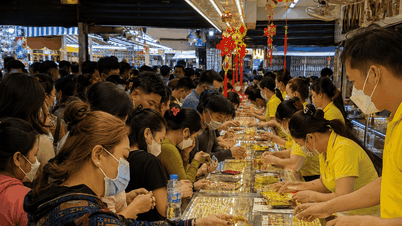
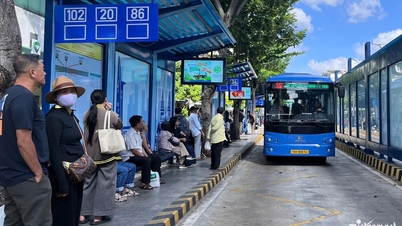
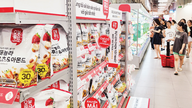
Consumers shop at AEON Mall Long Bien supermarket, Hanoi . (Photo by Dang Anh)
In the first quarter of 2026, the Vietnamese economy continued its high growth rate of 7.83%. However, the escalating conflict in the Middle East is increasing pressure on macroeconomic management, directly impacting the achievement of growth targets and inflation control for the entire year. Many solutions aimed at controlling factors that put pressure on inflation and supporting growth have been decisively implemented by relevant authorities.
Ensuring energy security
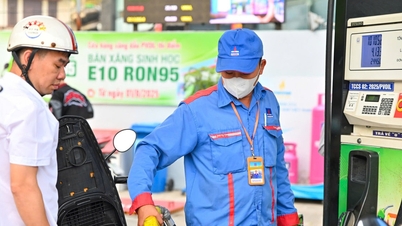
Starting in March 2026, the Consumer Price Index (CPI) has risen sharply due to the impact of global fuel prices and rising construction material costs. The General Statistics Office ( Ministry of Finance ) reported that the global energy price shock directly affected domestic retail gasoline prices, causing gasoline prices to increase by an average of 29.72% and diesel prices by 57.03% in March. The increase in fuel prices led to a 12.85% increase in the transportation CPI, contributing 1.28 percentage points to the overall CPI increase. The General Statistics Office forecasts that if global oil prices continue to escalate due to prolonged Middle East tensions, the annual CPI could increase by another 1-2 percentage points. Calculations show that a 10% increase in domestic gasoline prices will lead to a CPI increase of approximately 0.45 percentage points, spreading to many other goods and services.
To ensure the supply of petroleum products, the Tax Department has directed provincial and city tax offices and large enterprise tax branches to conduct surprise inspections of high-risk petroleum businesses. In cases where signs of hoarding, speculation, restricting sales to profit from price fluctuations, and other violations of regulations on invoice issuance and use, or price fraud are detected, strict action must be taken in accordance with regulations.
The urgent directive from the Tax Department was issued amidst concerns about irregularities detected during a review of electronic invoice databases for several petroleum businesses in the first quarter. Specifically, sales volumes before and after price adjustments fluctuated significantly; in some cases, the total sales volume of a business in the two days prior to the price increase was more than three times greater than the volume after the price hike, posing a high risk to tax management.
The Ministry of Finance also proposed that the Government extend the application period for the reduction of import taxes on certain petroleum products under Decree No. 72/ND-CP until June 30, 2026, instead of April 30, 2026, as the Decree originally stipulated, and apply preferential import tax rates to certain raw materials for petroleum production.
Associate Professor, Dr. Ngo Tri Long, an economic expert, commented that this is a necessary approach in the context of a still sensitive petroleum market, directly impacting production costs, transportation, and people's lives. It is noteworthy that these two solutions complement each other quite closely. On the one hand, extending the reduction in import taxes helps support supply, reduce pressure on input costs, and create more room for price stability. On the other hand, strengthening inspections of gas stations showing signs of hoarding, especially before, during, and after price adjustments, is a necessary measure to maintain market discipline, prevent profiteering and speculation, and avoid distorting support policies.
"
“The message from the governing body is very clear: The State is ready to share the difficulties with businesses and people, but absolutely will not tolerate the exploitation of policies to destabilize the market. This is precisely the requirement of a proactive and flexible governance system that does not relax discipline.”
Associate Professor, Dr. Ngo Tri Long
Previously, market management agencies and the Ministry of Industry and Trade repeatedly emphasized the need to prevent hoarding and disruptions in the supply of petroleum products. Flexible management is only truly effective when accompanied by strict supervision and synchronized coordination between the finance, tax, industry and trade, and market management sectors. Support policies must reach the right market, and enforcement discipline must be strong enough to deter acts of exploiting price fluctuations for profit. "The message from the regulatory agencies is very clear: The State is ready to share difficulties with businesses and people, but absolutely will not accept the exploitation of policies to destabilize the market. This is the requirement of a proactive and flexible management system that does not relax discipline," said Associate Professor, Dr. Ngo Tri Long.
Support for production and business
Confident that Vietnam has the resilience to overcome external shocks, thanks to its experience in responding to natural disasters, the Covid-19 pandemic, and geopolitical conflicts like the Russia-Ukraine conflict, Associate Professor, Dr. Tran Hoang Ngan, a member of the 16th National Assembly (Ho Chi Minh City delegation), believes that a current advantage is that budget revenue in the first quarter of 2026 has progressed well, exceeding the forecast and increasing significantly compared to the same period last year. This creates room for the Government to flexibly use financial tools such as tax and fee exemptions and reductions to stabilize prices and avoid the ripple effect of inflationary pressure. In addition, it is necessary to support costs and directly share difficulties with businesses by maximizing reductions in fees under state management such as taxes, customs fees, and transportation infrastructure fees… to maintain production and business activity.
In the coming period, it is necessary to coordinate and harmonize fiscal and monetary policies in a proactive, flexible, timely, and effective manner to maintain macroeconomic stability, control inflation according to the set target, and contribute to overcoming difficulties for production and business, supporting enterprise development, and promoting growth. Continue to implement a rational and focused expansionary fiscal policy, while monetary policy must simultaneously ensure the objectives of controlling inflation, supporting growth, and maintaining the safety of the system.

Vietnam encourages US businesses to expand investment in high technology.On the morning of June 26th, at the Government Headquarters, Deputy Prime Minister Ho Quoc Dung received Mr. Jeff Place, Supply Chain Director of Coherent Group (USA). During the meeting, the Deputy Prime Minister affirmed that Vietnam encourages US businesses to expand investment, especially in high-tech, innovation, and semiconductor industries. In its Q1/2026 report to the Prime Minister on the impact of the Middle East conflict on the production and business activities of enterprises, the Private Economic Development Research Board (Board IV) proposed seven main groups of solutions, focusing on prioritizing energy price stabilization, reducing input cost pressure, and supporting supply; promptly implementing solutions to support credit, debt restructuring, interest rate reduction, and improving cash flow for businesses...
The survey results from Committee IV show that the impact of the Middle East conflict is concentrated on sectors directly related to transportation, import and export, fuel, industrial production, agriculture, and international supply chains. Rising input costs are eroding businesses' cash flow and profit margins; investment sentiment, access to capital, and financial conditions are also beginning to be affected. At this time, the business community is also hoping for a substantial and accelerated reform of administrative procedures to remove legal obstacles and ensure enforcement, especially procedures related to tax refunds, imports, and access to capital, so that businesses can focus their resources on production, business operations, and risk mitigation...
With the advantage of maintaining macroeconomic stability and proactively reforming institutions, Vietnam has every opportunity to welcome a new wave of manufacturing relocation in the trend of restructuring global supply chains and investment. However, to take advantage of this opportunity, businesses need to prepare to meet the requirements of new orders with higher standards.
Source: https://baolamdong.vn/kiem-soat-lam-phat-on-dinh-kinh-te-vi-mo-434917.html







![[Image] National conference summarizing one year of operation of the overall organizational model of the political system, the three-tiered government model.](https://vphoto.vietnam.vn/thumb/1200x675/vietnam/resource/IMAGE/2026/07/01/1782882811691_ndo_br_1-jpg.webp)