

Few would believe that, from a wild weed growing everywhere from hills and cliffs to riverbanks, the reed grass (Erythrina variegata) can now be an export product, bringing income to those who know how to seize business opportunities...
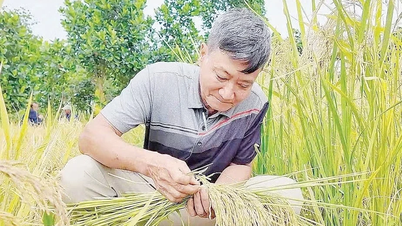
On a 3,000m² rice field in Bo Vi 2 residential area, Yen Thinh town (Yen Mo district), belonging to Mr. Luong Van Tue's family, vast fields of pristine white reeds lie neatly under the hot winter sun, waiting to be dried and processed to preserve their natural pure white color, beautiful fluffy blossoms, and just the right length.
Regardless of the scorching heat or biting cold, the workers diligently select and bundle reeds according to standards, preparing them for delivery to customers. Hong Tham, Mr. Tue's wife, while directing the workers to quickly bundle the reeds, shared stories about her dedication to the profession.
After accidentally learning about a relative in Lao Cai who specialized in collecting reeds for export to China, Mr. and Mrs. Tue researched the market and started a business collecting reeds. Although called a profession, the work of collecting, processing, and sorting reeds only takes place for about two months each year. Every year, around October, when the reeds bloom white on the hillsides, valleys, and riverbanks, people eagerly go to harvest them.
The reeds in Trang An, Ninh Binh are beautiful, attracting many young people who come to check in, take photos, and preserve beautiful memories of the peaceful, simple countryside, characteristic of this flower when winter arrives. For businesses, this is when the reeds are at their most beautiful. The reeds, which bloomed in October and November, are cut, and the upper part of the flowers is processed and dried. The finished product consists of fluffy, pure white reed flowers, packaged in plastic bags and sold to event organizers or accessory businesses.
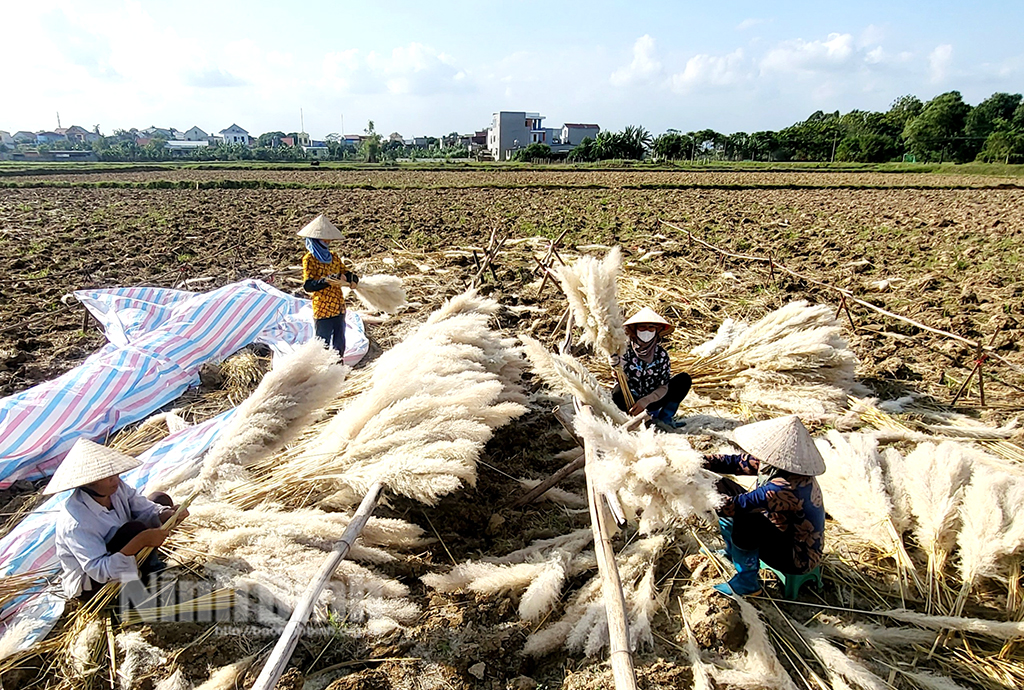
To source the raw materials, Mr. Tue had to travel to many provinces in the North and Central regions to find and transport them to Ninh Binh. Reeds from Cao Bang , Lao Cai, Nghe An, Thanh Hoa, etc., are gathered in his family's fields, where they undergo a process of selection, processing, and drying before meeting the standards for customers.
For the first two years of implementing the model, Mr. Tue's family mainly exported their cotton products to China through a relative's company. At its peak, his family had to hire up to 40 seasonal workers. This year, since exports are not possible, Mr. Tue's family has shifted their focus to offering their products to event organizing companies and accessory businesses in provinces and cities across the country, such as Hanoi and Ho Chi Minh City.
Currently, reeds are sold on the market for 10,000-15,000 VND per head. The harvesting and collection of reeds only lasts about two months. During the harvesting period, the biggest fear for collectors is the humid weather and rain. If it gets wet, the reeds spoil very quickly and are almost unusable.
Having been involved with these wildflowers for three years, it's one of the family's livelihoods. Although the income isn't long-lasting or truly stable, for Mr. Tuệ's family, contributing to bringing wildflowers to the city brings a sparkling joy. These wildflowers are now used in many aspects of life: for decorating wedding venues, in vases, and for event decorations… contributing to the beauty of a peaceful, simple countryside scene amidst the hustle and bustle of the city.
Besides that, on the days when the reeds are gathered in the fields, many photographers and locals come to take beautiful pictures with the reeds. Mr. Tue's family always happily welcomes them and creates all the conditions for them to have beautiful memories of the white reed season.
Text and photos: Bui Dieu
Source


![[Photo] General Secretary and President To Lam meets with National Assembly delegates from ethnic minorities.](https://vphoto.vietnam.vn/thumb/1200x675/vietnam/resource/IMAGE/2026/04/20/1776696701056_a1-bnd-8331-3342-jpg.webp)
![[Image] National Assembly discusses the implementation of the socio-economic development plan.](https://vphoto.vietnam.vn/thumb/1200x675/vietnam/resource/IMAGE/2026/04/20/1776696707422_ndo_br_img-20260420-185419-jpg.webp)

























































Comment (0)