

- Expanding the cultivation of the " World's Best Rice" variety in a rice-shrimp farming model.
- Increasing the value of rice through the supply chain.
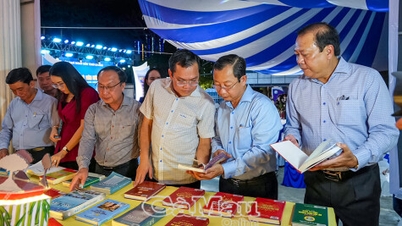
- The series of events served as a "boost" in building the brand of Ca Mau rice.
In recent years, Ca Mau has gradually expanded the area of high-quality rice cultivation, using salt-tolerant and acid-tolerant varieties suitable to its natural conditions. The province aims to strongly develop high-quality, low-emission rice models in the 2026-2030 period, linked with green growth and the establishment of raw material areas that meet export standards.
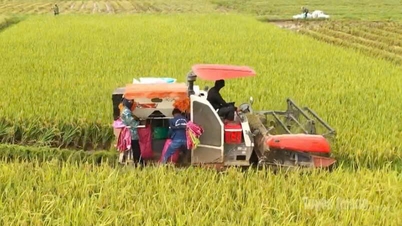
 Rice production needs to be further mechanized and digitized in order to improve productivity and quality.
Ca Mau is promoting the linkage of the rice production-processing-consumption chain, while applying technology to improve quality and reduce production costs. This approach helps farmers reduce their dependence on intermediaries and increase connections with purchasing and exporting businesses. In particular, specialty, organic, and eco-friendly rice products such as ST25 rice and low-emission rice-shrimp farming are opening up opportunities to increase their value in domestic and international markets.
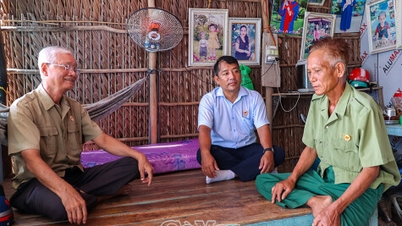
Mr. Pham Minh Tien, Deputy Director of Green Farm Ecological Agricultural Cooperative (Hoa Binh commune), said that a company has already signed a contract to purchase the product; at the same time, some export markets are also interested in Vietnam's low-emission rice products.
 New rice varieties are encouraged for production in order to build the province's rice brand.
Meanwhile, Mr. Trinh Van Cuong, Chairman and Director of Vinh Cuong Cooperative, said that the unit is participating in the 1 million hectare high-quality rice project. “Currently, Ca Mau, An Giang, and Tay Ninh have implemented about 13,000 hectares. The cooperative invests a total of 5-12 million VND/hectare and provides technical support to ensure the product meets export standards for the European market. The people are very enthusiastic about participating,” Mr. Cuong shared.
However, as a downstream province of the Mekong Delta, Ca Mau relies heavily on rainwater and groundwater, and therefore frequently faces droughts, saltwater intrusion, and freshwater shortages during the dry season, affecting rice production efficiency. The impacts of climate change and land subsidence further increase salinity, penetrating deeper inland.
Furthermore, production remains small-scale and fragmented, limiting the ability to apply technology and organize on a large scale. In fact, in 2025, falling rice prices and difficult market conditions have caused many farmers to worry, especially those growing common varieties like HB1, which account for a large proportion of their crops.
 In 2025, falling rice prices and limited purchasing markets have caused many farmers in Ca Mau to worry about finding buyers for their produce.
In light of this situation, the province is implementing a comprehensive set of solutions to sustainably develop the rice industry, ranging from applying technology and planning production areas to strengthening supply chain linkages and building brands.
Mr. Pham Van Muoi, Deputy Director of the Department of Agriculture and Environment of Ca Mau province, said that the province is focusing on developing sustainable production models such as shrimp-rice farming and low-emission rice farming. Currently, the shrimp-rice farming model covers approximately 94,000 hectares and has the potential to expand by another 25,000 hectares in suitable areas.
“This is a safe, environmentally friendly model, highly appreciated by many scientists. Along with that, the planning of production areas and the implementation of low-emission rice cultivation are being promoted. Many businesses have participated in linkages, supporting farmers with seeds, supplies, allowing deferred payment until the end of the season, and guaranteeing product purchase,” said Mr. Pham Van Muoi.
 The province has implemented various support policies regarding supplies and prices to encourage farmers to maintain rice production.
Emphasizing long-term orientation, Vice Chairman of the People's Committee of Ca Mau province, Le Van Su, stressed the need to promote the application of science and technology, especially in the program of 1 million hectares of high-quality rice, reducing emissions; and at the same time strengthen chain linkages to enhance value and expand the market for rice consumption.
The province will organize a science, technology, innovation, and digital transformation event in conjunction with the Mekong Delta's best rice competition in Ca Mau to promote and bring rice products to domestic and international markets.
 Ca Mau aims to build a brand and reputation for its rice in the international market.
With the coordinated efforts of the government, businesses, cooperatives, and farmers, Ca Mau is expected to further strengthen its position in the rice industry, contributing to food security and promoting local economic development.
Lam Khanh - Tien Luan
Source: https://baocamau.vn/nang-chat-nganh-lua-gao-trong-boi-canh-moi-a127973.html



































































Comment (0)