

In the face of the rapid, complex, and unpredictable changes in the global situation, the requirement is not only to maintain stability, but also to proactively create new strengths and capabilities, enhance self-reliance and policy-making capacity, thereby paving the way for the country to enter an era of sustainable development and prosperity.
Foreign relations continue to play a pivotal role in Vietnam's overall development strategy. A proactive, comprehensive, and balanced approach has helped Vietnam expand its network of relations, increase its "strategic space," and create a favorable international environment for development. A notable highlight is Vietnam's upgrading of its relations to Comprehensive Strategic Partnerships with five countries: New Zealand, Indonesia, Singapore, Thailand, and the United Kingdom, bringing the total number of countries with Comprehensive Strategic Partnerships to 14, including all five permanent members of the UN Security Council; establishing Strategic Partnerships with nine countries; and Comprehensive Partnerships with two countries. According to Professor Hal Hill (Crawford School of Public Policy, Australian National University), Vietnam is becoming a model for maintaining a "strategic balance" among major powers amidst increasing geopolitical competition in the Indo-Pacific region.

Expert Enzo Sim Hong Jun (Penang Research Institute, Malaysia) stated that expanding relations from major East Asian countries like Japan and South Korea to developing countries in Africa, amidst global instability and increasing tariff risks, helps Vietnam diversify its partners, avoid dependence on a single market, and thus maintain its autonomy and strategic balance.
Alongside expanding relations, Vietnam continues to deepen traditional ties. High-level visits by Vietnamese leaders over the past year to Russia, China, and North Korea affirm a consistent foreign policy approach: maintaining political trust and expanding substantive cooperation in long-term strategic areas. Neighborly diplomacy continues to strengthen strategic alignment and long-term partnership for sustainable development, self-reliance, and shared prosperity, exemplified by Vietnam and Laos adding a new dimension to their cooperation: "Great Friendship, Special Solidarity, Comprehensive Cooperation, and Strategic Alignment."
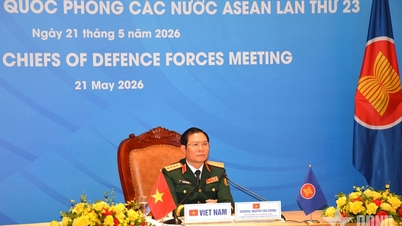
Building on a strengthened bilateral foundation, Vietnam continues to assert its role and voice in multilateral forums. After three decades of partnership with ASEAN, Vietnam is recognized as one of the members capable of leading, connecting, and shaping a long-term development vision for the bloc. Mr. Beni Sukadis (Indonesian Institute for Defence and Strategic Studies) assessed Vietnam as a "bridge" helping ASEAN strengthen relations with major partners, thereby consolidating ASEAN's central role. Ms. Dinna Prapto Raharja (Synergy Institute for Policy, Indonesia) noted that Vietnam has made a significant contribution to boosting intra-ASEAN trade, increasing it fourfold over the past 30 years.

Expert Collins Chong Yew Keat (University of Malaya, Malaysia) noted that Vietnam has transformed from a "beneficiary of integration" to an "active architect shaping the ASEAN agenda," demonstrating leadership in ASEAN expansion, promoting peace in the South China Sea, and leading digital transformation and green growth. Highlighting Vietnam's crucial role, ASEAN Secretary-General Kao Kim Hourn affirmed: "A strong Vietnam means a strong ASEAN, and vice versa."
The year 2025 also marks Vietnam's increasingly prominent presence in global frameworks. Vietnam's re-election as a member of the UN Human Rights Council for the 2026-2028 term with a high number of votes reflects the international community's confidence in Vietnam's prestige and contributions to promoting human rights. Notably, the opening ceremony of the UN Convention against Cybercrime (Hanoi Convention) has brought Vietnam to the forefront of international cooperation in the field of cybersecurity thanks to its proactive and constructive role. The Washington Times considers this event a testament to Vietnam's capacity to shape global rules in the digital age. Master Thong Mengdavid from the Institute for International and Public Policy Studies (Royal University of Phnom Penh) affirmed that hosting the signing of the Hanoi Convention elevated Vietnam's role as a neutral coordinator and a "bridge nation" in global governance, demonstrating Vietnam's maturity, prestige, and political acumen as a "middle power" that always respects international law and promotes global cooperation on the basis of multilateralism.
Vietnam's transformation journey in 2025 is also clearly illustrated by its role as a "responsible and forward-looking" nation, proactively sharing perspectives and initiatives and participating in shaping global policy directions. UN Secretary-General Antonio Guterres assessed Vietnam as an active member in a multipolar world and expects Vietnam to assume an increasingly proportionate role in global governance. Scholar James Borton, in an article published in International Policy Digest, noted that Vietnam is shifting from "participation" to "proactive leadership" in international integration.
Observers also note that Vietnam has effectively utilized forums such as the Davos Forum in Tianjin in Summer 2025 to promote messages of solidarity, cooperation, and the creation of a prosperous and sustainable "Asian era" in the face of global challenges.
Vietnam's appointment to important positions within UNESCO and its becoming a BRICS partner country in 2025 continues to be seen as a strategic move, reflecting a flexible foreign policy and long-term vision. According to Professor Dr. Phan Kim Nga (Pan Jin'e) of the Institute of Marxist Studies under the Chinese Academy of Social Sciences, Vietnam can play a "bridging" role between BRICS and ASEAN, promoting South-South cooperation and contributing to balancing international influence.
Amidst the challenges of a volatile global environment, international public opinion also highly appreciates Vietnam's reforms and strategic direction. Mr. Wei Wei, Head of the Vietnamese Section of China Central Radio and Television, emphasized the role of streamlining the administrative apparatus and merging provinces and cities. Meanwhile, Mr. Ludwig Graf Westarp, a lecturer at the Dortmund University of Technology (Germany), believes that the Politburo's "pillar" resolutions, particularly on private sector economy, innovation, and science and technology, will create momentum for the country's take-off era. According to Mr. Giulio Chinappi, Asia Regional Director of Anteo Edizioni Publishing House in Italy, clearly defining these "pillars" demonstrates a comprehensive vision in the new context.
Overall, international opinion assesses Vietnam as entering a new phase of development with a stable foundation, enhanced position, and expanding strategic space. However, it still needs to continue strengthening its internal capacity and improving the quality of growth to effectively respond to the unpredictable changes in the world in the coming time. In the medium and long term, many experts, including Professor Hal Hill, believe that by 2045, Vietnam will assert a greater role and influence in ASEAN and on the international stage. In this way, Vietnam has been, is, and will proactively create a new strategic position for the country in the new era.
Source: https://baotintuc.vn/thoi-su/kien-tao-vi-the-moi-20251230063051747.htm
















































Comment (0)