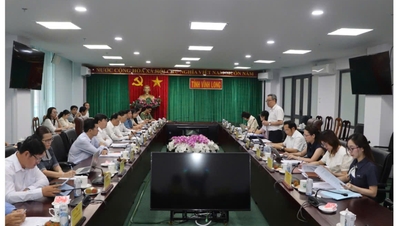
The first year of operating the new model was a special period of both implementation and adjustment, ensuring the smooth fulfillment of political tasks and gradually perfecting the coordination mechanism and operational procedures in a situation where there were no longer intermediate levels.
Practical experience in many localities within the province shows that positive changes in administrative reform, decentralization, delegation of power, and improvement of the quality of service to the people are contributing to clarifying the goals, meaning, and effectiveness of the two-tiered local government model.
 |
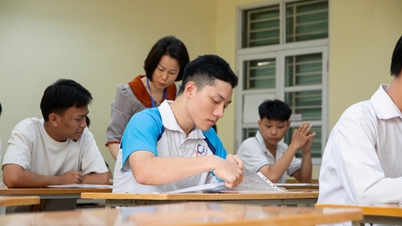
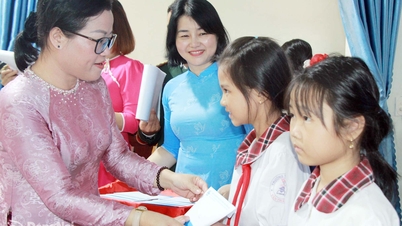
| A team of young volunteers assists residents of Trung Hiep commune with administrative procedures. Photo: CAM HUE |
Shift from an administrative mindset to a service-oriented one.
In its first year of operation under the two-tiered local government model, the provincial and commune-level government apparatuses in Vinh Long have been basically stable, operating smoothly and effectively, gradually affirming their role as a government close to and connected with the people. Administrative procedures for citizens and businesses have been handled more quickly and conveniently.
One of the most striking changes is the shift in management thinking and service methods. While previously public service primarily focused on administrative management, now citizens and businesses are placed at the center. From organizational structure and work processes to the application of digital technology, everything is geared towards providing faster, more transparent, and more efficient service.
Comrade Nguyen Thuy Yen Phuong, Secretary of the Party Committee of Cai Ngang commune, said that the commune's Party Committee always thoroughly understands the Party's guiding principles on the goal of streamlining the administrative apparatus and improving the effectiveness and efficiency of public service. The new local government model has made a strong mark in modernizing public administration to better serve the people. A prominent highlight is the establishment of the Public Administrative Service Center and the synchronized application of digital infrastructure: 100% of officials and civil servants are equipped with high-speed internet; 100% of incoming and outgoing documents (except confidential documents) are processed entirely online through the iOffice system.
Evaluating one year of operation of the overall organizational model of the political system, the two-tiered local government model, Comrade Nguyen Thanh Ha - Secretary of the Party Committee of Tan Hanh Ward, said: The implementation of the two-tiered local government model is a major policy of the Central Government, demonstrating a strong determination in reforming the organizational structure towards a streamlined, effective, efficient, people-oriented, and better-serving model.
It can be said that the past year was a year of great pressure, but also a year that clearly demonstrated the sense of responsibility, solidarity, and political determination of the entire political system of the ward. From the Party Committee, People's Council, People's Committee, Vietnam Fatherland Front Committee, and political and social organizations to each official and civil servant, everyone has strived to quickly adapt to new requirements, proactively innovate working methods, maintain local stability, and ensure continuous and uninterrupted service to the people and businesses. More importantly, through the quality of work, the service attitude, and the sense of responsibility of grassroots officials, the people's trust in the local government has been gradually strengthened.
In Tan Quoi commune, administrative reform and post-merger administrative procedures focused on simplifying processes and shortening waiting times for citizens, creating the most favorable conditions for organizations and individuals when conducting transactions. The promotion of online public services at levels 3 and 4, along with the active implementation of Project 06 and the population data system, has enabled citizens to access services anytime, anywhere, eliminating geographical barriers after the merger. These results modernize the grassroots administration, making a significant contribution to building a "Digital Government" and "Digital Citizen" in the locality.
Comrade Ngo Thanh Tam, Deputy Director of the Tan Quoi Commune Public Administrative Service Center, said that the center fully implements the posting and public disclosure of administrative procedures; receives and processes applications in accordance with regulations, and does not refuse applications included in the published list. In addition, the locality strengthens propaganda to help people and businesses understand the benefits of carrying out administrative procedures regardless of administrative boundaries.
The results in Tan Quoi commune also reflect the general picture in many localities in the province. Administrative reform, coupled with digital transformation and the implementation of administrative procedures regardless of geographical boundaries, has contributed to shortening the gap between the government and the people, reducing the time and cost of procedures, improving service quality, and gradually affirming the effectiveness of the two-tiered local government model.
For the satisfaction of the people
Practical experience after one year of operation shows that the effectiveness of the two-tiered local government model is measured by the streamlining of the administrative apparatus, the results of administrative reform, and the satisfaction of the people. The transformation in the work style and sense of responsibility of the staff and civil servants is gradually building the image of an administration that is closer to the people, more responsive to the people, and serves the people better.
In Quoi An commune, after the merger, the number of people coming to conduct administrative transactions increased significantly. However, the process of receiving and handling procedures was still carried out quickly and efficiently, with dedicated civil servants providing guidance, creating a sense of reassurance for the people.
 |
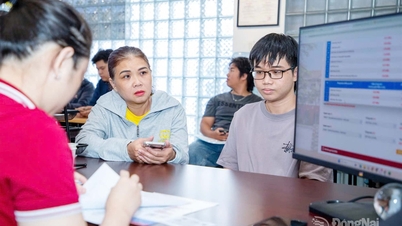
| Officials and civil servants at the Ham Giang Commune Public Administrative Service Center are dedicated to serving the people. Photo: TUYET NGA |
When Ms. Luong Thi Cuoc (from Vam An hamlet) went to the commune's Public Administrative Service Center to complete land surveying procedures, she received attentive guidance from the staff, even though it was almost noon. She shared: "Coming to complete the procedures, I felt very reassured by the enthusiastic guidance from the staff, despite my age and lack of technological familiarity. The center is well-equipped, the staff are responsible, and the instructions are very specific. I hope that in the future, Quoi An commune will serve its people even better."
In Tra Con commune, an area with a large Khmer population, the team of officials and civil servants, especially those of Khmer ethnicity, have become a bridge helping people easily access administrative procedures.
As a civil servant directly responsible for receiving and processing land-related documents, Mr. Thach So Thanh Na Rit always diligently guides citizens from the information declaration stage to document verification, aiming to minimize errors. He shared: "We always strive to provide dedicated support to the people, delivering results on time and reducing the need for multiple trips. The workload is greater, but each document processed on time is a source of joy for us."
That dedication has been appreciated by the people. Mr. Thach Kha Ly (Tra Con commune) said that every time he comes to complete administrative procedures, he is warmly welcomed by the officials and given specific guidance to complete the application. According to many local people, the fact that many procedures that previously had to be handled at the district level are now processed right at the commune has significantly saved time and travel costs.
Meanwhile, Long Vinh commune – which maintained its status quo after the reorganization – still faced considerable difficulties in operating under the new model. Infrastructure and information technology equipment were lacking and not yet synchronized, significantly impacting work efficiency. With the determination of the Party committee, the government, and the staff, the locality has accelerated the implementation of tasks in the digital environment, focusing on digitizing data, especially in the areas of land and archival documents; and effectively operating the Public Administrative Service Center. The rate of timely processing of applications reached 100%, and online applications increased by over 70%, contributing to improved service quality for citizens and administrative efficiency.
Alongside the positive results, the first year of operating the two-tiered local government model also revealed some difficulties, such as a larger administrative area and increased workload, while staffing and organizational structure have not been adjusted accordingly; information technology infrastructure and some shared databases are still not fully synchronized. Closely monitoring the practical situation and clearly identifying the obstacles from reality is crucial for further improving mechanisms and policies, and enhancing the effectiveness and efficiency of local government operations in the new phase.


Changes from grassroots practice show that the two-tiered local government model brings about changes in organizational structure, gradually innovating methods of governance and serving the people. This also forms the foundation for continuing to build a modern, professional administration that is people- and business-centered, meeting the development requirements of the new era.
REPORTER TEAM
Source: https://baovinhlong.com.vn/chinh-polit/202607/dau-an-sau-1-nam-van-hanh-chinh-quyen-dia-phuong-2-cap-ky-2-doi-moi-phuong-thuc-quan-tri-va-phuc-vu-nhan-dan-55f459f/