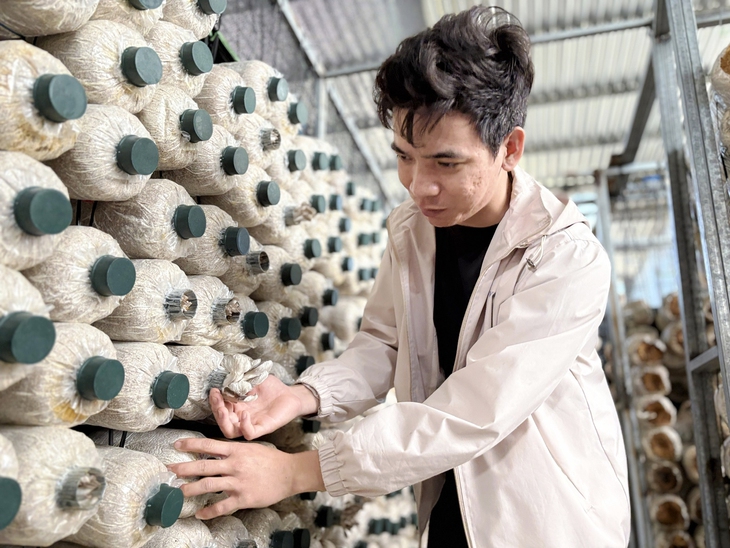
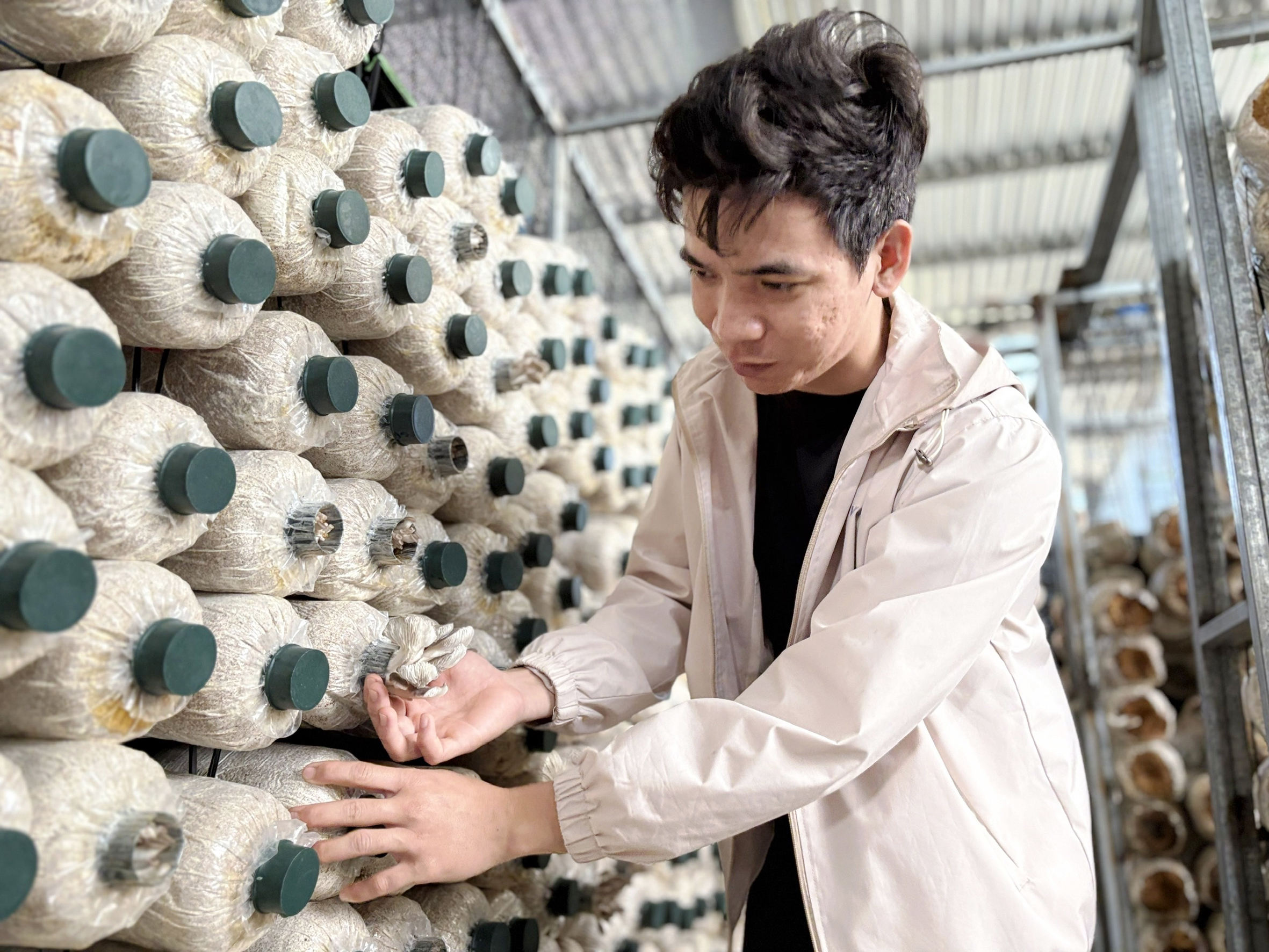
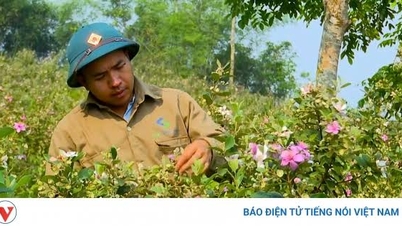
Young engineer Dinh Van Hao carefully inspects each mushroom substrate in his farm - Photo: L.CHI
That small farm on the outskirts of Hue City is the culmination of the passion of this young biotechnology engineer. He is pursuing his dream of clean agriculture after deciding to leave the city and return to his hometown to start a business.
The journey home
Early in the morning, Hao's mushroom farm was bustling with activity. In the yard, towering piles of sawdust had been thoroughly mixed. Several workers were busy bagging the sawdust, preparing it for the batch of mushroom spawn he had just received an order for. Amidst this work environment, Hao checked the environmental indicators displayed on his phone app. With a few taps, the misting and lighting systems in the mushroom farm were immediately adjusted.
Hao explained that the entire farm is operated using an Internet of Things (IoT) sensor system, allowing for remote monitoring and adjustment of factors such as humidity and light via a mobile application. "Thanks to this automated system, the amount of labor required is significantly reduced. More importantly, the environment in the farm remains stable, helping the mushrooms grow uniformly and reducing disease," Hao said.
To have a 150m2 mushroom farm with over 15,000 substrates operating with advanced technology like it is today, this young engineer had to overcome a rather long journey. After graduating with a degree in biotechnology from the University of Science (Hue University), Hao chose to move to Ho Chi Minh City to start his career, working at a company specializing in clean agriculture.
Hao's work took him to many provinces and cities, transferring mushroom cultivation technology to farmers. He recounted his trips to An Giang , Lam Dong, Vung Tau, and other places to help develop production processes, create mushroom spawn, and provide technical guidance to improve mushroom yields for local people. These long, continuous trips helped Hao better understand the value of clean agricultural products when they reach consumers.
The job provided a fairly stable income, but the young man still yearned for another dream. "Since my student days, I've been fascinated by mushroom cultivation and have visited many mushroom farms in Hue to learn the techniques. Building my own mushroom farm is a dream I've cherished for a long time," Hao shared.
You may also like
Writing indigenous stories using a digital mindset.Spring of the Year of the Horse - With a digital mindset and a desire to elevate local agricultural products, young entrepreneurs in Quang Nam province are transforming their homeland's resources into thriving brands through innovation and self-renewal every day. So, at the beginning of 2024, Hao decided to return to his hometown to start his own business after many years working away from home. And of course, the early days were not easy. Hao's mushroom farm at that time was on land he rented from local people. The land was low-lying and waterlogged, so after only one season, he had to move the entire system to another location and start over.
Although revenue isn't huge yet, I've already seen the fruits of my journey back home. Each mushroom is growing day by day, along with the dream of building a green business on my homeland.
DINH VAN HAO
The closed loop of organic farming
With nimble hands, Hào recounted his early entrepreneurial journey and his decision to pursue organic farming. He avoids chemicals, fertilizers, and growth stimulants in his mushroom cultivation process. This contributes to the crispness and chewiness of his grey oyster mushrooms, which have a naturally sweet flavor and a subtle aroma.
About three days before harvesting the mushrooms, the farm always stops watering. Hao explains that this reduces the weight of the mushrooms slightly, resulting in a small economic loss for the producers, but in return, the mushrooms don't swell with water, so they can be preserved longer and taste sweeter.
After harvesting, the mushrooms are meticulously trimmed before being sold, a bit laborious but ensuring quality. Even the packaging is carefully planned by the young owner. The harvested mushrooms are wrapped in sterilized paper to maintain freshness. The young engineer also uses QR codes for traceability. Customers can simply scan the code to access all the product information.
One of the things he was particularly concerned about from the beginning of his entrepreneurial journey was how to maximize the use of materials and minimize waste. This included using sawdust from wood processing facilities or straw after the harvest season as a substrate for mushroom cultivation. With approximately 15,000 mushroom substrates, each production cycle requires about 20 tons of sawdust.
After the harvesting cycle ends, the substrate is reused to grow straw mushrooms. Then, after harvesting the straw mushrooms, the remaining substrate is composted into bio-fertilizer for crops. Currently, he is researching how to utilize waste products to produce biofuel pellets, aiming towards a circular agriculture model. "I want to build a closed production cycle, minimizing material waste," Hao said.
Making vegetarian products from mushrooms

Vietnam encourages US businesses to expand investment in high technology.On the morning of June 26th, at the Government Headquarters, Deputy Prime Minister Ho Quoc Dung received Mr. Jeff Place, Supply Chain Director of Coherent Group (USA). During the meeting, the Deputy Prime Minister affirmed that Vietnam encourages US businesses to expand investment, especially in high-tech, innovation, and semiconductor industries. For about the past six months, Hao and his colleagues have researched and developed a vegetarian sausage made from mushrooms. However, the sausage must be stored in the refrigerator and consumed within 5-7 days because it does not contain preservatives.
This new product is currently made to order only. He said he is finalizing the procedures for product registration before officially launching it on the market. At the same time, he is also experimenting with the production process of shredded oyster mushroom floss.
Transfer of mushroom cultivation technology
Currently, Hao's mushroom farm mainly grows grey oyster mushrooms, with a small amount of straw mushrooms and white wood ear mushrooms. Each month, it supplies over 1 ton of fresh mushrooms to the Hue market and several neighboring areas. In addition to producing fresh mushrooms, he also provides mushroom spawn for those who need it, at a price of approximately 7,000 VND per spawn if purchased in large quantities.
In addition, Hao also organizes training courses on mushroom cultivation techniques, transferring technology for growing oyster mushrooms, black termite mushrooms, cordyceps, etc. Many trainees, after completing the course, have built their own mushroom farms and started harvesting their first crops of mushrooms.
Source: https://tuoitre.vn/ky-su-ve-que-trong-nam-sach-20260428083416287.htm






![[Photo] National Assembly Chairman Tran Thanh Man attends the Conference to announce the Master Plan for Hanoi Capital City with a 100-year vision.](https://vphoto.vietnam.vn/thumb/1200x675/vietnam/resource/IMAGE/2026/06/29/1782709639728_ndo_br_1-jpg.webp)
![[Image] A look back at the capital's preparations for the century-long master plan.](https://vphoto.vietnam.vn/thumb/1200x675/vietnam/resource/IMAGE/2026/06/29/1782750453122_quy-hoach-100-nam-minh-duy-1-2118-jpg.webp)
![[Photo] General Secretary and President To Lam works with the Party Committee of the Government on the work of preventing and combating storms, floods, extreme natural disasters and climate change.](https://vphoto.vietnam.vn/thumb/1200x675/vietnam/resource/IMAGE/2026/06/29/1782729441945_a1-bnd-0385-9454-jpg.webp)



















































![[Image] Building an elevated road through the Ma Da forest.](https://vphoto.vietnam.vn/thumb/402x226/vietnam/resource/IMAGE/2026/06/29/1782724737750_anh-man-hinh-2026-06-29-luc-16-18-43.png)