


In the former Bac Son base area, many families display portraits of President Ho Chi Minh , General Vo Nguyen Giap, along with numerous medals, decorations, and certificates of recognition from the Fatherland... these are glorious testaments to the history of revolutionary struggle, and to the losses and sacrifices made.
A village, a family, and a revolution.
Mr. Ban Tien Duong married and had six children, three sons and three daughters. His eldest son, Ban Quy Hinh, had a strange fate. People said he was "unlucky," having been unsuccessful in his numerous attempts to find a wife in the surrounding area. One time, while working far from home and staying with an acquaintance, Mr. Ban Tien Duong met a kind and hardworking Dao girl. Finding her appealing, he asked for her hand in marriage, and finding their destinies compatible, he decided to arrange the marriage for his son. Although they respected Mr. Ban Tien Duong, the long distance, the fact that the family had few children, and the fact that the girl was an adopted child and the family wanted a nearby husband for easier visits, led to a polite refusal, demanding a dowry of ten large pigs and ten large jars of wine. Mr. Duong was determined to marry her off. He gathered his wealth, sought help, and mobilized hundreds of people to carry the dowry. The wedding was lively for three days and three nights, boisterous and sacred, like a momentous event for the entire village. Upon welcoming the bride home, the groom's family set off firecrackers that burned even the rice granary. That bride was Trieu Thi Luu, who later became the spiritual pillar of the entire family during the tragic years of history. From this marriage, a generation of Dao people deeply connected to the revolution was born.
Bàn Quý Hinh and Triệu Thị Lưu had six children, three sons and three daughters. Their second son, Bàn Dầu Châm, later became a living witness to a historical tragedy.
Under French colonial rule in the late 19th century, the people of Bac Son had to bear all kinds of taxes. Besides the poll tax (tax levied on individuals aged eighteen to sixty) and land tax, they also had to pay taxes on land, forests, markets, and even salt, with a policy of using salt to punish those who resisted. Furthermore, "Under an increasingly cruel and barbaric regime, the poor people of Bac Son had to bear the additional burden of forced labor, unpaid labor – a terrible, oppressive, inhumane, and tragic regime" – (Announcement of the Northern Regional Party Committee, June 9, 1930). Politically and socially, the French colonialists implemented a divide-and-conquer scheme, deliberately creating disparities and inciting animosity among the people of Bac Son. They implemented a policy of deliberate ignorance, resulting in 95% illiteracy. Alongside the political system, the French colonialists established a military system with district-level units, below which were general units and commune-level units commanding militia and patrol forces, and they colluded with each other to easily suppress the enemy.
Faced with the harsh policies of the feudal colonial government, the vast majority of the working people were filled with intense indignation and were ready to stand on the side of national interests to fight. As early as 1885, when King Hàm Nghi issued the "Cần Vương" (Support the King) decree, the anti-French movement surged throughout the country, spreading to Bắc Sơn with the people's enthusiastic support for the uprising led by Hoàng Đình Kinh in Hữu Lũng, Bắc Sơn. This was followed by continued support in terms of manpower and resources for the armies of Hoàng Hoa Thám, Lâm Trung Lập, and others. Although these uprisings were brutally suppressed, immediately after the founding of the Communist Party of Vietnam (February 3, 1930), Bắc Sơn became one of the important locations chosen to direct and consolidate the revolutionary movement.
The patriotic spirit and indomitable fighting will of the people of Bac Son forced the enemy to heighten their vigilance. In Bac Son, the French colonialists built a dense system of forts and outposts. As early as 1893, they built the Mo Nhai and Dang Lang forts. During the period when the revolutionary movement in Bac Son developed, especially after the uprising of September 27, 1940, and the demonstration and rally of October 28, 1940, at Vu Lang school, they established several more forts and outposts such as Quang Thai, Nam Nhi, Bac Bai, Tam Canh, and Vu Le commune forts. In addition, they also established a concentration camp in Chieu Vu commune, using secret agents to monitor and capture revolutionary fighters. After the Bac Son uprising, there was a separate branch of secret agents here under the command of the Northern Vietnam Secret Police Department.
After suppressing the Bắc Sơn people's rally at Vũ Lăng school, the French colonialists intensified their terror against the revolutionary movement, searching throughout the communes of Vũ Lăng, Vũ Lễ, Chiêu Vũ, Ngư Viễn… to hunt down cadres and terrorize the people, aiming to eliminate the Bắc Sơn guerrillas. The French colonialists' frenzied actions created many difficulties for the revolutionary movement, but under the leadership of the Central Committee and the Northern Regional Committee, and with the encouragement of the revolutionary movement nationwide, the revolutionary movement in Bắc Sơn grew stronger. The Bắc Sơn guerrilla zone expanded, connecting with Võ Nhai and partly with Đồng Hỷ and Phú Bình (Thái Nguyên). In early 1941, the Northern Regional Committee assigned comrades Lương Văn Tri, Hoàng Văn Thái, Bùi Thống… to lead and consolidate the guerrilla forces and build the Bắc Sơn-Võ Nhai base. Military training spread throughout the villages and hamlets. The forests of Khuoi Noi, Phu Thuong, Lau Thuong, Ban It, and Trang Xa became training centers for guerrillas and self-defense forces, boosting the fighting spirit of the people of Bac Son.
In February 1941, a delegation of the Party, including comrades Truong Chinh, Hoang Van Thu, Hoang Quoc Viet, and Tran Dang Ninh, attending the 8th Central Committee Conference in Pac Bo (Cao Bang) convened by leader Nguyen Ai Quoc, stopped at Khuoi Noi (Vu Le). There, Comrade Hoang Van Thu, Secretary of the Northern Regional Party Committee, informed all cadres and Party members of the Bac Son Party Committee about the Central Committee's decision to rename the Bac Son guerrilla unit to the Bac Son National Salvation Army – the first revolutionary armed force led by the Party. On February 23, 1941, the Bac Son National Salvation Army held its official founding ceremony in the Khuoi Noi forest. The base of the Bac Son National Salvation Army was located at the headwaters of the Khuoi Noi stream, in the Tam Tau forest, about three kilometers from National Highway 1B. The first task assigned by the Central Party Committee to the Bac Son National Salvation Army immediately after its formation was to guide and protect leading Party cadres attending the 8th Central Committee Conference. From May 10th to 19th, 1941, the 8th Central Committee Conference was held in Pac Bo, Cao Bang. The conference laid down many important policies for the revolution, including the task of strengthening and consolidating the Bac Son National Salvation Army and developing the Bac Son - Vo Nhai base area.
According to the plan, on International Labor Day, May 1, 1941, the Bac Son Party Committee and the Command Board of the National Salvation Army organized a rally and simultaneously launched the Bac Son National Salvation Army at Khuoi Noi. Immediately after this event, the Bac Son Party Committee began planning to welcome and protect the Central Committee officials returning from the 8th Central Committee Conference. However, the journey was exposed. Upon arriving in Binh Gia, they saw signs of a major terrorist attack. Soldiers and secret agents patrolled and guarded all roads from Binh Gia to Bac Son. On the evening of June 23, 1941, the Central Committee officials, including comrades Truong Chinh, Hoang Van Thu, Hoang Quoc Viet, Phung Chi Kien, etc., arrived in Lan Pan (Tan Lap commune), but to ensure their safety, they were immediately taken to a base in Khuoi Cuom (Mo Pia - Tan Lap commune). While assessing the situation and directing operations, the delegation continued to move, changing locations to Lan Tay, Lan Rieu, Na Cai, Po Luong, and then back to Lan Nam and Lan Rao. However, the reactionary forces had "sniffed out" and tracked the delegation's movements. Here, sensing signs of exposure, the Bac Son Party Committee continued to send central-level cadres to our base in Sa Khao (Vu Lang commune).
Unable to force the people to hand over their cadres, on July 25, 1941, the French colonialists launched a large-scale terrorist attack on the Bac Son - Vo Nhai base. Wherever they went, they set up outposts, dividing the forest and villages to conduct raids, arrest people, rob, burn houses, and intimidate the people. On July 27, 1941, they attacked the Mo Pia base. Failing to capture the Central Committee members, the enemy retaliated by terrorizing the masses. A mass arrest and massacre took place right there. All the old and young, men and women of Mo Pia village were arrested and imprisoned in Dang Lang prison (Quynh Son). The revolutionary fighters were tortured and imprisoned, and none survived to return.
At Vu Le, the French troops captured most of the people in the villages of Na Cai and Ban It. Sensing signs of revolutionary life in the Khuoi Noi forest, the French colonialists moved their troops to Khuon Khat. The small village had no self-defense force strong enough to resist. The invaders came like a jungle storm, burning and destroying every house, plundering property. The men in the village had steel wire impaled through their palms and were taken away in agony. The sky above Khuon Khat was ablaze with fire.
The massacre of sixteen Dao ethnic minority households in Khuon Khat village that year will forever remain a painful and hateful milestone in the history of the revolutionary struggle in Bac Son.
Ban Dau Cham - the next generation rising from the ashes.
Trieu Thi Luu – this very woman was tasked with supplying food to the revolutionary cadres and guerrillas that day – the day the French troops advanced on Khuon Khat. Returning from the deep forest, she saw raging fires, heard shouts and screams of hatred echoing against the cliffs. Something had happened. She froze. From within the dense thicket, she clearly saw her house engulfed in flames. The villagers were beaten, herded together in a crowd, their clothes stained with blood, in pain and panic. Her heart felt as if it were being squeezed as she thought of her husband, her sons, and her daughters… Suddenly, a thought flashed through her mind: “Ban Dau Cham, my second son. Today, Dau Cham took the buffaloes to graze in the distant forest…” She ran across the garden back into the forest and encountered two young girls, Ban Thi Tam and Ban Thi Tu, hiding behind an embankment. She immediately signaled the buffaloes towards her, and the three of them fled through the forest. Turning around the small slope, they unexpectedly encountered Ban Dau Cham, who was also rushing back to the village after hearing the cries for help from the villagers. “No!…” Mrs. Luu shook her head. Seeing his mother’s distraught expression, Ban Dau Cham stopped. After a quick exchange, the four of them, mother and children, ran together.
Run! Run! Run!... They kept running, through the forest, across streams, through the night. They ran and ran as fast as they could, as if even a moment's delay would bring death. They ran in pitch darkness, surrounded by mountains and forests. They ran with hunger, thirst, and panic, their only clothes torn and stained with blood... By the time they reached Nhat Tien, they were almost completely exhausted. Fortunately, a relative's family, despite the danger, opened their hearts and took in the mother and her two children, sharing with them the minimum necessities to survive.
Thus, Mr. Ban Quy Hinh's family was shattered in the blink of an eye. Mrs. Trieu Thi Luu, penniless, relied on the support of relatives to raise her three children. They lived in constant fear until the success of the August Revolution, when a glimmer of hope for a more stable future emerged. Once, Dau Cham and her mother risked their lives to return to Khuon Khat, but the village was gone. Trees had grown green on the blood-soaked foundations of the houses of the past. Sixteen houses, sixteen homes, over a hundred inhabitants—all remained in memory. It is said that amidst the ashes of that day, an old woman in the family retrieved a half-burned incense burner and a bamboo tube containing fifteen ancestral portraits. Knowing that Dau Cham and her mother had returned to Khuon Khat village, a nearby family called them back and returned the stray buffalo they had kept and used to plow their fields for several years. Bringing the buffalo back to Nhat Tien, along with a nearly forty-kilogram pig, Mrs. Luu exchanged it for four acres of land. In that extremely difficult situation, Mrs. Lu decided she had to find someone to rely on. Duong Choi Sinh, the man who extended a helping hand, was also the one who organized the four "dry" funerals for Mrs. Lu's husband, Mr. Ban Quy Hinh; his younger brother, Mr. Ban Quy Minh; and Mrs. Lu's two sons, Ban Dau Chau and Ban Dau Hang. They were all captured by the French along with many other villagers in the massacre at Khuon Khat village, and none of them survived. The funeral ceremony is the final sacred ritual in a Dao person's life cycle, important and expensive. Mrs. Lu will be grateful to Mr. Choi Sinh for that for the rest of her life.
Bàn Dầu Châm married and built his life amidst poverty and loss, but also in love, guided by his mother's teachings about loyalty, truth, and the crimes of the enemy. He never forgot the day fire engulfed Khuôn Khát, the villagers' desperate cries, and his mother's vacant stare. He fathered eight children, raising five – three sons and two daughters – all of whom he provided with education in extremely difficult circumstances. Since having grandchildren who call her grandmother, every New Year's Eve, as an unchangeable ritual, Mrs. Lưu would recount the heartbreaking story of the past to her grandchildren and later her great-grandchildren. She did not want anyone to forget those dark days. Each time she told the story, she would choke back tears. But for her, tears needed to flow to nourish aspirations. After her death, Mrs. Triệu Thị Lưu was posthumously awarded the title of Heroic Vietnamese Mother.
Bàn Dầu Châm lived a quiet life, passing on the never-ending flame of the desire to live from his mother to his sons and daughters. One of his children, Bàn Nho Hiển, grew up and dedicated his life to the revolution, serving as Chairman of the People's Committee and Chairman of the People's Council of Nhất Tiến commune for twenty-five years and five years.
Confucian scholar Bàn Nho Hiển and his efforts to realize the aspiration for independence, freedom, and happiness.
In Nhat Tien, Mr. Hien is a highly respected official in the region. This man carries in his veins not only the red blood of the Dao people but also the unforgettable memories of his grandmother, the memories of the souls that forever remain in the deep forests of Khuon Khat.

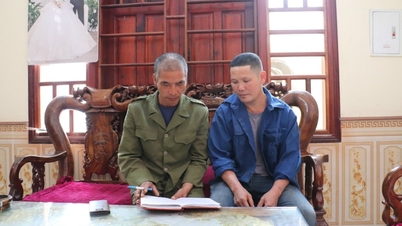
Mr. Ban Nho Hien held in his hand a small notebook in which he had personally recorded the story of his family lineage.
I met Mr. Ban Nho Hien on an autumn day in Nhat Tien commune. The story evokes a dark cloud weighing heavily on my memory.
“My grandmother, Trieu Thi Luu, would always call her children and grandchildren to sit around the fireplace on New Year's Eve to listen to her tell old stories. After lighting incense at the altar, she would tell the stories while weeping. I remember once my father saying, 'The story is over, why keep telling it?' But she said, 'As long as I live, I will keep telling it. So that my children and grandchildren will know how our ancestors survived in these mountains and forests.'"
As he spoke, Mr. Hien flipped through a small notebook where he himself had recorded the story of his family lineage. The Dao man, seventy-seven years old, a Party member for forty-seven years, who had served as Chairman of the People's Committee for twenty-five years and Chairman of the People's Council for five years, yet in that moment, when mentioning his grandmother, he was like a child reliving a childhood moment, quiet, emotional, and full of respect.
He pointed outside the door and told me, "That big kapok tree, the one right by the village road, was planted by my teacher himself. He was the only one assigned by the revolution to teach here, and my father welcomed him to our house. Even on a good day, the class only had five or seven Dao children. Many days, it was just me..."
Ban Nho Hien was the second son, but because his first son died young, Nho Hien became the eldest. When Mr. Dau Cham had another son, Ban Nho Ly, General Chu Van Tan (then Secretary of the Viet Bac Regional Party Committee) asked Mr. Dau Cham to send one of his sons to live with him so he could raise and educate him. But Mr. Dau Cham chose to keep his sons with him, like protecting young saplings to ensure their branches are strong and their roots are warm. As soon as his son turned eighteen, Mr. Dau Cham arranged a marriage for him. Nho Hien had seven children, four sons and three daughters.
“I participated in community work, joined the Party, and then served as Chairman of Nhat Tien Commune for five consecutive terms. During my time there, I twice sought out a provincial-level official, also of the Dao ethnic group, Mr. Dang Tang Phuc – Head of the Provincial Resettlement Committee – to ask for his help. The first time was for building a road into the commune. I had agreed with the villagers to contribute labor, and I wanted government support. After hearing my explanation, Mr. Dang Tang Phuc, I don't know which departments or agencies he met with, but then the government sent vehicles and machinery to the commune to support us. On the day of road construction, everyone in Nhat Tien, young and old, men and women, contributed their labor and effort; no one was left out. The second time was when we had limited funds, and together with the villagers, we planned to build two rows of classrooms for students, but we didn't have enough money for roofing. That day, I went to a meeting in the district, and after the meeting, I stayed overnight at a friend's house. The next day, I took a bus to the province to meet Mr. Phuc. I only had thirty dong in my pocket, and the bus fare was ten dong. When I met Mr. Phuc, he gave me the money.” I went to the market to eat, then went to the Department of Education, where I met a female colleague to present my request. After I returned, I don't know who Mr. Phuc went to meet next. Later, the commune received funding and bought 540 roofing sheets, enough to roof two rows of classrooms for the students… That's how difficult things were in my time. Now things are much better. Nhat Tien has electricity, roads, a school, and a well-equipped health station. Since they started planting trees, the people are no longer suffering…”
Our conversation flowed smoothly through Mr. Ban Nho Hien's memories. Occasionally, he would forget something, and Mrs. Ban Thi Tam – his younger sister (her name is the same as her maternal aunt), former Vice President of the Women's Association of Bac Son District – would gently remind him, making the story more coherent. That day, I didn't meet Ban Nho Quy, the youngest son of Mr. Ban Dau Cham, now the principal of Nhat Hoa Primary School. If Quy had been there, the story would surely have been extended.
“People often ask me why I dedicated my whole life to the revolution, serving as the village chairman for so many years without complaint. I can only answer that it’s because I still carry on my back the memories of a village that was burned down…” – Ban Nho Hien said, his voice low and distant.
I left Mr. Ban Nho Hien's house on a bright afternoon. The sky was clear blue, sunlight streaming down on the sturdy, peaceful rooftops. Amidst this scene, I involuntarily pictured the chilly New Year's Eve, by the fire, the crackling of burning wood, the pungent smell of incense smoke, an old man slowly recounting the story of a village burned to the ground, a family torn apart, a lineage scattered… all compressed into an indelible memory. It was this memory that transformed into strength, a source of life, enabling the people of Bac Son to remain steadfast through bloodshed and to understand how precious the freedom and happiness we enjoy today truly are.
Source: https://baolangson.vn/ky-uc-bac-son-5059631.html











![[Photo] Prime Minister Pham Minh Chinh receives the Chinese Ambassador to Vietnam](https://vphoto.vietnam.vn/thumb/1200x675/vietnam/resource/IMAGE/2026/04/05/1775397481797_ndo_br_dsc-5512-jpg.webp)



















































Comment (0)