In the early days of settlement, people often erected shrines to worship their ancestors who had contributed to the reclamation and development of the land, as well as to venerate goddesses and benevolent deities who governed the land. This was done to meet spiritual needs and to pray for protection so that the inhabitants could "settle down and prosper" in the new land.
As the village gradually developed, the population grew, and life became more prosperous, with increasing emphasis on connecting with relatives to honor ancestors and worship benevolent deities.
Driven by religious needs or based on the geographical and ecological characteristics of their settlements, many shrines have been established by clans for worship and community bonding. These shrines are built on land reclaimed by the clan, with small but ancient architecture, often surrounded by old trees as evidence of the shrine's long-standing presence in the Trang Bang region.

The ancestral temples in Trang Bang worship their ancestors using ancestral tablets such as "Nine Generations of Ancestors," "High Generations of Ancestors," and "Foreign and Post-Ancestors," referring to ancient ancestors or the great-great-grandfather (or great-great-grandfather), great-great-grandmother (or great-great-grandmother) - a respectful title in the ancestral worship beliefs of Southern Vietnam, considered a superior being, representing the ancestors who had great merits, and whose descendants rely on their blessings and protection for the family lineage, such as the Ong Temple of the Tran family, the Trinh family temple in Hoa Loi neighborhood; the Le family temple, the Pham family temple (also known as the Mango Tree Temple) in Hoa Hung neighborhood; the ancestral temple in Gia Huynh neighborhood;...
In Hoa Binh neighborhood, within the grounds of An Hoa Kindergarten, there is still a shrine of the Tran family (also known as the shrine of Mr. Muoi) dedicated to Mr. Tran Mai. Mr. Tran Van Loi, a descendant of the family, said that Mr. Mai came to the hamlet in the past to clear the land and establish the family; currently, many descendants of the Tran family live around the shrine, and every year on the 9th of April (Lunar Calendar), about 60 people from the entire family return to the shrine to commemorate him.

Many family shrines are dedicated to female deities, with most shrines primarily dedicated to the Goddess of the Land, such as the shrine of the Nguyen family in An Thoi neighborhood, the Dang family in Hoa Loi neighborhood, or shrines with secondary deities such as the Pham family shrine in Hoa Hung neighborhood, the Trinh family shrine in Hoa Loi neighborhood, etc.
The belief in worshipping the Goddess of the Land within clans is understood as the mother goddess of the land, governing the land where the clan lives. Therefore, worshipping her also reflects the principle of "drinking water and remembering the source." In folk beliefs, she is also believed to have the power to bestow blessings, inflict misfortune, protect the community, grant wealth, and bless businesses, trade, and bountiful harvests, etc., which is why she is revered and worshipped by many.


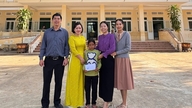

The belief in worshipping the Five Elements Goddesses is also practiced by various clans. Nestled beside the Trang Bang canal (Loc Thanh neighborhood), the temple of the Ta-Nhan clan, founded by Mrs. Nhan Thi Rot, is approximately 100 years old. This belief worships five female deities representing the five elements that constitute the universe according to the Five Elements theory: Metal, Wood, Water, Fire, and Earth.
From abstract material elements in Eastern philosophy, these are personified into "Goddesses" so that people can easily worship them, entrusting their faith in them for favorable weather, abundant harvests, prosperous businesses, and peace.
The temple also preserves two statues of the Goddess made from old Saigon Cay Mai pottery, a type of painted earthenware – a pottery style that flourished and developed most brilliantly in the late 19th and early 20th centuries.

Given the geographical features along the Vam Trang canal (Vam Co Dong river), upon arriving at An Thoi hamlet in An Hoa village (now An Thoi neighborhood, Trang Bang ward) to settle, establish a livelihood, and build his family lineage, Mr. Nguyen Van Su established the Ba Thuy Long temple, worshipping the female deity who governs rivers and waters in Vietnamese folk beliefs.
Originally, since the beginning of the 19th century, An Thoi hamlet already had a temple dedicated to the Water Goddess Thuy Long, built and worshipped by the local people until today. The appearance of the temple belonging to the Nguyen family further affirms the importance of the worship of the Water Goddess Thuy Long in the spiritual life of the people in this riverside region.

At the ancestral shrine of Bà Cố in Hòa Lợi neighborhood, established by the Trịnh family over 100 years ago and spanning four generations, descendants still pass down the story of the shrine dedicated to their ancestral grandmother. When we arrived, the small old shrine was still standing next to the new one built in the year of the Pig (2019). On the plaque inscribed directly on the wall, in the center is "Cố Hỷ nương nương," flanked by shrines to Chúa Xứ nương nương, Chúa Tiên nương nương, Chúa Ngọc nương nương, the ancestral grandmother, along with the Left and Right altars and local deities within the same grounds.
From the worship of Bà Cố Hỷ as the principal deity, we surmise that the Trịnh family's origins may be from the South Central coastal region, having migrated south to settle, establish their lives, and build their lineage here. The baggage they brought to Trảng Bàng included not only folk beliefs – a valuable spiritual asset – but also a psychological "shield" that helped them survive in this new land.

Annually, ancestral shrines are usually held on the anniversary of the founder's death, such as at the Tran family shrine (Hoa Binh neighborhood), or in the spring according to the lunar calendar, with the concept of "May the spring bring peace and prosperity" or "Spring Festival". For example, the Thuy Long shrine of the Nguyen family and the Chua Xu shrine of the Nguyen family (An Thoi neighborhood) hold their ceremonies on the 3rd day of Tet; the Tran family shrine (Hoa Loi neighborhood) holds its ceremony on the 7th day of Tet; the Trinh family shrine and the Chua Xu shrine of the Dang family (Hoa Loi neighborhood) hold their ceremonies on the 15th-16th of January; the Pham family shrine (Hoa Hung neighborhood) holds its ceremony on February 12th; the Ngu Hanh shrine (Loc Thanh neighborhood) holds its ceremony on February 16th; the Le family shrine (Hoa Hung neighborhood) holds its ceremony on the 3rd day of Tet, and in the years of the Rat, Horse, Rabbit, and Rooster, a large ceremony is held on March 16th.



The temples all perform traditional rituals; in particular, the temples dedicated to the clan's goddesses invite female shamans to perform folk dances and offerings of gold. On this occasion, descendants of the clan and neighbors return to the temples to worship their ancestors, remember their origins, share a meal together, and connect and support each other in life.


The ancestral temples in Trang Bang clearly demonstrate that folk beliefs are not only about ancestor worship and benevolent deities, but also a vivid memory of the process of expanding the territory, settling, and building communities in this new land. These temples serve as sacred spaces to honor ancestors, as well as gathering places for spiritual connection and strengthening family and community bonds. Annual ceremonies not only maintain traditions but also reinforce unity, helping descendants remember their roots and creating a distinctive cultural identity for the Trang Bang region.
Source: https://baotayninh.vn/ky-uc-vung-dat-tu-nhung-ngoi-mieu-ho-150348.html


![[Photo] General Secretary and President To Lam works with the Party Committee of the Government on the work of preventing and combating storms, floods, extreme natural disasters and climate change.](https://vphoto.vietnam.vn/thumb/1200x675/vietnam/resource/IMAGE/2026/06/29/1782729441945_a1-bnd-0385-9454-jpg.webp)
![[Image] A look back at the capital's preparations for the century-long master plan.](https://vphoto.vietnam.vn/thumb/1200x675/vietnam/resource/IMAGE/2026/06/29/1782750453122_quy-hoach-100-nam-minh-duy-1-2118-jpg.webp)























![[Photo] National Assembly Chairman Tran Thanh Man attends the Conference to announce the Master Plan for Hanoi Capital City with a 100-year vision.](https://vphoto.vietnam.vn/thumb/1200x675/vietnam/resource/IMAGE/2026/06/29/1782709639728_ndo_br_1-jpg.webp)

























![[Infographic] Notable new regulations for civil servants effective from July 1, 2026](https://vphoto.vietnam.vn/thumb/402x226/vietnam/resource/IMAGE/2026/06/30/1782779868692_infographic-nhung-quy-dinh-moi-dang-chu-y-doi-voi-vien-chuc-co-hieu-luc-tu-ngay-1-7-202620260629111721.webp)