DONG THAP PROVINCE: Organic rice production models in Tam Nong district not only help farmers increase profits by at least 30% but are also environmentally friendly.
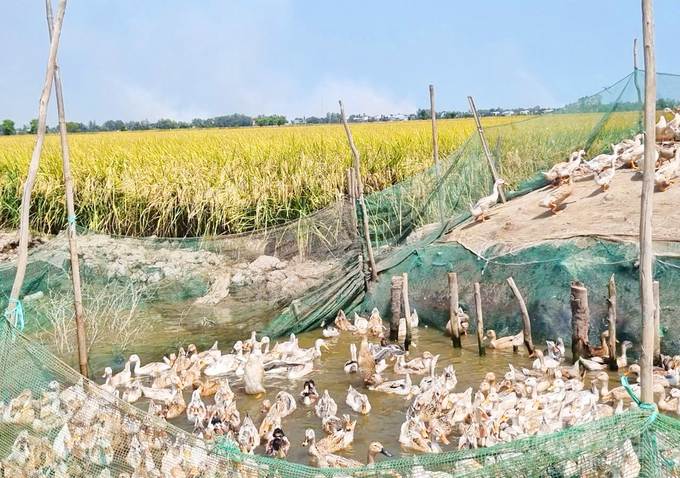
The rice-fish-duck farming model at Quyet Tien Agricultural Service Cooperative (Phu Thanh A commune, Tam Nong district, Dong Thap province). Photo: Le Hoang Vu.
In the last two years, organic rice production in Tam Nong district ( Dong Thap province) has seen remarkable development, expanding from an initial 20 hectares to nearly 200 hectares throughout the district. The organic rice production models have yielded significant results, bringing about many positive effects and attracting both farmers and businesses to participate.
Senta branded rice is produced from the 20-hectare organic rice field of the Quyet Tien Agricultural Service Cooperative (Phu Thanh A commune, Tam Nong district). Initially, a group of farmers in the cooperative shared the idea of jointly raising fish in nets during the flood season and growing rice organically.
Subsequently, with the determination of the farmers and guidance from the agricultural sector, through several rice seasons, cooperative members received technology transfer, applied integrated pest management (IPM), and developed rice-duck or rice-fish-duck intercropping models. The cultivation process was then digitized using electronic logbook software.


Mr. Nguyen Minh Tuan, Director of Quyet Tien Agricultural Service Cooperative, is a pioneer in directly implementing the circular, low-emission agricultural production model. Starting in 2023 with an initial area of 20 hectares/8 participating households, by 2024, the area of rice produced according to the cooperative's organic, circular, and reduced-emission process had expanded to 80 hectares/23 households.
After two years of implementation, the model has been embraced by many farmers who are very satisfied with the technical process, such as applying cluster and sparse sowing methods to reduce the amount of seeds to 50-70 kg/ha; using organic fertilizer to partially replace inorganic fertilizer and reducing the amount of inorganic fertilizer by about 30-40% compared to outside the model (about 100-150 kg/ha); and reducing the number of pesticide sprayings by 2-3 times compared to outside the model.
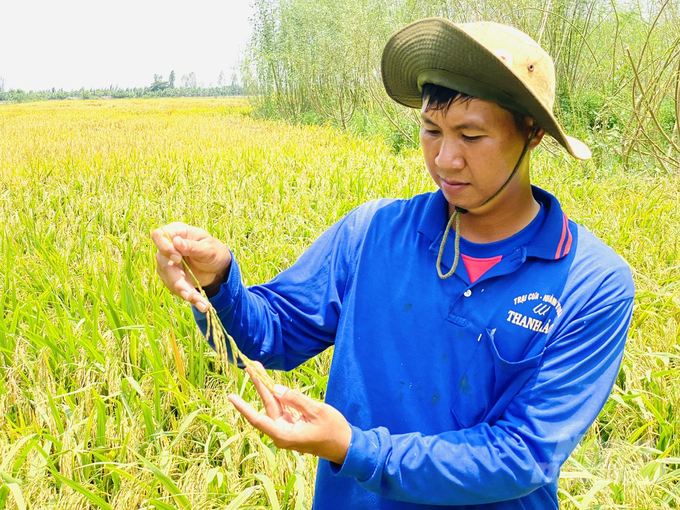
Organic rice production is guaranteed by businesses, helping farmers increase their profits by 30% or more compared to traditional farming. Photo: Le Hoang Vu.
After harvesting, about 87.5% of the straw (equivalent to 70/80 hectares) is collected from the fields. For the remaining straw, farmers in the cooperative spray Trichoderma fungi to decompose it, adding nutrients to the soil. Farmers in the cooperative also apply mechanization throughout the production process, from planting to harvesting (sowing rice, spraying pesticides, applying fertilizer, harvesting).
Through several farming seasons, Mr. Tuan observed that most farmers in the cooperative participating in the model had changed their mindset in rice production, boldly applying technical advancements such as using cluster seeders for sowing, spraying pesticides with drones, and applying organic fertilizers to improve soil...



Mr. Nguyen Hoai Bao, Director of Wildbird Tram Chim Co., Ltd. (Tam Nong district), said: Currently, the company is collaborating with Quyet Tien Agricultural Service Cooperative to produce organic rice that meets quality and safety standards for consumers under the Senta brand. The company hopes that through this production partnership, it will help farmers in Tam Nong prosper from organic rice production and aims to sell organic rice at prices 2-3 times higher when it enters export markets.
Mr. Tran Thanh Nam, Chairman of the Tam Nong District People's Committee, happily stated: "In the coming time, the district will continue to promote the effectiveness of this model and expand it to other enclosed rice paddy areas in the district to increase profits per unit area. The district will also call on businesses inside and outside the province to cooperate in the production and consumption of rice for farmers, and at the same time encourage farmers, cooperatives, associations, etc., to negotiate prices with businesses to facilitate rice consumption."
After harvesting, the rice is purchased by the enterprise, so farmers participating in the model increase their profits by 30% or more compared to traditional farming. Although the rice grown organically does not yield as much as traditional farming, thanks to the consumption agreement with the enterprise and the purchase price being 1,500-2,000 VND/kg higher than the market price, farmers still increase their profits.
Source: https://nongsanviet.nongnghiep.vn/lam-lua-huu-co-loi-nhuan-tang-30-tro-len-d401388.html

![[Photo] Strengthening character and expertise: Intense training for artillery soldiers.](https://vphoto.vietnam.vn/thumb/1200x675/vietnam/resource/IMAGE/2026/06/30/1782815602541_lu-368-1875-4571-jpg.webp)



























![The Essence of the Viet Bac Villages: [Part 3] The Precious Fragrance of Nghinh Tuong](https://vphoto.vietnam.vn/thumb/402x226/vietnam/resource/IMAGE/2026/05/29/1780020600366_5237-tinh-tuy-ban-lang-viet-bac-bai-3-chuyen-o-nghinh-tuong-050626_700.jpeg)
![The Quintessence of Northern Vietnam's Villages: [Part 2] The Famous Cassava Noodles of Kunming](https://vphoto.vietnam.vn/thumb/402x226/vietnam/resource/IMAGE/2026/05/28/1779937455892_3929-3144-mien-dong-15-nongnghiep-023138.jpeg)