"Asking AI about everything"
Dang Thi Thuy Linh (26 years old, residing in Duc Nhuan Ward, Ho Chi Minh City) said: "Before, I used to ask my friends, but now I ask AI about everything. From writing emails to request leave, choosing birthday gifts, to even what to eat to lose weight. AI answers quickly and in detail."
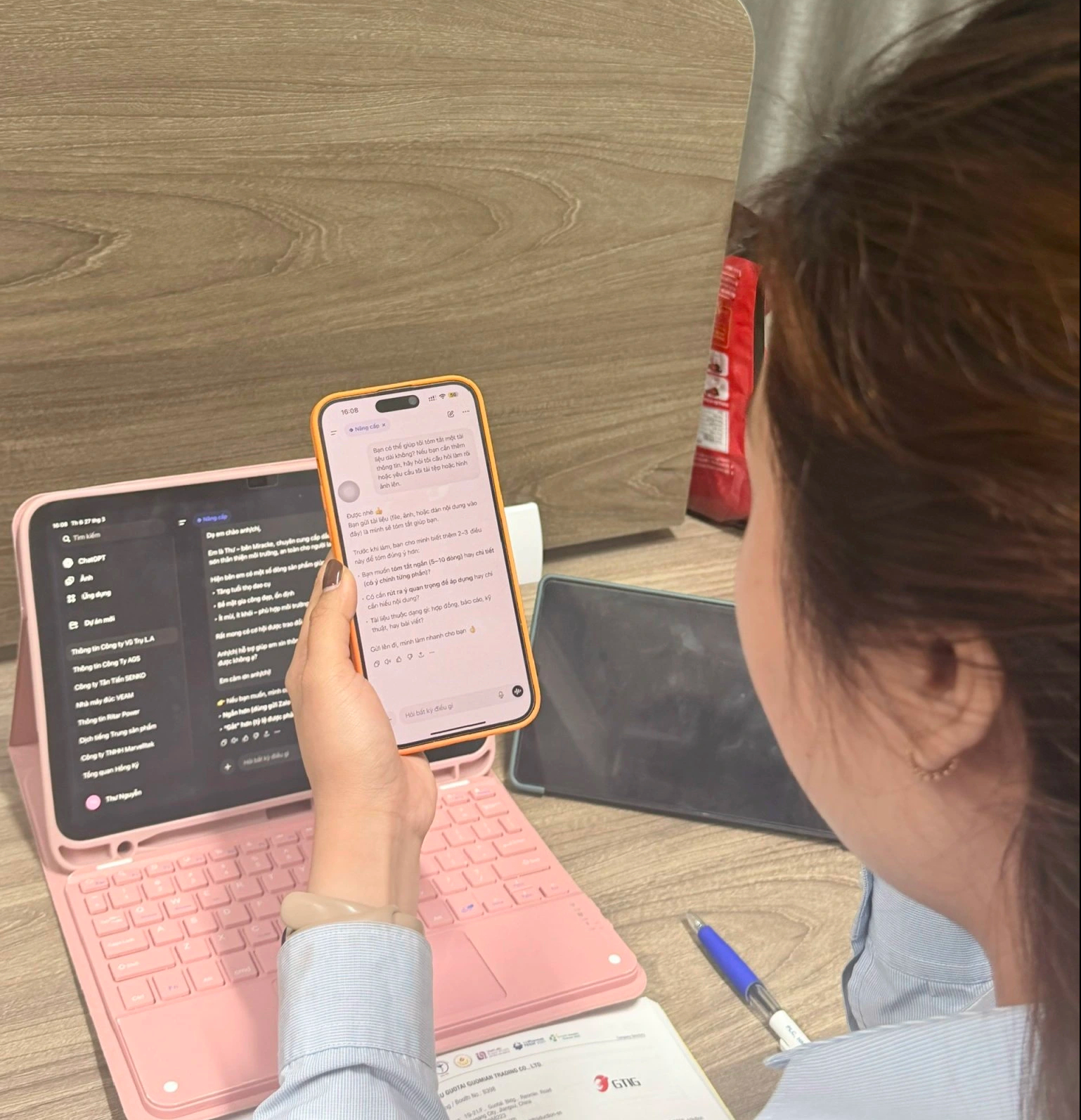
Many young people have a habit of "asking AI whenever they have a question."
PHOTO: THANH NAM
Linh isn't alone; many young people are viewing AI as a "friend" always ready to offer support. Nguyen The Hoan (27 years old, residing in Vuon Lai Ward, Ho Chi Minh City) said that with just a few lines of input, AI can provide a range of suggestions: gym workout schedules, diet plans, romantic proposals, personal financial plans, and psychological advice.
AI provides fluent, logical answers, easily leading users to believe it's the "truth." However, in reality, AI lacks life experience and is not accountable for the decisions of any young person. Furthermore, instead of asking friends and family, many young people choose to ask AI, which can weaken relationships.
Mr. Tran Hung Nguyen , PhD candidate in data science , Northeastern University (USA)



Nguyen Thi Bich Tram (27 years old, residing in Vuon Lai Ward, Ho Chi Minh City) also said: "I ask AI about almost everything I'm curious about. Absolutely everything in life." On the social media platform Threads, it's not difficult to find posts like: "I ask AI before deciding anything," "If I don't ask AI, I feel like something is missing"...
According to psychologist Le Vu Hoang Phuong from the Healing Hub Applied Psychology Center (Binh Tay Ward, Ho Chi Minh City): "Young people are living in an environment with many pressures to choose from, in terms of career, finances, and relationships... AI appears as a 'shortcut,' helping them reduce uncertainty."
Ms. Phuong pointed out several reasons for this phenomenon. Firstly, absolute convenience. AI responds almost instantly, without waiting or lengthy explanations. In a fast-paced life, this is extremely attractive to young people. Secondly, a sense of psychological security. Unlike asking real people, where one might be judged, AI creates a feeling of anonymity. Users are willing to ask even private questions such as relationship issues, weight, income, etc. Thirdly, trust in technology. Gen Z grew up with the internet, so they easily believe that technology "knows everything." When AI answers clearly and with evidence, this belief is further reinforced. Another reason is that a segment of young people lack self-determination skills; they "are reluctant to think" or fear making wrong decisions. Asking AI becomes a way to "reduce responsibility." This leads to the perception of AI as an indispensable assistant in daily life.
The disadvantages outweigh the advantages.
Tran Hung Nguyen (28 years old), a PhD student in data science at Northeastern University (Boston, Massachusetts, USA), believes that relying on and delegating all life's questions to AI would do more harm than good.
Psychologist Le Vu Hoang Phuong offers this advice: "It's important to stay connected with real people. AI cannot replace friends, family, or psychologists. Real conversations are still essential. Don't ask AI for every little thing. Make simple decisions in your daily life yourself. Always cultivate and develop personal skills such as decision-making, emotional management, and communication, because these are things AI cannot completely replace. In the age of technology, AI's infiltration into every aspect of life is unavoidable. But the important thing to understand is that AI cannot live your life for you."
Nguyen analyzed: "The information provided by AI is not always accurate. AI can give wrong, outdated, or inappropriate answers for a specific situation. If users blindly trust it, they may face risks, especially in matters such as health and finances. Another problem is that it can easily create illusions among young people about the 'perfect advisor.' AI answers fluently and logically, easily leading users to believe it's the 'truth.' But in reality, AI lacks life experience and is not responsible for any young person's decisions. And most importantly, instead of asking friends and family, many young people choose to ask AI, which can gradually weaken relationships."
Mr. Tran Hung Nguyen added: "The problem isn't the technology itself, but how people use it. Young people turning to AI is inevitable in the digital age. What's worrying is when they give AI complete decision-making power instead of using it as a reference tool. In other words, AI isn't dangerous; extreme dependence is what's concerning."



So how can we use AI without becoming "dependent" on it? Mr. Nguyen recommends leveraging AI intelligently.
"Think of AI as an assistant, not a decision-maker. AI can offer suggestions, but the final decision must be yours. Always ask yourself: 'Is this right for me?' And learn how to verify information, don't blindly trust AI's answers, especially on important issues. Compare with reliable sources or seek expert opinions. At the same time, regularly practice critical thinking. Instead of asking 'what should I do?', try asking 'why should I do it?' This helps you understand the essence of the problem," Mr. Nguyen shared.
Source: https://thanhnien.vn/lam-sao-de-dung-ai-ma-khong-le-thuoc-185260626193502658.htm
![[Image] National conference summarizing one year of operation of the overall organizational model of the political system, the three-tiered government model.](https://vphoto.vietnam.vn/thumb/1200x675/vietnam/resource/IMAGE/2026/07/01/1782882811691_ndo_br_1-jpg.webp)