

However, during the recent heavy rains in some areas of Bac Ninh province, neither of these solutions proved effective due to a lack of coordinated planning and operation of the irrigation system. As a result, rainwater flooded the fields but could not drain away, causing prolonged flooding and significantly affecting the lives and production of the people.
It was necessary to demolish the dike to drain the water.
During the heavy rains and floods that occurred last October, Tien Luc commune was one of the most severely affected areas. Prolonged heavy rainfall caused the river level to rise by nearly 1 meter, exceeding the historical flood level of 1986, submerging a large part of the commune. Many dikes and sluices in the area could not withstand the pressure of the raging water, resulting in breaches and flooding of residential areas. Up to 60% of the area was deeply submerged and completely cut off, especially villages located within the flood drainage corridor such as Tan Lap, Bo Lo, Soi, Giua, Tram, Ben Pha, Gai Bun, Ben Cat, Ngoai...
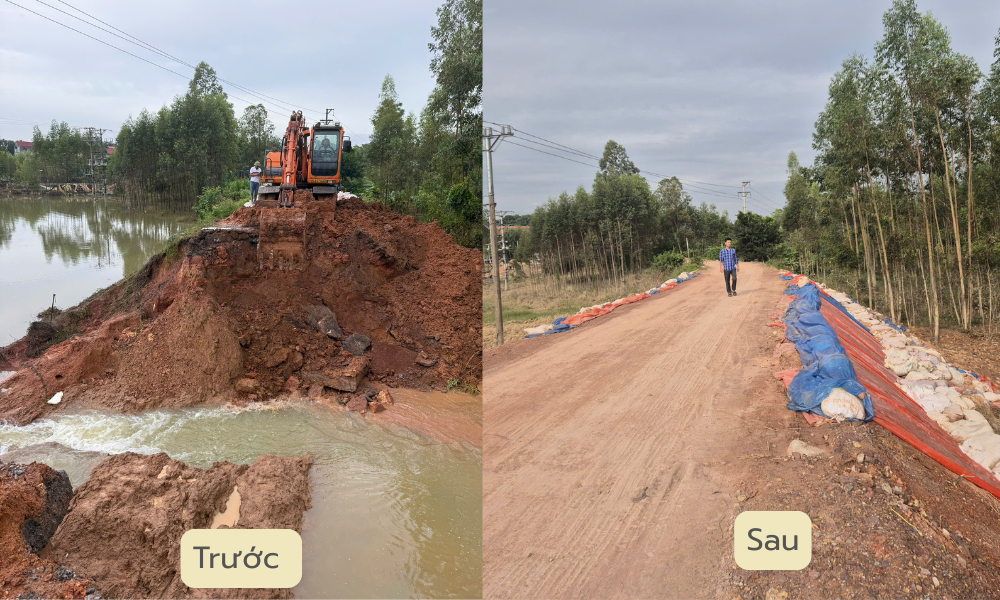 |
The embankment must be demolished to drain the water before and after it is restored. |
A worrying issue after the floodwaters on the Thuong River receded is the situation where water from the river overflowed into rice fields and residential areas but could not drain away. According to Mr. Hoang Minh Thanh, Vice Chairman of the People's Committee of Tien Luc commune, even when the river water level had dropped, the water level in the fields was still about 1 meter higher than the river level. It is estimated that millions of cubic meters of water remain stagnant, and many villages are still deeply flooded. Meanwhile, the drainage system relying solely on the Linh sluice gate in Ben Pha village, with a 1.2-meter opening, is insufficient to handle the enormous volume of water in a short time. It is estimated that using only this sluice gate would take about 10 days to drain all the water, prolonging the flooding and seriously affecting people's lives, posing a potential risk to safety.
| Based on field surveys, the Department of Agriculture and Environment advised the Provincial People's Committee to declare a state of emergency for several sections of dikes to promptly address the incidents. Simultaneously, a comprehensive plan for the renovation and upgrading of the dike and irrigation system for the period 2026-2030 was developed, prioritizing key areas such as My Thai, Tien Luc, and other regions at risk of similar incidents. |
Faced with the urgent situation, the commune held a meeting, sought opinions from higher levels, and unanimously agreed on a plan to demolish the embankment to create a drainage channel from the fields to the river. This decision was implemented quickly, and in just under two days, most of the water had drained away, creating conditions for people to gradually restore production after the flood. Immediately afterward, the local authorities mobilized forces and equipment to build, reinforce, and restore the embankment to its original state, ensuring safety for residential areas.
Integrated investment
Along with Tien Luc commune, Duong Duc commune has also had to struggle to cope with the consequences of the recent floods. Although the rain has stopped and floodwaters have receded for many days, many villages in the commune are still deeply flooded, transportation is partially cut off, and people's lives are difficult. The main cause has been identified as the limited drainage system in this area. The entire commune only has one sluice gate in Duc Mai, Duc Tho village, that serves to drain water, but the sluice gate has a small cross-section, and the water channels are clogged. Many sections of the canals are buried and not regularly dredged, preventing water from flowing and leading to prolonged stagnation.
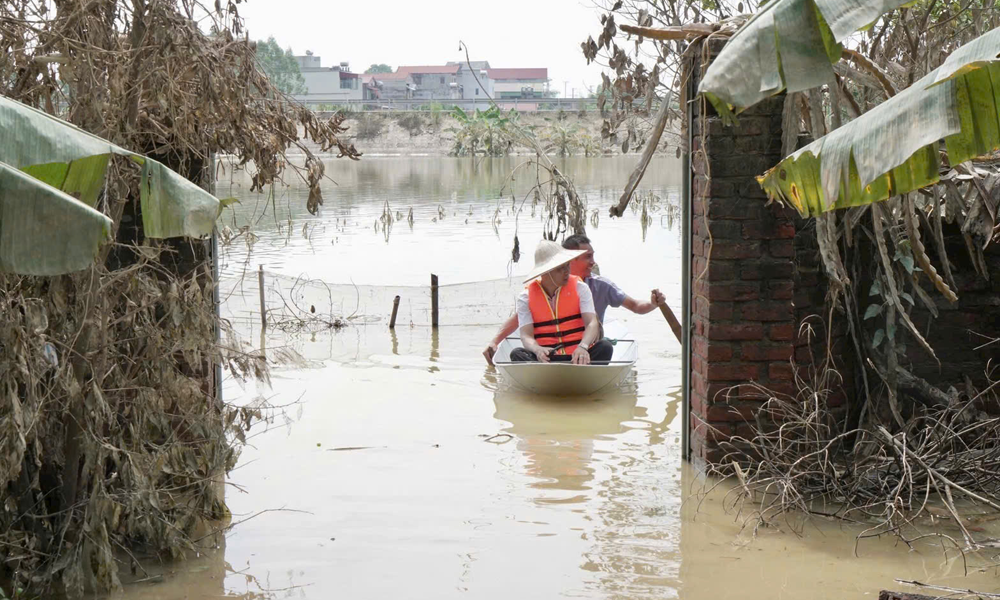 |
After several days of rain, the floodwaters receded, but Hong Giang village in My Thai commune remains deeply submerged. Photo taken on October 23rd. |
To prevent a recurrence of flooding like the recent heavy rains, the People's Committee of Tien Luc commune has requested the Provincial People's Committee to consider and provide funding to implement urgent remedial measures during the dry season at the end of 2025. Accordingly, the commune proposes repairing and reinforcing broken and eroded dikes, and treating termite nests within the dike bodies; especially rebuilding the 226-meter section of dike that was damaged to improve drainage. At the same time, they propose constructing a new drainage culvert in the Cong Linh area to ensure local drainage for six villages: Ben Pha, Bo Lo, Soi, Giua, Tram, and Nua Quan; and investing in expanding the dike from Dong Son bridge to Ben Tuan bridge, approximately 15 km long. This dike not only plays a role in disaster prevention and rescue but also serves as an important transportation artery, contributing to the development of agricultural economy and enhancing the capacity to respond to climate change for the entire riverside region. The total estimated cost is over 200 billion VND. For the irrigation canals managed by the commune, the commune People's Committee will allocate funds for immediate repair and remediation.
My Thai commune has proposed the simultaneous implementation of solutions to improve disaster prevention and control capacity, including the renovation and upgrading of the Duc Tho dike; the construction of anti-erosion embankments along the river at the Tram Ha dike; the reinforcement of the Dong Nghe, Dong Chan, Duc Tho, and Do Mom dikes; and the upgrading of the Duc Mai sluice gate to increase drainage efficiency.
According to Mr. Dang Cong Huong, Deputy Director of the Department of Agriculture and Environment, through a comprehensive review of the irrigation and drainage systems in localities, especially in areas experiencing deep and prolonged flooding for the first time such as My Thai and Tien Luc, the Department has identified many shortcomings in infrastructure planning. Despite the investment in new construction projects, many localities have not adequately considered the increase in water flow. The restoration of completed projects often only focuses on restoring the original state, without considering long-term development needs. The mentality of "getting it done quickly" has led to many projects becoming ineffective, even hindering the already weak drainage system.
Based on field surveys, the Department advised the Provincial People's Committee to declare a state of emergency for several sections of dikes to promptly address the incidents. Simultaneously, it developed a comprehensive plan for the renovation and upgrading of the dike and irrigation system for the period 2026-2030; allocating funds in phases, prioritizing key areas such as My Thai, Tien Luc, and other regions at risk of similar incidents. Investment plans were carefully considered to ensure efficient drainage from fields to rivers, contributing to the stability of agricultural production and people's livelihoods.
Source: https://baobacninhtv.vn/lam-sao-do-nuoc-tu-dong-ra-song--postid430216.bbg

![[Photo] General Secretary and President To Lam meets with National Assembly delegates from ethnic minorities.](https://vphoto.vietnam.vn/thumb/1200x675/vietnam/resource/IMAGE/2026/04/20/1776696701056_a1-bnd-8331-3342-jpg.webp)

![[Image] National Assembly discusses the implementation of the socio-economic development plan.](https://vphoto.vietnam.vn/thumb/1200x675/vietnam/resource/IMAGE/2026/04/20/1776696707422_ndo_br_img-20260420-185419-jpg.webp)









































































Comment (0)