

SGGP
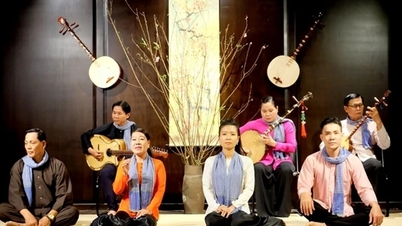
Amidst the vibrant influx of imported music , many people still hold a special place in their hearts for traditional Vietnamese music. For them, traditional Vietnamese instruments create a resonance that no modern instrument can achieve.
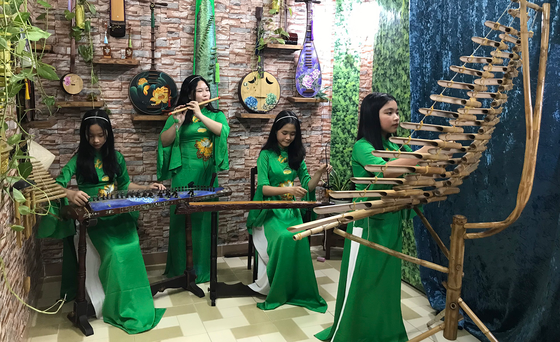 |
| Young students perform together in a traditional Vietnamese musical instrument class in Ho Chi Minh City. |
Preserving traditional musical instruments
At a zither class at the end of a small alley in Tan Binh District, Ms. My Dung (41 years old, an office worker) began her first zither lessons after 35 years of dreaming. Ms. Dung recounted: “When I was 6 years old in Cu Chi, I saw a woman in the neighborhood playing the zither, and I immediately loved it. I thought it was a hobby for the rich, so I just watched from afar. Growing up, I still harbored that desire, and I often listened to zither music in my free time.” Therefore, when she was over 40 and her life was relatively stable, Ms. Dung was determined to sit beside her beloved instrument at least once in her life, and she went to a music center to learn.
Meanwhile, Bao Ky (30 years old, a student studying in France) came to the zither not only to share very Vietnamese melodies with his friends around the world but also because of his concern about "losing collective memory." Seeing that few of his peers knew about the zither or the zither, and even lacked access to videos of traditional music performances, Ky worried: "Many young people among us don't know how to appreciate the wonderful things that are ours anymore, and I find that really sad." However, attending zither classes and seeing many young people who work during the day and come to class to practice, as well as many elderly people and high school students who are enthusiastic and diligent in practicing, he became very excited. Particularly fond of the sound of the zither, and realizing that "music is a language that doesn't need translation," Ky regularly attends classes three times a week to learn advanced techniques so that when he returns to France, he can perform pieces like "Dem Dong," "Nam Ai," and "Nam Xuan."
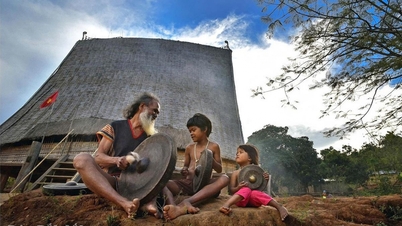
Finding ways to "go the long distance" with ethnic groups.
With 10 years of experience teaching the zither, Ms. Dang Thi Thuy Vy (Bachelor of Music and Arts Education, Saigon University, residing in Tan Binh District) believes that traditional zither playing is a difficult subject to master, due to the playing techniques and accompanying skills such as tuning the strings and handling problems on the instrument. To pursue it, learners need a lot of passion and time for practice.
For international students learning online, the challenges are even greater: the sound transmitted through the computer system is not accurate, teachers cannot directly correct finger technique, there are no places to repair instruments, and shipping costs are exorbitant (ranging from over 15 million VND, depending on the country)... "For students who are new to this subject and are unsure if it suits them, I lend them instruments for free practice for a month; for university students, to avoid financial pressure, I organize classes in groups of 3-6 people with affordable tuition fees, which can be paid daily. As for students abroad, I find ways to explain things clearly so they can understand, encouraging them to persevere until they can play a piece fluently, thereby inspiring them to conquer the next steps," Thuy Vy shared.
As for Ms. Tran Ngoc Tu (a graduate of the Ho Chi Minh City Conservatory of Music, with 20 years of teaching experience, residing in District 3), she recognized that the biggest obstacle was students, despite their desire to learn, felt they lacked talent, didn't know music theory, and struggled to find a suitable and empathetic teacher. Therefore, she created a space with a full range of traditional Vietnamese musical instruments, allowing students to try them out and choose whichever instrument they liked. With her flexible teaching style, tailored to the students' psychology, Ms. Tu's classes have many young students, each learning 2-6 instruments simultaneously, comfortably. On weekends, students gather to perform the pieces they practiced that week. Ms. Tu stated: "Traditional Vietnamese music may not attract a huge number of people, but when these sounds touch someone's heart, they become a very important part of their spiritual life."
For those who love traditional Vietnamese musical instruments, a music teacher with many years of experience shares that if you want to start learning traditional instruments, you should try the zither and the T'rưng – these are the two easiest to learn and play. More difficult to play are the kìm (also known as the nguyệt) and the tứ. Playing the flute is a lightweight option but requires a lot of physical strength. If you want to challenge yourself with the most difficult traditional instruments, you can try the bầu (độc huyền cầm) and the cò (nhị). These two instruments require a great deal of perseverance and passion.
Source


















































































Comment (0)