

(NB&CL) The bamboo flute – a purely Vietnamese musical instrument whose life is closely tied to village festivals and religious ceremonies – can now be heard in any corner of the world .
The calling… of being a teacher
The person who brought Vietnamese flute music abroad is none other than artist Bui Cong Thom. Born in a village, with a childhood covered in mud and dirt, his skin tanned from days spent fishing, catching dragonflies, flying kites, and playing with spinning tops..., Bui Cong Thom, born in the 1980s, often jokingly describes himself in this way.
After 13 years of studying at the Vietnam National Academy of Music, Bui Cong Thom graduated with numerous certificates and awards. He was retained at the Academy as a lecturer. One might have thought he would be content with his position as a civil servant, at least less strenuous and less stressful, while still contributing to the training of future generations of flute players. But no, he still harbored a big dream for the Vietnamese bamboo flute, with a desire to revive the bamboo flute and begin the process of bringing the Vietnamese flute to the world.
According to artist Bui Cong Thom, although the flute is closely associated with the lives of Vietnamese people, like many other traditional musical instruments, fewer and fewer people know how to play it over time. Especially in the age of electronic devices and the influx of many flashy and modern art forms, the simple and humble flute has become even more marginalized. Performances attract fewer and fewer viewers, artists are forced to abandon their profession, and those who remain have to find additional work…
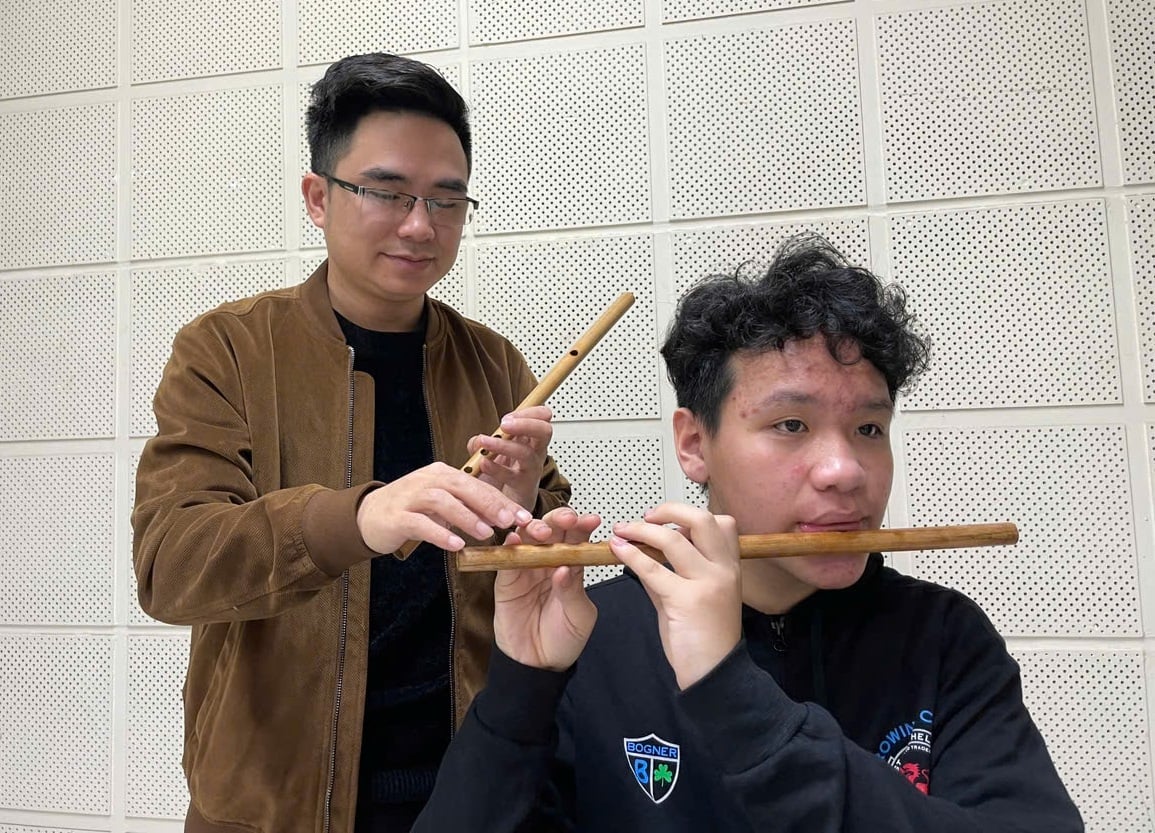
Artist Bui Cong Thom instructs students in a live bamboo flute class. Photo: Provided by the artist.
However, from another perspective, Bui Cong Thom realized that because few people play the flute, and few have had contact with it, the public is unaware of the beauty and richness of its sound. He asserts that the sound of the bamboo flute still holds value and a special place in the hearts of Vietnamese people. Proof of this is that every time he plays the flute in public areas or schools, he sees that "nine out of ten people exclaim: 'Wow, how beautiful that flute sound is! I didn't know about it!'" Even while still a student, Bui Cong Thom had a "hobby" of wanting to share and introduce the flute to those around him, to help them understand its sound better. Initially, it was just a few classmates "gathering" in the park to play the flute, sharing their skills and knowledge. Gradually, more people learned about the flute, and he began teaching flute lessons for free to those who wanted to learn.
"I teach flute because I enjoy it, because of my passion, not to make a living. From then on, as if by fate, teaching became my profession, and to this day, I am still a teacher," shared Bui Cong Thom.
Changes are needed to make the flute music reach more people.
At the end of 2023, Bui Cong Thom established the Vietnam Institute for Music Research, Training and Development - an organization specializing in researching solutions for online music learning. At this time, the flute playing movement had improved, but it could not yet be considered strong.
"Perhaps within a 10km radius around here, the number of people who play the flute can still be counted on the fingers of one hand. Moreover, almost all flute players and enthusiasts in our country learn through apprenticeship, imitating each other, and very few have basic knowledge of music theory," said artist Bui Cong Thom.
With years of experience teaching music, artist Bui Cong Thom understands all too well the limitations of traditional group teaching methods. Learning music requires a mentor, someone to verify whether students are practicing correctly or incorrectly. But with a distance of 20km, the class will certainly not attract many students. Therefore, to maintain the class, the only way is for the teacher to change. They must find a way to make the flute more accessible to more people, and to make learning as simple and easy as possible.
“Initially, we experimented with online teaching models via Zoom. But there were many drawbacks because it depended on the internet connection. And with music, when the network lags, the rhythm and tempo are off. Some organizations also offered a solution by recording courses and broadcasting them online. Personally, I don't rate this method highly because it loses the role of the instructor guiding the students and is not suitable for teaching and learning art subjects,” the bamboo flute artist shared.
Artist Bui Cong Thom stated that traditional teaching methods would address all the aforementioned technical limitations, but reverting to a one-on-one teaching approach would result in insufficient teachers for hundreds of students. Furthermore, this method would lead to very high costs, unsuitable for the income of the majority of the population. Through numerous experiments, they have created and standardized a teaching and learning system based on social media. Accordingly, teachers compile a curriculum, but instead of assigning everything to students for self-study, they send individual lessons via Facebook to students in small groups for practice. After practicing, students record their work and post it in the group for teachers to review, comment on, and correct. Only when students have "passed" a lesson are they assigned new lessons.
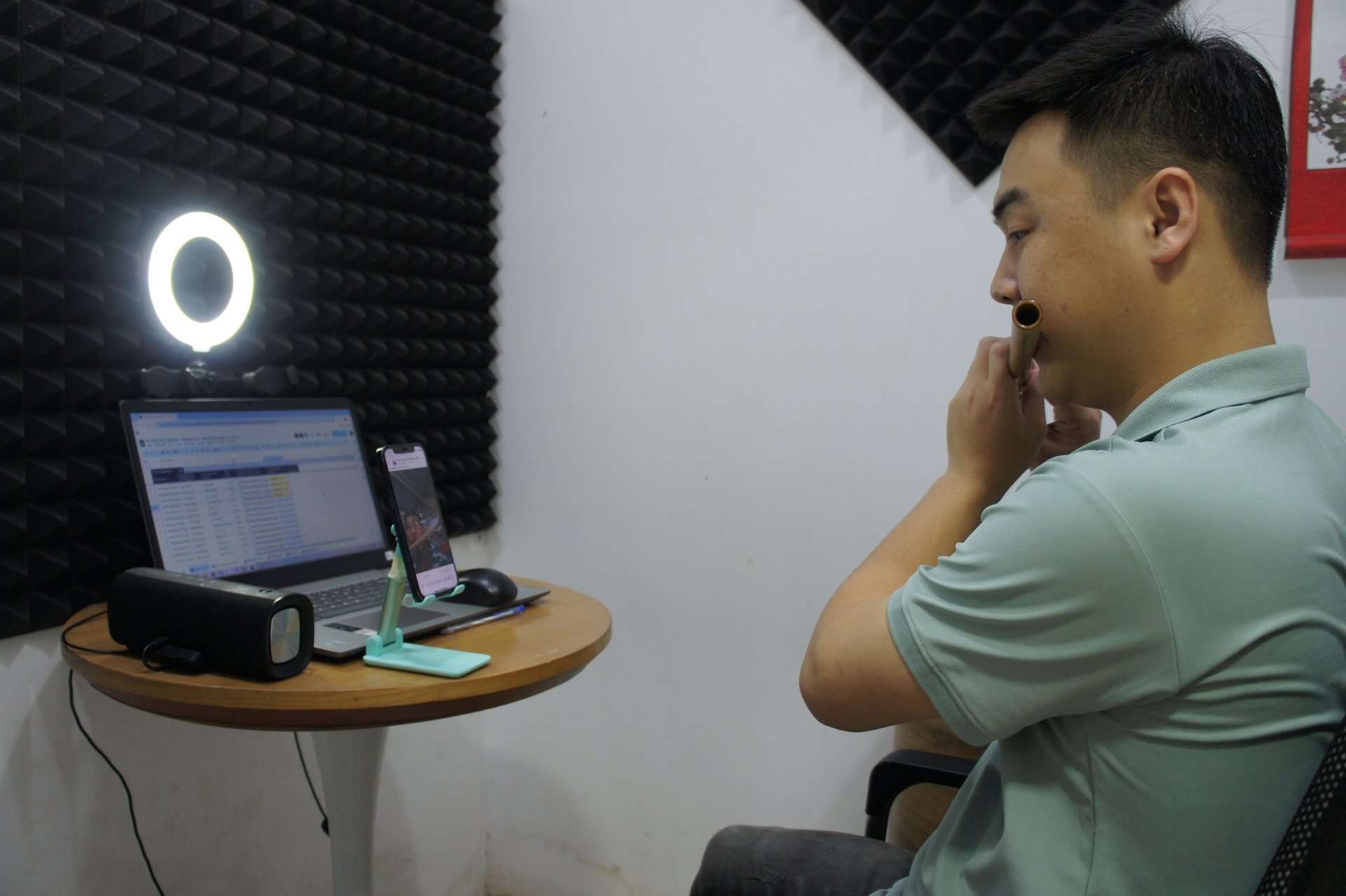
Despite having a very small space, instructors at the Vietnam Institute for Music Research and Development are still able to organize classes through the Facebook platform. Photo: T. Toan
“This model will solve many problems. Firstly, it is very flexible in terms of space and time. Students can submit assignments anytime, anywhere. Teachers can also check students' work in various locations, as long as they have equipment and an internet connection. Secondly, the cost of learning is very low; thirdly, one teacher can teach thousands of people,” said Mr. Bui Cong Thom.
According to the artist, it is precisely because of this method that, even with only 30-40 staff members, the Vietnam Institute for Music Research, Training and Development can still effectively teach tens of thousands of students simultaneously. Currently, in addition to nearly 10,000 students in Vietnam, there are hundreds of students from Japan, South Korea, the United States, Canada, Australia, and other countries. Over the past four years, more than 8,000 students have completed the course, and all of them can now play the bamboo flute proficiently.
Sharing further, Mr. Bui Cong Thom said that from the age of 8, he was taught the technique of making bamboo flutes by teacher Le Thai Son. Currently, he is running a facility producing these musical instruments, making tens of thousands of flutes every year. His Bui Gia bamboo flute brand sells nationwide and has distributors in overseas markets. The flutes have also followed his students, spreading the sound of Vietnamese flutes to the US, Europe, and other countries.
"I wouldn't dare talk about Vietnamese flutes abroad because I don't have the information. But I'm certain that my students, somewhere outside Vietnam's borders, still use Vietnamese flutes every day to play traditional Vietnamese melodies," artist Bui Cong Thom concluded.
Khanh Ngoc
Source: https://www.congluan.vn/lan-xa-tieng-sao-truc-viet-nam-post337265.html
![[Photo] General Secretary and President visit the China-ASEAN AI Application Cooperation Center](https://vphoto.vietnam.vn/thumb/1200x675/vietnam/resource/IMAGE/2026/04/17/1776404277677_vna-potal-tong-bi-thu-chu-tich-nuoc-tham-trung-tam-hop-tac-ung-dung-ai-trung-quoc-asean-8706616-2286-jpg.webp)


























![[Photo] National Assembly Chairman Tran Thanh Man attends the policy seminar to promote Vietnam-Türkiye cooperation.](https://vphoto.vietnam.vn/thumb/1200x675/vietnam/resource/IMAGE/2026/04/16/1776351415367_vna-potal-chu-tich-quoc-hoi-tran-thanh-man-du-toa-dam-chinh-sach-thuc-day-hop-tac-viet-nam-tho-nhi-ky-8705791-jpg.webp)























































Comment (0)