

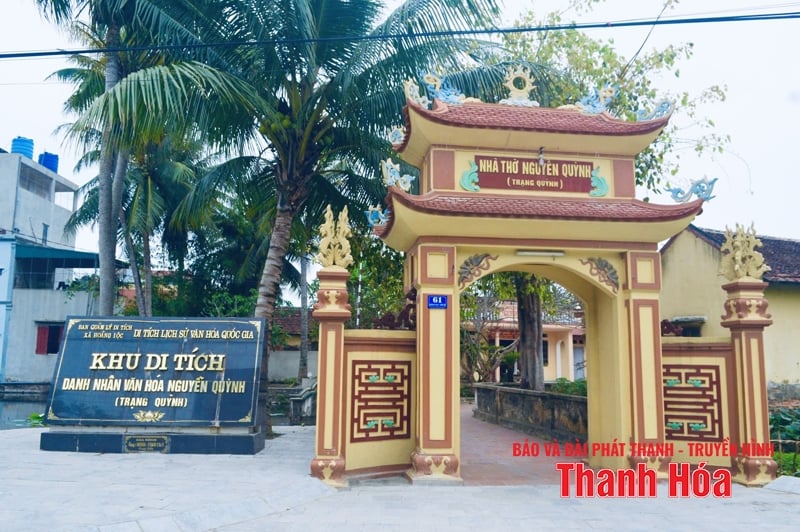
The Nguyen Quynh Church, a national historical and cultural relic, is located in Hoang Loc district.
Mentioning Hoang Loc evokes memories of a land of learning and scholarship, associated with the famous historical, cultural, and architectural monument of Bang Mon Dinh. In the past, besides its normal function as a community meeting place, Hoang Loc communal house also served as a meeting place for scholars and intellectuals, a place to celebrate the achievements of the community, including 12 doctoral laureates returning home, along with hundreds of other successful candidates. This means the communal house also served as a literary shrine. The communal house also worships the village's tutelary deity, Nguyen Tuyen – a meritorious official of the Ly Dynasty, a talented general who helped King Ly Thai Tong defeat the Champa invaders in the 11th century. After his death, he was posthumously awarded the title of Supreme Blessed Deity and is revered by the villagers as the village's tutelary deity.
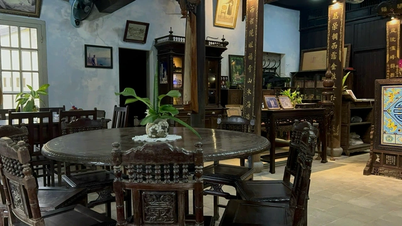
Bang Mon Dinh is situated on a fairly large plot of land, facing south. Originally laid out in the shape of the Chinese character "ding," Bang Mon Dinh consists of a horizontal main hall, with a sanctuary behind it. Exploring the main hall, visitors are strongly captivated by the exquisite and graceful details of the wood carvings. The two inner roof trusses of the temple are decorated with carvings depicting the four mythical creatures (dragon, lion, turtle, phoenix). Under the skillful hands of the artisans, each line and pattern is realistic, vivid, sophisticated, and rich in folk art.
Every year, the government and people of Hoang Loc commune organize a ceremony on the 10th of March and the 21st of December of the lunar calendar. At Bang Mon Dinh, before the festival opens, the people of the commune listen to the "Uprising Text" of the two villages of Bot Thai and Bot Thuong to reinforce cultural traditions and teach moral values passed down from their ancestors. Also in the village temple space, the village festival is held from the 3rd to the 6th day of the Lunar New Year with many folk games such as wrestling, chess matches, poetry and painting competitions...
Today, Bang Mon Dinh remains a prominent cultural and spiritual center of Hoang Loc commune in particular, and the wider surrounding area in general. Besides holidays and festivals, Bang Mon Dinh is a frequent destination for students before each exam season. Without needing elaborate feasts, during important exams that mark significant milestones in each person's academic and career path, parents, grandparents, or teachers often bring their children and students to offer incense, hoping for the village's guardian deity to protect them, grant them health, and enlighten their minds...
In particular, in recent years, Bang Mon Dinh has been one of the venues for many unique and meaningful activities within the framework of the But Nghien Festival. The festival is organized with the aim of honoring the tradition of studiousness of the people of Hoang Hoa, educating about this tradition, arousing pride among all strata of people in the district and the people of Hoang Hoa, thereby enhancing the spirit of unity and building the homeland... This is also the "opening" event for the Hai Tien beach tourism season. The ceremony of offering incense to the 12 great scholars at the Bang Mon Dinh historical and cultural architectural site is an indispensable spiritual ritual before the opening of the festival.
Besides Bang Mon Dinh, there is another historical site that anyone visiting Hoang Loc is eager to see: the Nguyen Quynh Church - the person believed to be the prototype of the famous Trạng Quỳnh in folk tales.
Nguyen Quynh, also known as Thuong, pen name On Nhu, posthumous name Vi Hien (1677-1748), came from a Confucian family and received a good education. From a young age, he displayed intelligence and a thirst for knowledge. Despite his talent, his career was fraught with difficulties due to his unfortunate circumstances. He held various positions before eventually becoming a compiler at the Han Lam Academy.
Nguyen Quynh was skilled in Nôm script literature, fond of humor, and often spoke out in defense of the underprivileged and those facing "unpleasant" issues in society. The extent of the connection between folk tales and the character of Nguyen Quynh is uncertain. The book "Nam Thien Lich Dai Tu Luoc Su," a historical work likely written in the early Nguyen dynasty, mentions Nguyen Quynh with a noteworthy sentence: "Quynh, from Bot Thai, Hoang Hoa, famous for his literary talent, eloquent and insightful, skilled in Nôm script literature and humorous." Perhaps, the talents and personality of Nguyen Quynh and the character of Trang Quynh in folk tales share many similarities, leading many to believe that he was the "historical origin" of the folk tales about Trang Quynh.
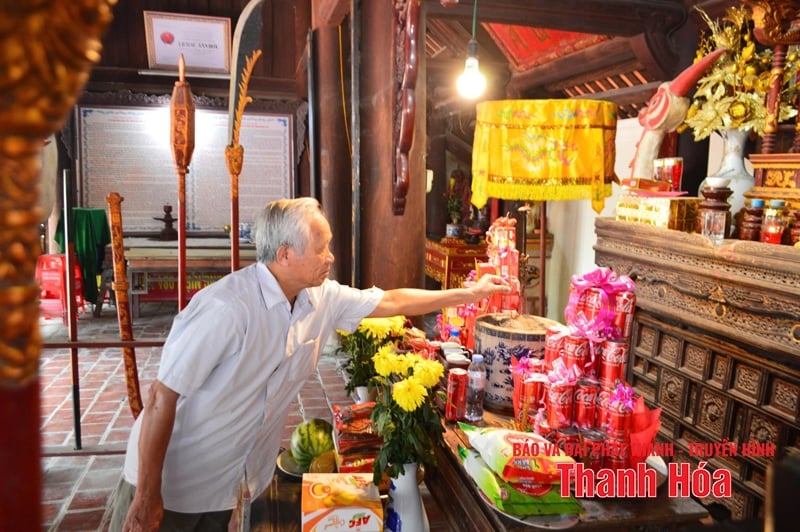
The worship space inside Bang Mon Dinh.
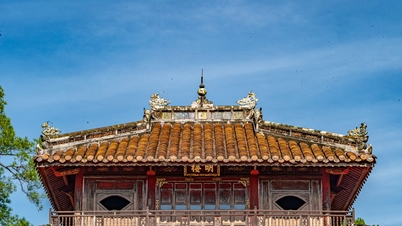
Having lived a life of simple austerity, the ancestral temple of Mr. Nguyen Quynh in his hometown of Hoang Loc is not ostentatious or grand. The temple is surrounded by shady trees, and right next to it is a fragrant lotus pond in the summer. The temple's architecture is simple, with a few tiled rooms; the worship space is simply and intimately decorated. Like Bang Mon Dinh, the Nguyen Quynh temple is a cultural and spiritual center that attracts not only many people from within and outside the commune to visit, but also to offer incense, pray for health and peace, ask for blessings, and listen to more stories about the life and career of Mr. Nguyen Quynh.
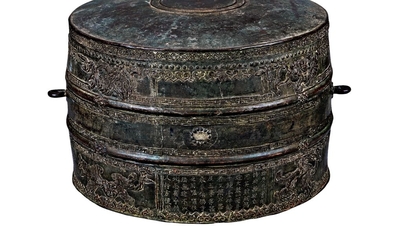
In the past, Hoang Loc was also considered a center of Buddhist activity in the region, with two ancient temples: Thien Vuong and Thien Nhien. According to the elders in the village, Thien Vuong Temple, located 1km west of the village, had a simple architecture: three rooms, brick walls, and a tiled roof. Inside, there was a large statue of Thien Vuong, wearing a sash, sitting on a throne, with a crown carved into the temple's roof. Today, Thien Vuong Temple no longer exists. However, Thien Nhien Temple has endured, becoming a beautiful symbol in the spiritual and cultural life of generations of people here. After many renovations and restorations, the temple still retains its traditional architecture, evoking a sense of sacredness and intimacy. The front hall is a tiled-roof house with traditional wooden rafters. The central section of the front hall houses an altar, with a council of officials on it. On either side are statues of guardian deities. Next to it is an altar dedicated to Duc Ong. The rear hall is designed with three rooms, two wooden rafters, and a tiled roof. The temple grounds are lush and shady with trees. In the courtyard stands a statue of Avalokiteshvara Bodhisattva, a reminder for everyone to cultivate compassion, generosity, and goodness. Thien Nhien Temple also preserves several ancient artifacts such as stone steles and stone bells.
Hoang Loc has many ancestral temples dedicated to famous figures and successful scholars of the village, such as: the complex of tombs and temples of the Minister and Duke Bui Khac Nhat; the Nguyen Tho Tru ancestral temple; the Nguyen ancestral temple; the complex of temples and tombs of Mr. Ha Duy Phien... In addition, this place still preserves a number of unique ancient houses and wells, like pieces that make up the soul of the village, anchoring its spirit.
The newly established Hoang Loc commune was formed by merging the existing natural area and population of the communes of Hoang Thinh, Hoang Thai, Hoang Loc, Hoang Thanh, Hoang Trach, and Hoang Tan. With this merger, Hoang Loc commune has not only expanded its administrative boundaries but also increased its spiritual strength. The historical and cultural heritage will gain more fertile "alluvial branches," further strengthening its inherent power and providing impetus for the continuous development of Hoang Loc commune.
Text and photos: Hoang Linh
*This article uses material from the book "Hoang Hoa Cultural Geography" (Social Sciences Publishing House); "History of the Hoang Loc Commune Party Committee 1953-2005".
Source: https://baothanhhoa.vn/lang-di-tich-253493.htm
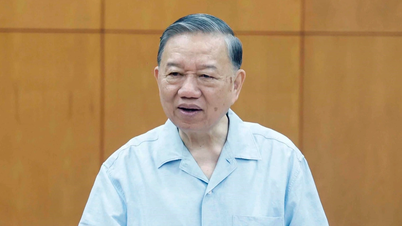
![[Photo] General Secretary and President To Lam presides over a meeting on assessing national development resources.](https://vphoto.vietnam.vn/thumb/1200x675/vietnam/resource/IMAGE/2026/05/20/1779253785852_a1-bnd-2943-8519-jpg.webp)



























































Comment (0)