"Never before has the sun been as scorching as this year," Mr. Pham Dinh Vinh (Phu Loc 3 village, Phu Trach commune, Quang Tri province) told us, standing in the middle of the salt field.
On the salt fields, dozens of salt farmers work diligently under the scorching sun, their faces glistening with sweat…

On the salt fields of Phu Loc village. Photo: TP
The hotter the weather, the whiter the salt.
In late June, the outdoor temperature in the northern rural areas of Quang Tri province was scorching. From early morning, the sun beat down, blazing and burning. Even in the late afternoon, the intense heat continued like a fire...
During the scorching days with temperatures reaching nearly 40 degrees Celsius, the Phu Loc salt fields are bustling with workers. At this time, salt farmers are in the midst of harvesting, raking the salt into piles that, from a distance, look like giant white cones turned upside down.
Under the scorching sun, the villagers diligently gather salt, transport it to the collection point, and then bring seawater into the fields…
The salt fields in Phu Loc village cover an area of over 75 hectares, with planned embankments, irrigation canals, and concrete roads for transportation. Over 250 households in the village participate in production. Most of the salt farmers here have a long tradition of salt making spanning generations.
Mr. Pham Dinh Vinh's family owns three salt fields (commonly known as "chap fields"). He said that the salt harvesting season in Phu Loc usually lasts from April to August each year.

Each salt-making season, Phu Loc village supplies the market with 5,000 to 7,000 tons of high-quality granulated salt. Photo: TP



"Salt-making has been a tradition for generations and is still preserved by the people today. In drought years, the season starts earlier and lasts until September," Mr. Vung said.
According to many salt farmers, in the "hot spot" of Phu Loc salt village, seawater drawn from the Loan River under the scorching sun crystallizes into the renowned salt of Central Vietnam. The salt here crystallizes faster, is whiter, and commands a higher price than salt from other salt fields.
Mr. Pham Ngoc Dong, Chairman of the Farmers' Association of Phu Trach commune, said: "Every year, the Phu Loc salt fields supply the market with 5,000 to 7,000 tons of salt. This year, the prolonged hot weather and higher temperatures have resulted in even whiter, more beautiful, and firmer salt crystals, with a higher yield than the previous season. We hope for stable prices so that farmers' incomes will increase."
Salt farmers earn millions of dong every day.
As he pushed dozens of sacks of salt from the salt fields up to the storage area along the production road, Mr. Vung said breathlessly, "On average, each family with two people working in salt production harvests 1.5 to 2 tons of granular salt, and traders come to buy it right in the fields."
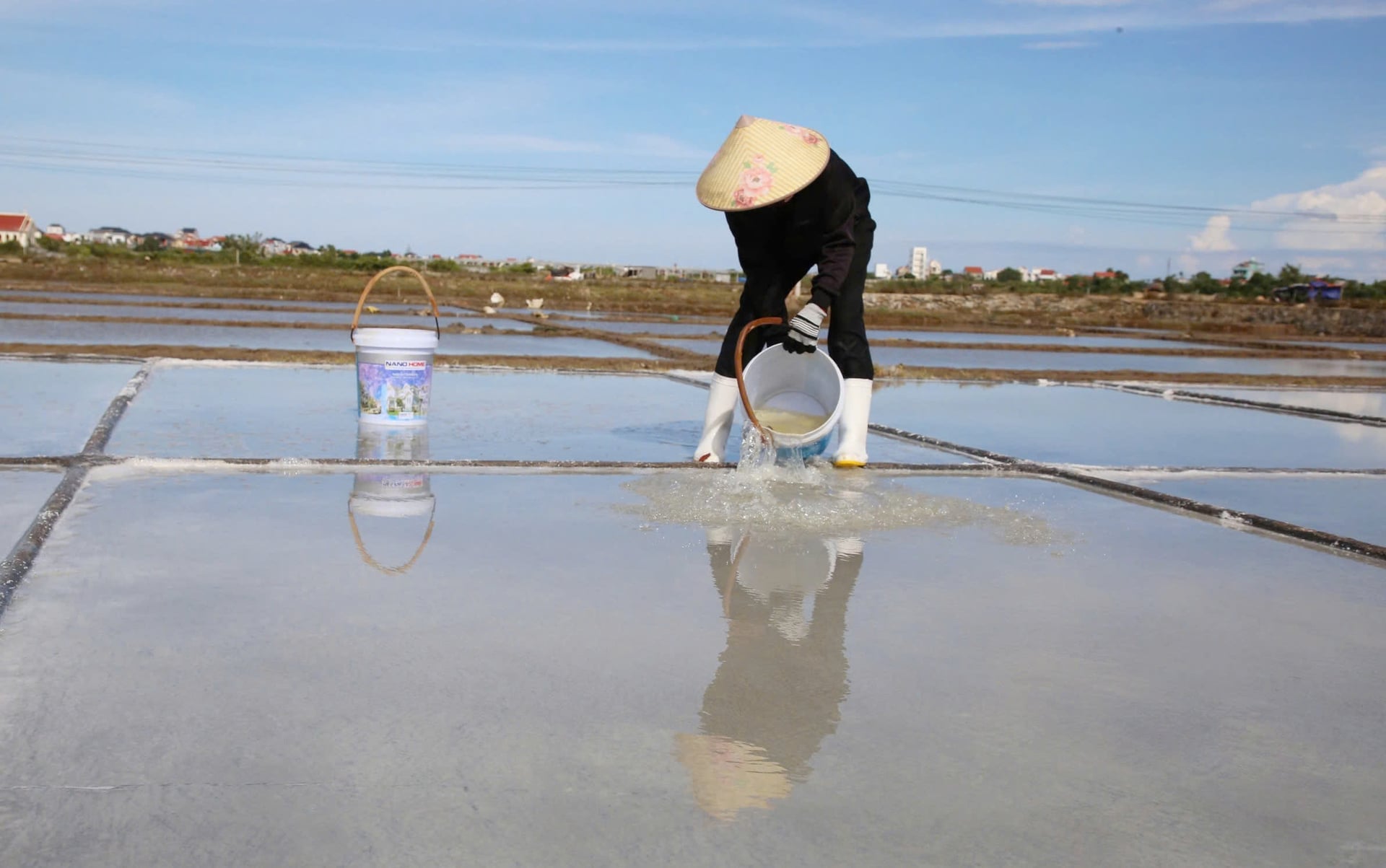
After harvesting, the locals channel seawater into the salt fields and let the salt crystallize in the sun. (Photo: TP)
Currently, traders and cooperatives in the area are buying granulated salt at 1,500 VND/kg. “If a household has enough salt pans for two people to work in, the income can be around 2 million VND. On average, each person earns 1 million VND per day. If a family has more salt pans and more workers, the income can be even higher,” Mr. Vung explained.
Next to her, Ms. Vo Thi Thanh had just finished harvesting crystallized salt and was taking seawater that had been sun-dried for a day to pour into the salt pans.
The closed-loop salt production process includes the following steps: Seawater is channeled to the salt fields, left to dry in the sun for one day, then transferred to the drying ponds the next day to continue drying in the sun. Usually, if the sun is strong, it is dried for another day before the salt can be harvested. After harvesting, seawater is brought back into the fields to dry again...
Vietnam encourages US businesses to expand investment in high technology.On the morning of June 26th, at the Government Headquarters, Deputy Prime Minister Ho Quoc Dung received Mr. Jeff Place, Supply Chain Director of Coherent Group (USA). During the meeting, the Deputy Prime Minister affirmed that Vietnam encourages US businesses to expand investment, especially in high-tech, innovation, and semiconductor industries.Encourage U.S. businesses to expand investment in high-tech sectors.Deputy Prime Minister Ho Quoc Dung said that Vietnam welcomes US businesses to continue expanding their operations in Vietnam, especially in high-tech industries and sectors with high added value.Vietnam and the United States strengthen cooperation in addressing the consequences of war.VTV.vn - On June 22, General Secretary and President To Lam received Acting Secretary of the US Navy Hung Cao.




On scorching hot days, salt farmers can earn over 1 million VND per day. (Photo: TP)
According to Ms. Thanh, in recent years, the lives of salt farmers have changed significantly. Most salt-producing households have stable and comfortable lives thanks to income from the salt fields. She said: "A successful salt harvest can bring each worker an income of 70 million to over 100 million VND. With this income, farmers focus on investing in their fields to reduce labor and improve efficiency."
Mr. Pham Ngoc Dong, Chairman of the Farmers' Association of Phu Trach commune, said that for the salt-making industry in Phu Loc to develop sustainably, comprehensive solutions are needed regarding production, processing, and consumption. This will help people feel secure in their profession and continue to preserve the value of this traditional craft village for future generations. This is also the last salt-making village in Quang Tri province.
Source: https://nongnghiepmoitruong.vn/lang-muoi-trong-nhung-ngay-nang-lua-d818981.html

![[Photo] Strengthening character and expertise: Intense training for artillery soldiers.](https://vphoto.vietnam.vn/thumb/1200x675/vietnam/resource/IMAGE/2026/06/30/1782815602541_lu-368-1875-4571-jpg.webp)