

The journey to wealth in a new homeland.
Quang Hoa village, Tam Dien hamlet, Tam Giang commune, Dak Lak province, is nestled in a deep valley surrounded by endless rolling hills. Amidst the vast expanse of green trees, the red tiled roofs of traditional stilt houses stand out, a testament to the prosperous and comfortable life of the local people.
Recalling the difficult times when the Nung An people (a subgroup of the Nung ethnic group) left Cao Bang to settle here, Mr. Nong Van Minh (born in 1970) said that back then, the area was still wild and covered in dense forests. Life was full of hardships, but with determination to stay on the land, they initially planted short-term agricultural crops, and later the people began to familiarize themselves with growing coffee.
The villagers boldly invested in purchasing seedlings, improving the soil, conducting trial plantings, and persistently learning. In 1991, the first coffee crop ripened on the hillsides, opening up a new direction. From a few initial rows, the people expanded the area, then quickly intercropped durian, macadamia, and other fruit trees. The land was suitable for the crops, the people were suited to the work, and their lives changed with each season.
Mr. Minh pointed to his lush green coffee and durian orchard: "My family owns more than 1 hectare. This year the coffee harvest is good, I'm sure we'll get over 3 tons of beans, about 400 million VND."
Standing in front of a stilt house over 30 years old, Mr. Mong Thanh Hon, Head of Tam Dien village, said: The village currently has 115 households with 541 inhabitants, divided into two villages: Quang Hoa village, which is 100% Nung An people, and Coc Xoai village, which is home to Tay and Nung people.
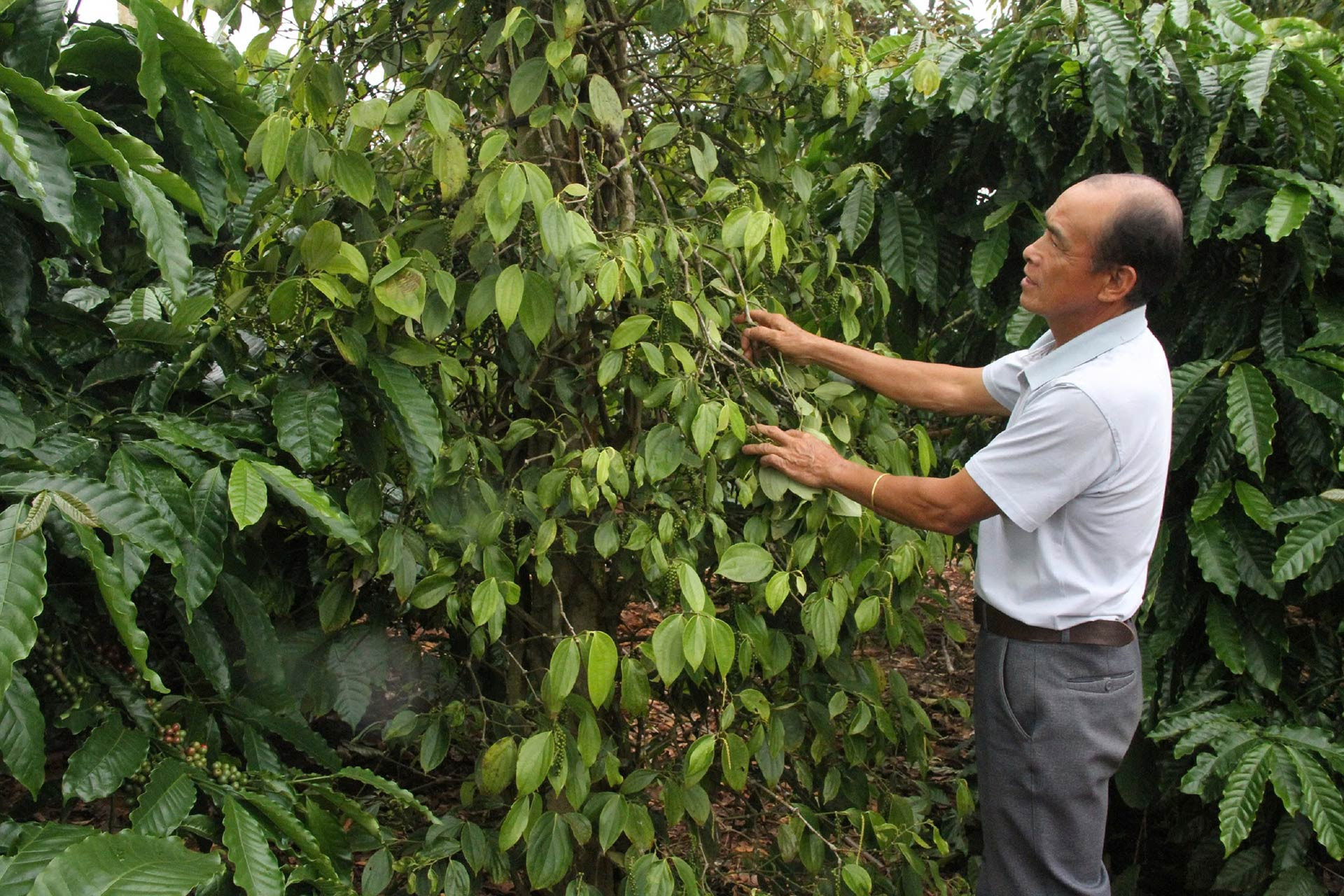
According to Mr. Hon, Quang Hoa village alone has 53 households with over 270 inhabitants, each owning 2-4 hectares of intercropped coffee. Even the lowest-income households earn several hundred million dong, while most earn billions of dong annually. Almost every household owns one or two tractors, and to date, 11 households in the village have purchased cars. “My family also has 3 hectares, with an average yield of 4 tons/hectare. For the past two years, prices have been good, earning over 1 billion dong each year. But what's valuable isn't just the economic aspect , but the unity and solidarity among the villagers as they move forward together,” Mr. Hon shared.
Preserving the original identity
Despite economic development, Quang Hoa village has preserved its traditional culture intact. Along both sides of the road, the four-roofed stilt houses – a characteristic architecture of the Nung An people – still stand proudly. Each house has 30-56 pillars, a wooden staircase leading to the main room, and inside, a hearth and ancestral altar are placed in a prominent position.
The village head of Tam Dien, Mong Thanh Hon, said: "No matter how rich we are, we will never abandon our stilt houses. They are treasures left behind by our ancestors." Two years ago, a family in the village unfortunately had their house burn down. While the fire was still burning, the villagers rushed to put it out, saving the frame and pillars. Afterwards, the whole village contributed to repairing and rebuilding a new stilt house according to the original design.
In Quang Hoa, culture is not just about architecture. The Nung An people here still preserve their traditional costumes, musical instruments, then singing, rituals, and especially the heo phuon singing – a gentle, melodious love song, as soft as a stream and as poignant as the voice of the heart. During family gatherings, the sound of heo phuon resonates under the stilt houses, connecting the threads of memory to their ancestral homeland in the North.
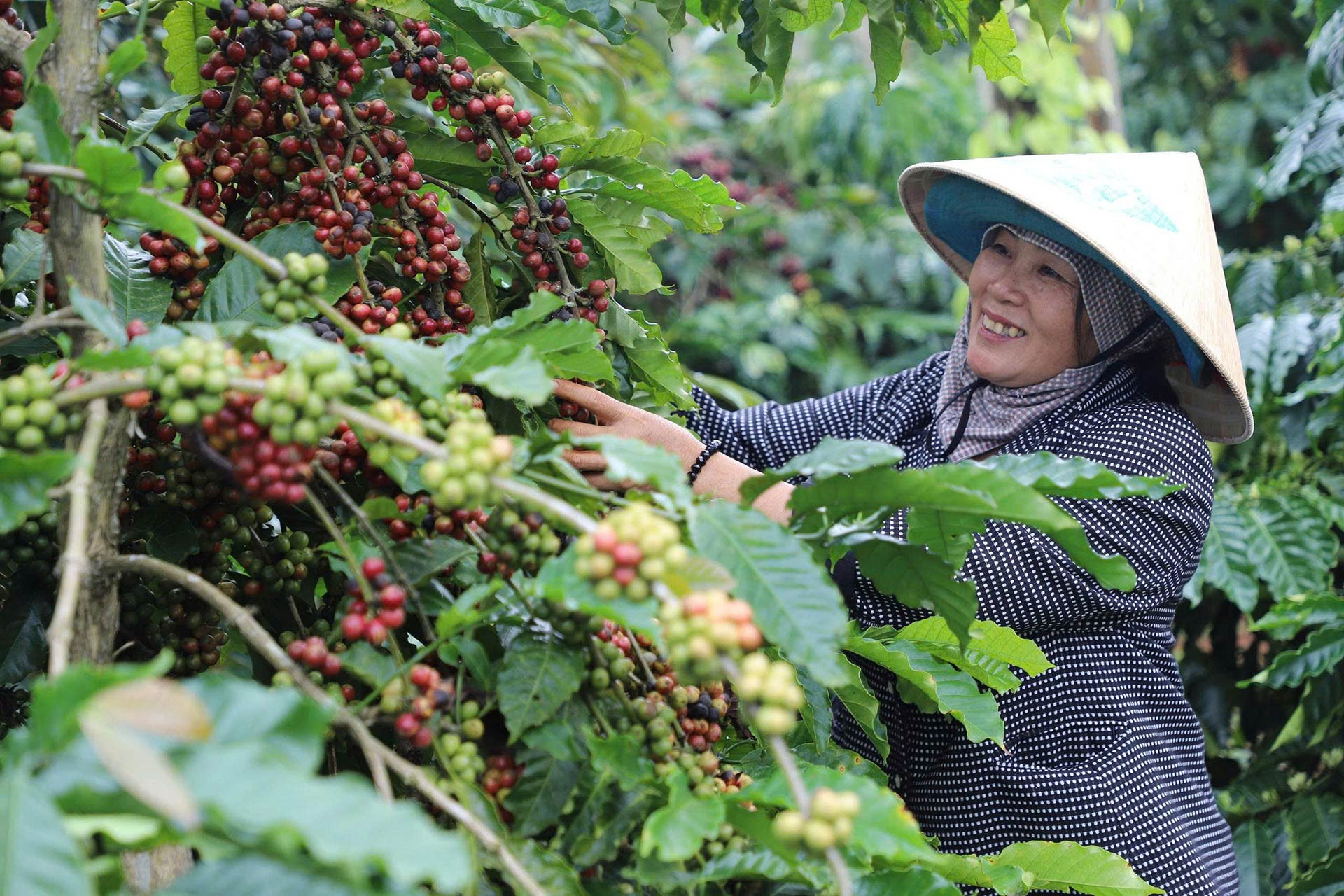
Ms. Nong Thi May (born in 1965), a folk singer, shared: "We were born and raised in stilt houses. Wherever we go, whatever we do, we must preserve the traditions and songs of our people. Only then can we maintain our roots."
Local authorities also pay special attention to preserving cultural identity. According to Le Ky Su, Chairman of the People's Committee of Tam Giang commune, the commune is home to 21 ethnic groups, with over 51% being ethnic minorities, mainly Tay and Nung people from the northern provinces.
"The village of Quang Hoa, in particular, has preserved its traditional stilt houses almost intact and revived the Hèo Phườn singing tradition. This is a valuable cultural resource, both for preservation and for developing community tourism in the future," Mr. Su said.
Thanks to the harmonious blend of cultural identity and agricultural economy, Quang Hoa is not only rich in material wealth but also rich in spirit and tradition. Nestled in the highlands, Quang Hoa village today stands as a vivid narrative of a community's journey in overcoming difficulties, preserving its heritage, and striving for progress.
The "billionaire" village in the heart of the plateau is not only rich in money, but also rich in pride, rich in tradition, and deeply imbued with the spirit of its homeland.
Source: https://vietnamnet.vn/lang-ty-phu-giua-long-cao-nguyen-2489653.html
























































































Comment (0)