

Unconventional methods of reforestation
In the mountainous commune of Tuyen Lam, if you ask who is a skilled forest planter, many people will likely recommend them. However, if you ask who is skilled at planting forests using native tree species, the person most likely to be mentioned is Mr. Dinh Xuan Niem in Ha village.
Mr. Niem currently owns a forest spanning over 5 hectares, containing many valuable timber species such as rosewood, ironwood, agarwood, and other precious woods; some of the trees are tens of meters tall and over 30 years old. This forest is the culmination of a lifetime of dedication from this elderly farmer who loves the forest.
The story begins over 30 years ago. Back then, Thanh Hoa commune (formerly), Mr. Niem's hometown, was known as the "forest bandit" commune, because the lives of most of the people there depended on logging. Mr. Niem himself was no exception; to feed his family of seven, he had to carry his axe into the forest every day.
Day after day, month after month, the seemingly endless forests were exploited to the point of exhaustion by Mr. Niem and the local people. Despite the burden of making a living, many nights he couldn't sleep as the image of the deforested areas kept flashing before his eyes. Mr. Niem was tormented by the thought that after years of relying on the forest for his livelihood, he himself had cut down hundreds of trees. If everyone in the village did the same, the forest wouldn't grow fast enough to keep up with the felling.
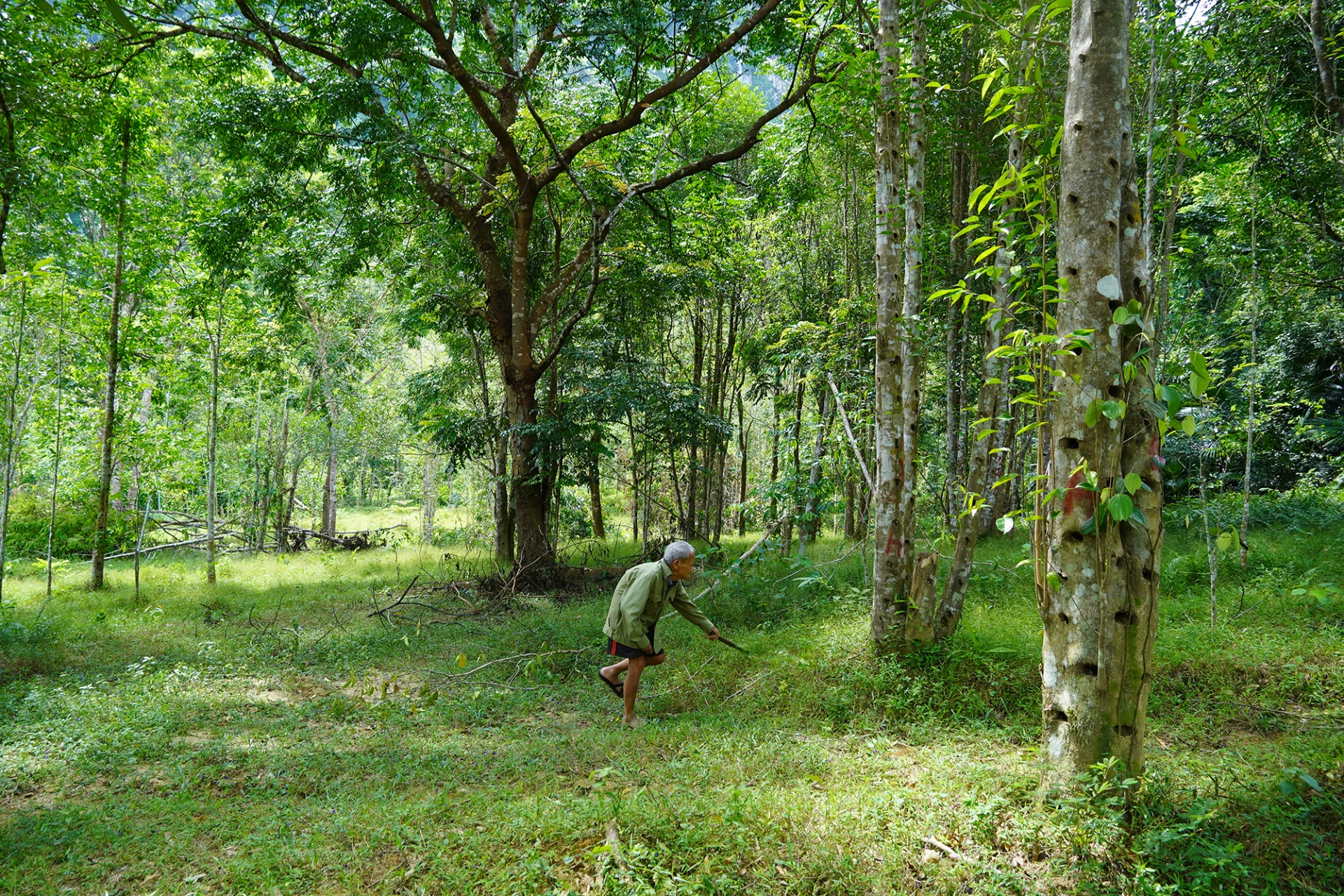 |
| Mr. Dinh Xuan Niem's "natural" forest - Photo: PP |
Having returned from the fierce battlefields of Quang Tri , Mr. Niem understood the value of forests better than anyone else. During his years fighting, the vast forests in the Khe Sanh and Huong Hoa regions had repeatedly sheltered him, allowing him to survive the enemy's bombing raids and shelling.
Feeling guilty about the forest, in 1997, Mr. Niem decided to give up his work as a "forest poacher," no longer entering the forest to exploit timber. Around the same time, the government launched a policy encouraging people to reclaim and reforest barren hills and mountains. He decided to take on a desolate area, riddled with unexploded bombs and ammunition from the war, next to Len Ha cave, to plant a forest.
Unlike others, Mr. Niem didn't plant trees like acacia or eucalyptus, but focused on planting native forest trees, including many valuable species such as rosewood, ironwood, yellow heartwood, and agarwood. Back then, people hadn't yet propagated native forest tree seedlings, so Mr. Niem had to pack his own food and go into the forest to find saplings. Day after day, he would trek through the forest searching for seedlings, then dig the soil to plant them, and then bend his back to carry buckets of water from the stream to water them. In good weather, 5 out of 10 trees might survive; in droughts, sometimes none would. Yet, he never lost heart; each sprouting branch was a motivation for him to plant more... When the trees' canopies closed to form a forest, his hair began to turn gray.
Leaving a "legacy" for future generations.
Despite his advanced age, Mr. Niem remains healthy and agile. Although his back is slightly hunched and his movements are somewhat slow, he enthusiastically guided us through his family's forest. Following him, we felt as if we were lost in a primeval forest with hundreds of trees reaching tens of meters in height, their green foliage stretching as far as the eye could see.
While clearing trees with a machete, Mr. Niem introduced us to the forest. He said that after more than 30 years of hard work and perseverance in planting native trees, his family's forest, which covers more than 5 hectares, now has over 1,000 ironwood trees, 500 rosewood trees, 500 yellow heartwood trees, and 3,000 agarwood trees, along with many other rare and valuable native timber trees.
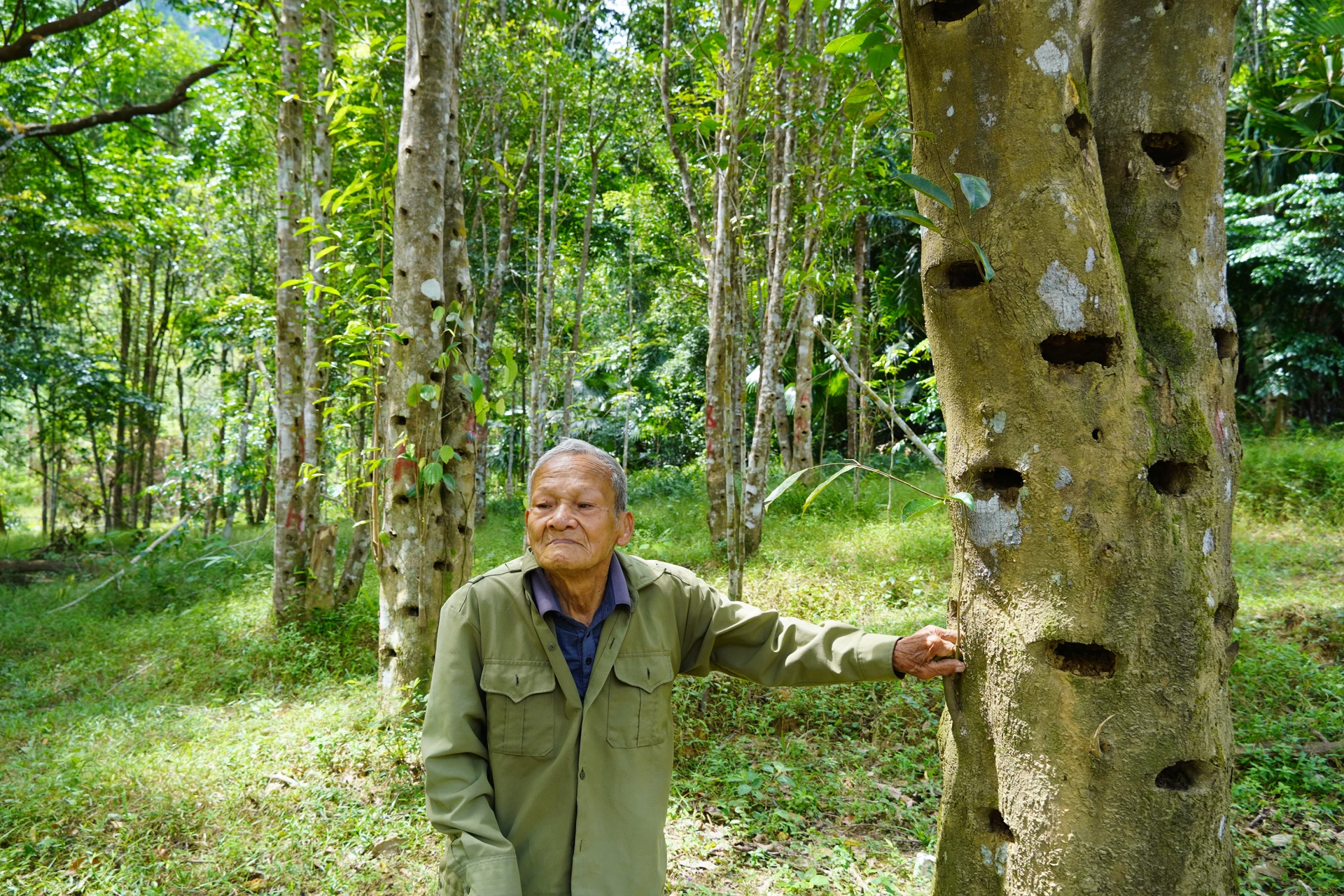 |
| Mr. Niem stands beside an ancient agarwood tree in the process of "creating" agarwood - Photo: PP |
He showed us an ancient ironwood tree—one of the first trees he brought from the forest to plant. The tree is about 30 meters tall, with a trunk as thick as an adult's arm span, and it's ready for harvesting. He has quite a few large ironwood trees like this in his forest, and many people have offered over 100 million dong for them, but he has no intention of selling them.
Stopping by a patch of agarwood forest, where many large trees have holes drilled around their trunks, Mr. Niem explained that these were agarwood trees he had sold to agarwood traders, who were now "catching" the trees to produce agarwood, and therefore still asked him to look after them. Currently, agarwood is the only commercially viable tree species in his forest.
With thousands of agarwood trees, Mr. Niem could become a billionaire if he sold them all at once. However, over the years, he has only sold them in stages, once the trees have grown. Where a mature agarwood tree is harvested, he immediately plants saplings. In addition, his family also earns income from by-products of the forest and fruit trees in his garden.
"Planting acacia and eucalyptus trees yields quick harvests, but their exploitation negatively impacts the environment. I plant native trees with the hope of restoring the forest to its pristine natural state, contributing to the conservation of valuable timber trees to repay my debt and gratitude to the forest," shared Mr. Dinh Xuan Niem.
After nearly two hours of trekking through the forest and listening to Mr. Niem recount his "philosophy" of reforestation, we understood that, after more than 30 years of dedicated work, he has left behind not only a rare natural forest, but also his love and gratitude for it. Mr. Niem explained that recently, due to his advanced age and declining health, he has divided some of the forest land among his children. When handing over the forest to his children, he repeatedly emphasized the need to adhere to regulations on harvesting and how to "compensate" for the forest's sustainable development, ensuring both a sustainable income source and good environmental and ecosystem protection for the community.
Mr. Dinh Xuan Thuong, Secretary of the Party Committee and Chairman of the People's Committee of Tuyen Lam commune, assessed: "Mr. Niem is a prime example of forest planting and economic development in the locality. With his progressive thinking on forest planting, his model has affirmed that planting forests with native tree species is the right direction, adapting to current climate change. In the future, the commune will adjust its forest planting policy, encouraging people to choose native forest tree species for planting to develop the economy and contribute to environmental protection."
Phan Phuong
Source: https://baoquangtri.vn/xa-hoi/202510/lao-nong-yeu-rung-b3a12c0/
![[Photo] Prime Minister Pham Minh Chinh receives the Chinese Ambassador to Vietnam](https://vphoto.vietnam.vn/thumb/1200x675/vietnam/resource/IMAGE/2026/04/05/1775397481797_ndo_br_dsc-5512-jpg.webp)




































































Comment (0)