

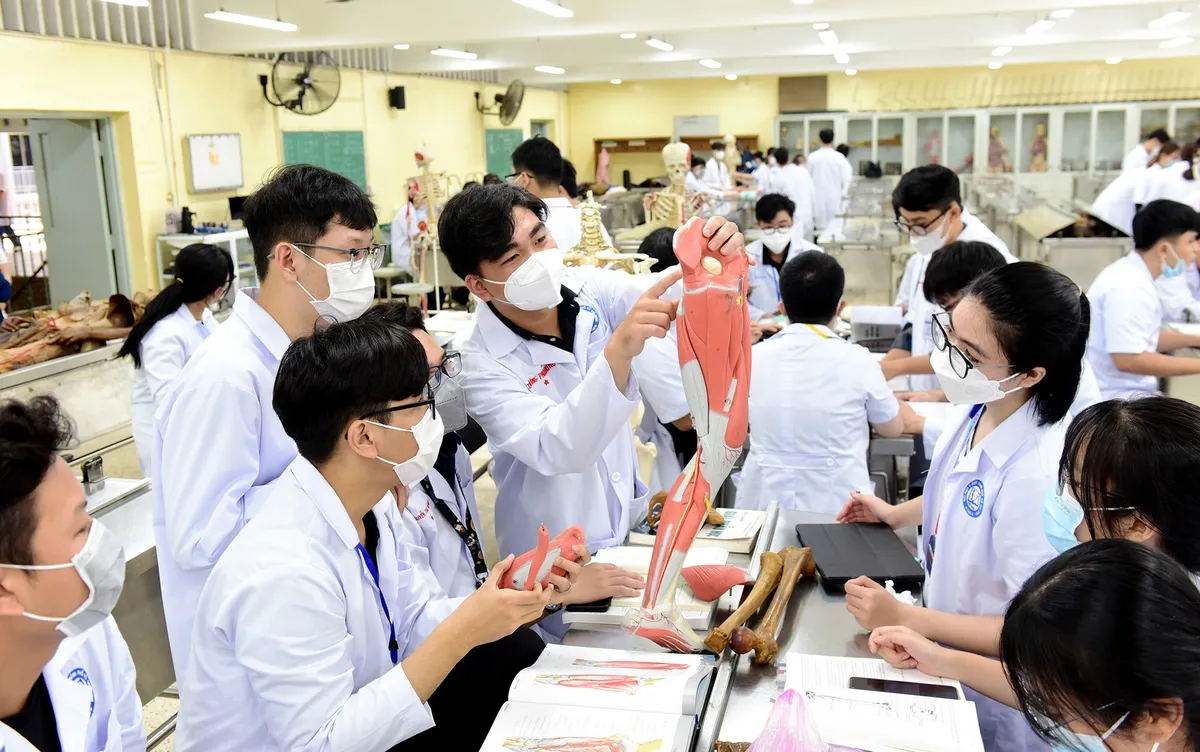
Medical students during a practice session.
In just a few years, the number of universities offering medical and pharmaceutical programs has increased rapidly to an uncontrollable extent. Many experts point out that at numerous institutions, practical training infrastructure is lacking, there are insufficient training hospitals, and faculty is limited, with the ratio of full-time faculty even failing to meet the minimum requirements. Meanwhile, training doctors demands a very high level of standardization, a long duration, and rigorous curricula for both study and practice.
The increasing demand for healthcare personnel in the context of a larger population is real, but meeting the demand for quantity cannot be an excuse to compromise on quality. Looking at the world, countries with developed medical systems set strict requirements when licensing medical schools and supervising training, from faculty standards, practice systems, affiliated hospitals, to student-to-faculty ratios, output standards, and internship duration. Many countries also apply independent periodic accreditation mechanisms, along with the right to immediately suspend programs that do not meet standards.
Meanwhile, in Vietnam, the criteria for opening new medical programs are sometimes overly focused on administrative procedures, while the evaluation process is not rigorous enough. Many National Assembly representatives have reported that some institutions are aggressively recruiting students despite inadequate laboratories, libraries lacking specialized materials, and a teaching staff that is both insufficient in number and lacking in expertise. A medical student who is not trained to the correct standards will graduate with deficiencies in both knowledge and practical skills.
The consequences extend beyond the quality of training; they directly impact the image and reputation of the entire medical profession. Society's trust in doctors is built upon the standards and rigor of the training process. Every medical error can have significant and widespread consequences, ranging from professional mishaps to a crisis of confidence. A lax training system will create "gaps" that are difficult to rectify throughout the entire healthcare system.
To avoid repeating the mistakes of many sectors that experienced rapid but uncontrolled growth, tightening the management of medical schools and medical programs is an urgent requirement. But how can this be done to ensure both quality and meet the demand for human resources?
According to many experts, the first step should be to raise the standards for opening new academic programs in a more substantive way. Licenses should only be granted to schools with standard-compliant teaching hospitals, strong faculty, and a commitment to long-term investment in facilities. The situation of opening new programs first and then hastily adding requirements later is unacceptable.
Furthermore, an independent accreditation mechanism based on international standards should be established for all medical training programs. Accreditation results must be made public for social oversight. In addition, the professional competency assessment system needs to be more rigorous and substantive; if professional examinations are sufficiently strict, low-quality training programs will be naturally eliminated.
All policies related to medical training must prioritize the health of the people. Society needs many doctors, but even more so, it needs doctors who are highly skilled, proficient, and ethically sound.
The quality of medical training is not just a matter for the education or healthcare sectors; it's the foundation for the safety, health, and trust of the entire society. Only by resolutely prioritizing quality can we build a sustainable and reliable healthcare system for the future.
Source: https://kinhtedothi.vn/lay-chat-lam-goc.916363.html
![[Photo] A vibrant celebration of generations of Nhan Dan Newspaper staff](https://vphoto.vietnam.vn/thumb/1200x675/vietnam/resource/IMAGE/2026/03/11/1773228432744_cb-75-nam-7-7034-jpg.webp)






























































































Comment (0)