

The film depicts soldiers living and fighting in underground tunnels. (Photo: Provided by the producer) |
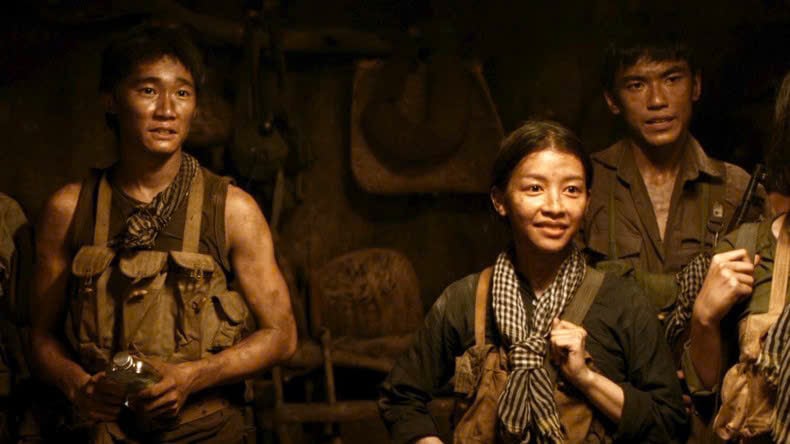
Midweek, late-night screenings of "Underground Tunnels: The Sun in the Darkness" were nearly sold out, mostly with young people. In an atmosphere steeped in history, occasional soft sobs could be heard. Despite only having early screenings on April 2nd and 3rd before its official release on April 4th, the film had already sold 60,000 tickets – a number that speaks volumes about the film's strong appeal and the public's deep interest in national memory.
In 128 minutes, the film takes viewers back to the Cu Chi battlefield in 1967 – one of the most brutal battlefields in the resistance war against the US – with intense scenes of smoke and fire and the indomitable fighting spirit of the guerrilla soldiers. 21 guerrilla fighters, under the command of Bay Theo (Thai Hoa), bravely held their ground in the tunnels, tasked with protecting a crucial base for strategic intelligence operations.
The film's highlight is its portrayal of people in wartime with a realistic and humane perspective. The work doesn't idealize or deify the characters, but instead allows them to appear very "real" with all their emotions: fear, pain, the yearning for love…
The film breaks away from conventional storytelling in cinema: there is no central character. Each person has their own personality, their own fears, their own wounds, but all share a common spirit: patriotism. The director also doesn't delve into the personal backgrounds of each character, unlike the many generations who sacrificed for the independence and freedom of the nation, as in the poem "The Country" (epic poem "The Road of Thirsting for Hope," by Nguyen Khoa Diem): "They lived and died / Simply and peacefully / No one remembers their faces or names / But they created the Country."
The underground tunnels in the film are not just physical spaces, but also special characters with their own souls. They are not only places of battle, but also places to listen to songs, witness love stories, and the simple moments of life; they are symbols of undying hope. It is within these underground tunnels, amidst the smoke and fire of war, that ordinary people find love, sacrifice, and a meaningful life.
Bui Thac Chuyen chose a realistic, documentary-style storytelling approach, avoiding fictional scenes designed to heighten emotions and elicit tears from viewers. The director aimed to keep the audience level-headed, prompting reflection and the study of historical lessons about war. Instead of fleeting emotions, he wanted to leave a lasting impression, something that would make people think and feel deeply.
"Underground: The Sun in the Darkness" left a strong impression, not only because of its unique approach but also because of its profound humanistic message about life, humanity, and courage in the harshest circumstances. The soldiers in the film found a brilliant "sun" during those brutal months. And in peacetime, we also have millions of other "suns."
That was the director's ten-year dream – the aspiration to recreate the indomitable patriotic spirit of the people of South Vietnam. He steadfastly pursued a documentary film style – authentic, not sentimental, not driven by drama – believing that history itself is majestic enough and does not need exaggeration. The director hoped the work would open up a new perspective, helping viewers understand the sacrifices of their ancestors for today's peace .
It was the actors' fierce dedication and sacrifice for their roles. Patriotism was the driving force behind their daily efforts during the arduous months-long preparation process. They voluntarily lost weight to achieve the physique of wartime soldiers, underwent rigorous military training with live ammunition on the training ground, and honed their physical fitness and knife-fighting skills. They crawled into tunnels, carrying weapons and moving at maximum speed according to a stopwatch – not only to make their performances more realistic but also to show their profound respect for history and the real people who fought in the Cu Chi Tunnels.
That reflects the deep care and affection of the audience, especially the younger generation. Going to the cinema is not just a simple entertainment experience, but an opportunity to connect with the past, with the glorious history of the nation. The vivid footage of the Cu Chi Iron Land, a place deeply marked by the indomitable spirit of resilient heroes, reminds them of their responsibility to continue the unwavering spirit, unwavering will, and patriotism of previous generations.
“Underground Tunnels: The Sun in the Darkness” has been a resounding success in evoking national pride from multiple perspectives, from the filmmakers and actors to the audience. Each participant in this creative journey not only contributed their talent and dedication but also carried a great responsibility, conveying a powerful message about history and the tireless sacrifices of previous generations. The work is not just a film, but a lasting bridge connecting the past and present, instilling in each person a firm belief in the strength of the nation.
LE THI THU HA
Source: https://baodanang.vn/channel/5433/202504/lich-su-song-lai-qua-tung-thuoc-phim-4003540/

![[Image] National Assembly discusses the implementation of the socio-economic development plan.](https://vphoto.vietnam.vn/thumb/1200x675/vietnam/resource/IMAGE/2026/04/20/1776696707422_ndo_br_img-20260420-185419-jpg.webp)
![[Photo] General Secretary and President To Lam meets with National Assembly delegates from ethnic minorities.](https://vphoto.vietnam.vn/thumb/1200x675/vietnam/resource/IMAGE/2026/04/20/1776696701056_a1-bnd-8331-3342-jpg.webp)
























































































Comment (0)