

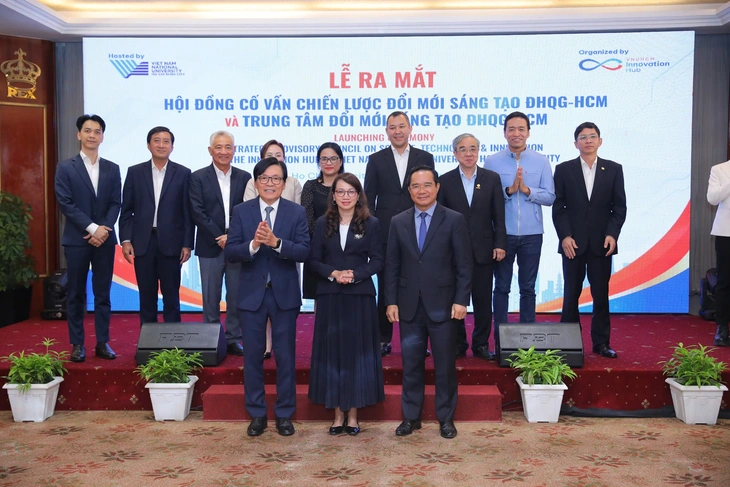
Launch ceremony of the Innovation Strategy Advisory Council on January 28 - Photo: KHAC HIEU
Speaking to Tuổi Trẻ newspaper, Mr. Phạm Phú Ngọc Trai - Chairman of the Vietnam Packaging Recycling Alliance (PRO Vietnam), and also Chairman of SACSTI - emphasized that only by thinking differently and doing differently can innovation be created.
And only innovation can unlock double-digit growth momentum for Ho Chi Minh City in the coming period.
 Mr. PHAM PHU NGOC TRAI
Converging resources creates collective strength.
* Sir, many people believe that advisory councils in the public system often... stop at making recommendations. So what will be the differentiating factors of SACSTI?
- This is precisely the question we asked ourselves from the very beginning when forming SACSTI. The first distinguishing feature of SACSTI is its very clear positioning of its role.
The council is not an executive body, does not allocate budgets, and does not directly implement projects.
SACSTI acts as an independent "think tank," tasked with maintaining strategic alignment and advising the leadership of the Vietnam National University Ho Chi Minh City and the city's leadership on major decisions before resources are deployed.
Secondly, SACSTI focuses on advising on fundamental and long-term issues, especially trends in science and technology, priority areas, research and development, and "ordering" mechanisms.
Thirdly, the council is involved from the very beginning in designing the innovation ecosystem, with a focus on the tripartite linkage model involving the State, schools, and businesses. Finally, SACSTI plays a role in reviewing and evaluating strategies for major programs and projects.
* Isn't one of the biggest challenges facing Ho Chi Minh City currently how to bring together science, the market, businesses, and policies to work towards a common goal, sir?
- I believe Ho Chi Minh City does not lack knowledge, innovation, or talented people. The much more difficult challenge is how to organize the convergence of these resources to create a collective strength.
When it comes to convergence, it's crucial to create a "common alliance" based on the city's development goals.
Once a common goal has been agreed upon, contributions, critiques, or proposals from each side must revolve around questions such as what value is added, what the impact is, and whether it serves the long-term growth strategy.
For example, with SACSTI, we will set "KPIs" for specific impacts. Criteria such as the level of collaboration between the three stakeholders, the number of substantive collaborative projects formed, or the ability to create ripple effects need to be quantified with clear indicators to avoid fragmented operations.
This will be a shared space where different perspectives can look toward a common goal, share responsibility for their impact, and contribute to improving the quality of strategic decisions.
"The catalyst" for tripartite linkage
* The tripartite linkage has been discussed extensively over the years, but in your opinion, why is it still difficult to create substantive collaborations with a clear impact in practice?
- I believe the problem lies in the fact that we haven't yet organized the three-way linkage in a sufficiently proactive and groundbreaking way. Universities focus on research and training, businesses are under market pressure, and the State is constrained by institutional and procedural limitations.
Without a sufficiently clear common goal and a strong coordination mechanism, the collaboration can easily become merely a formality.
To truly integrate these three stakeholders, I believe proactive action from all sides is necessary. The government needs to create a testing ground and accept controlled risks, schools need to be more open to practical and market-oriented problems, and businesses must participate early on, ready to invest both short-term and long-term.
In this context, the role of intermediary structures is crucial. These structures do not replace the actions of the parties involved, but rather help identify each party's strengths, connect them within a common network, and ensure that resources are focused on goals with a significant impact.
Take the field of unmanned aerial vehicles (UAVs) as an example; it has both economic potential in logistics, transportation, and agriculture, and is also linked to important requirements in security, defense, and search and rescue.
SACSTI is currently collaborating with Mr. Luong Viet Quoc of RealTime Robotics, a highly skilled UAV expert, to integrate training and research at the Vietnam National University Ho Chi Minh City, conducting trials within the university environment, and simultaneously connecting with the needs of the city.
In other words, such emerging technology fields require a long-term vision and consistent support. Many technology companies around the world have gone years without being profitable but were still given the opportunity to build their position.
If Ho Chi Minh City wants to create new growth drivers to achieve double-digit growth, it needs to think in a similar way, not just focus on short-term results.
* In your opinion, where does the line lie between genuine science and technology innovation and innovation that is merely slogan-based?
- I think we need to look at innovation in a simpler way first. Innovation doesn't necessarily have to be complex scientific and technological products or major inventions.
Many innovations begin with small things, such as a different way of doing things, a new solution that increases efficiency, reduces costs, or solves a familiar problem more effectively.
It is these small but genuine innovations, if encouraged, accumulated, and scaled up, that will lay the foundation for bigger changes.
From that foundation, the role of the new city becomes clear. For Ho Chi Minh City, science, technology, and innovation must be the almost sole strategic spearhead to create a difference in double-digit growth.
However, Ho Chi Minh City's innovation cannot be pursued in a scattered manner. The city needs to clearly define its direction, priorities, and investment timelines: which areas should be focused on first to create impact, and which areas should be prepared for the medium and long term.
Without strategic choices, resources will be dispersed, management costs will increase, but the results will not be commensurate.
In my opinion, the line between genuine innovation and mere slogan-based innovation lies in whether we start with concrete, measurable changes and dare to focus resources on directions that create value.
When innovation transforms the way we work, make decisions, and allocate resources, it ceases to be a slogan and becomes a genuine driving force for development.
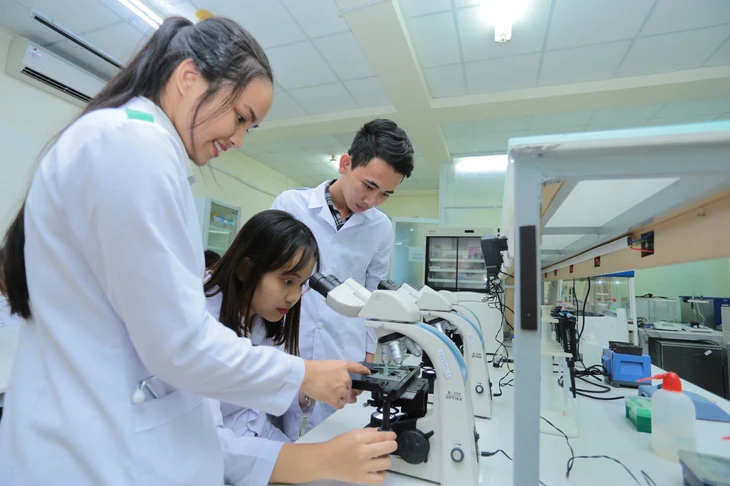
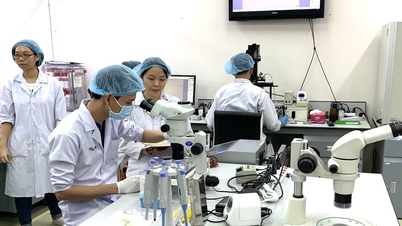
Students participating in scientific research at the Vietnam National University Ho Chi Minh City - Photo: KH
Developing core technologies to promote regional development.
According to Professor Dr. Nguyen Thi Thanh Mai - Director of the Vietnam National University Ho Chi Minh City, SACSTI is a key strategic advisory pillar for the Innovation Center of the Vietnam National University Ho Chi Minh City.
SACSTI will contribute to creating conditions for member universities of the Vietnam National University Ho Chi Minh City to directly access market problems, have clear guidance for research and development activities, and thereby promote the formation of products and solutions with potential applications.
Through this, the Innovation Center of the Vietnam National University Ho Chi Minh City is expected to become a hub connecting ministries, departments, localities, businesses, universities, and investors to jointly address practical issues.
Furthermore, the Innovation Center of the Vietnam National University Ho Chi Minh City will leverage existing infrastructure to build strong research groups, develop core technologies in cutting-edge fields such as artificial intelligence, drones, and biotechnology, and simultaneously develop in depth through Ho Chi Minh City's innovation ecosystem.
Meanwhile, Deputy Minister of Science and Technology Hoang Minh stated that one of the main functions and tasks of the Innovation Center is to connect and mobilize resources to support innovation and technological innovation activities of businesses and organizations, as well as to provide shared services and infrastructure for innovation.
In particular, given the position of the Vietnam National University Ho Chi Minh City, Mr. Minh believes that the Innovation Center is a place where Ho Chi Minh City, as well as ministries, departments, and localities, can confidently commission solutions to major local and national problems.
With the participation of experienced and reputable managers, scientists, and entrepreneurs, SACSTI will help strengthen connections and mobilize diverse resources both domestically and internationally.
14 leading experts from both domestic and international backgrounds.
SACSTI comprises 14 members, headed by Pham Phu Ngoc Trai. The finance, investment, and market sector includes Mr. Tran Hung Huy (Chairman of the Board of Directors of ACB), Mr. Don Lam (CEO of VinaCapital), and Mr. Nguyen Ngoc Hoa (Chairman of the Board of Directors of the Ho Chi Minh City State Financial Investment Company).
The business, technology, and manufacturing sector includes Ms. Dang Huynh Uc My (Chairwoman of the Board of Directors of TTC AgriS - TTC Bien Hoa), Mr. Le Hong Minh (Chairman of the Board of Directors of VNG Group), Mr. Bolat Duisenov (Chairman of the Board of Directors of Coteccons), and Mr. Nguyen Thanh My (Chairman of the Board of Directors of Rynan Technologies Vietnam).
In the science, education, and policy sector, there are Lieutenant General, Professor Dr. Nguyen Van Thanh (Vice Chairman of the Central Theoretical Council), Mr. Young-Sup Joo (former Minister of Science and ICT of South Korea), Professor Dr. Mai Thanh Phong (Rector of the University of Technology), Professor Dr. Ngo Thi Phuong Lan (Rector of the University of Social Sciences and Humanities), Associate Professor Dr. Tran Le Quan (Rector of the University of Natural Sciences), and Associate Professor Dr. Hoang Cong Gia Khanh (Rector of the University of Economics and Law).
Source: https://tuoitre.vn/lien-minh-thuc-day-doi-moi-sang-tao-20260202090722809.htm






















![[Photo] Tran Cam Tu, Standing Member of the Secretariat of the Central Committee, presides over the first meeting of the Central Steering Committee on the Development of Vietnamese Culture.](https://vphoto.vietnam.vn/thumb/1200x675/vietnam/resource/IMAGE/2026/03/19/1773895004549_ndo-br-bnd-1195-2-jpg.webp)
















































Comment (0)