Accordingly, one Javan pangolin was discovered by Mr. Ho Van Luan, residing in Xa Vi village, Huong Hiep commune ( Quang Tri province ), while traveling on the road, and he voluntarily handed it over. The other pangolin was discovered by Mr. Dinh Pi, residing in Troi village, Thuong Trach commune (Quang Tri province), in his garden area.
Upon receiving them, both individuals were in poor health. The individual found in Thuong Trach commune was young, weighing approximately 0.9 kg; the individual found in Huong Hiep commune was female, weighing 1.2 kg. Immediately after receiving them, the center's veterinarians conducted health checks and assessments, implemented isolation, monitoring, care, and rehabilitation according to professional procedures before considering their release back into the natural environment when conditions permit.
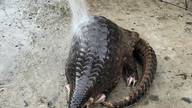
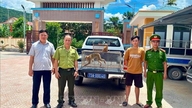
Previously, on June 29th, the People's Committee of Khe Sanh commune received a report from Ms. Ngo Thi Hoai Phuong, residing in Tan Xuyen village, Khe Sanh commune, regarding the discovery of a wild animal. Upon inspection, the People's Committee, in coordination with the Forest Protection Department, determined that it was a Javan pangolin weighing over 4 kg. To ensure rescue, care, and reintroduction into its natural environment, the People's Committee of Khe Sanh commune has submitted a request to Phong Nha - Ke Bang National Park to take possession of the animal in accordance with regulations.
The Javan pangolin is an endangered, rare, and precious wild animal, prioritized for protection, and classified as Group IB according to Circular No. 85/2025/TT-BNNMT dated December 31, 2025, of the Ministry of Agriculture and Environment, which regulates the management of endangered, rare, and precious species, common forest animals, and the implementation of the Convention on International Trade in Endangered Species of Wild Animals and Plants (CITES). This wild animal is also classified as critically endangered in the Red List of the International Union for Conservation of Nature (IUCN) and its exploitation from the wild and international trade for commercial purposes are strictly prohibited.
According to representatives from the Wildlife Rescue, Conservation and Development Center, the proactive approach of people in discovering and voluntarily handing over wild animals to authorities, instead of keeping them in captivity or engaging in illegal trade, is a positive sign, contributing to improved biodiversity conservation efforts. After being cared for, their health restored, and their ability to adapt ensured, the animals will be released back into their natural environment according to regulations.


Source: https://baotintuc.vn/xa-hoi/lien-tiep-tiep-nhan-cac-ca-the-te-te-java-quy-hiem-de-cuu-ho-20260703084502138.htm