

The main drivers came from supply risks, pushing oil prices close to $100 a barrel, while wheat surged due to weather concerns and stable demand.

Oil prices are nearing $100 a barrel as supply risks increase.
According to the Vietnam Commodity Exchange (MXV), the energy market surged yesterday as supply risks in the Middle East increased across the board, prompting the market to react more strongly to these supply risks.
Although the US and Iran have resumed talks in Islamabad, Pakistan, expectations for a comprehensive peace agreement are waning. Instead, the parties are reportedly only aiming for a temporary memorandum to limit conflict, raising concerns that disruptions to energy supplies will continue.
Market confidence continued to decline as news emerged that some European and Gulf countries were preparing for a scenario where negotiations could last up to six months, instead of reaching a conclusion as quickly as previously expected.
Beyond diplomatic factors, real-world disruptions are also evident. Attacks on energy facilities in the Middle East have directly impacted production, while the risk of disruption to the Strait of Hormuz continues to be a potential bottleneck in global supply chains.
Notably, the latest report from OPEC shows that the group's crude oil production in March fell sharply by nearly 27.5% compared to the previous month. This development reinforces expectations of a supply tightening cycle, thereby increasing the risk premium in the oil market.
Against this backdrop, oil prices received strong support and maintained an upward trend. At the close of trading, Brent crude rose approximately 4.7%, reaching $99.4 per barrel – nearing the $100 per barrel mark, a crucial psychological threshold reflecting the market's sensitivity to supply shocks. Meanwhile, WTI crude also increased 3.7%, reaching $94.7 per barrel.

Domestically, regulatory agencies have quickly implemented measures to stabilize the market. The Tax Department issued Official Dispatch No. 09/CĐ-CT to implement the regulations in Resolution No. 19/2026/QH16 of the National Assembly regarding tax adjustments on petroleum products.
Accordingly, the environmental protection tax and special consumption tax on gasoline have been reduced to 0%; the environmental protection tax on diesel, kerosene, fuel oil, and aviation fuel has also been reduced to 0%. At the same time, these items are exempt from value-added tax declaration and payment, but are still eligible for input tax deductions, contributing to reducing domestic cost pressure and supporting price stability.
Wheat prices rise, supply faces risks.
The agricultural commodities market also saw positive developments, with wheat being a bright spot as both supply and demand factors signaled support for prices.
At the close of trading, Kansas wheat futures for May delivery surged 2.8% to $236.1 per ton, while Chicago wheat rose nearly 1% to $220 per ton.
According to MXV, this upward trend reflects the simultaneous increase in supply risks and the continued high level of import demand, thereby reinforcing the price level.
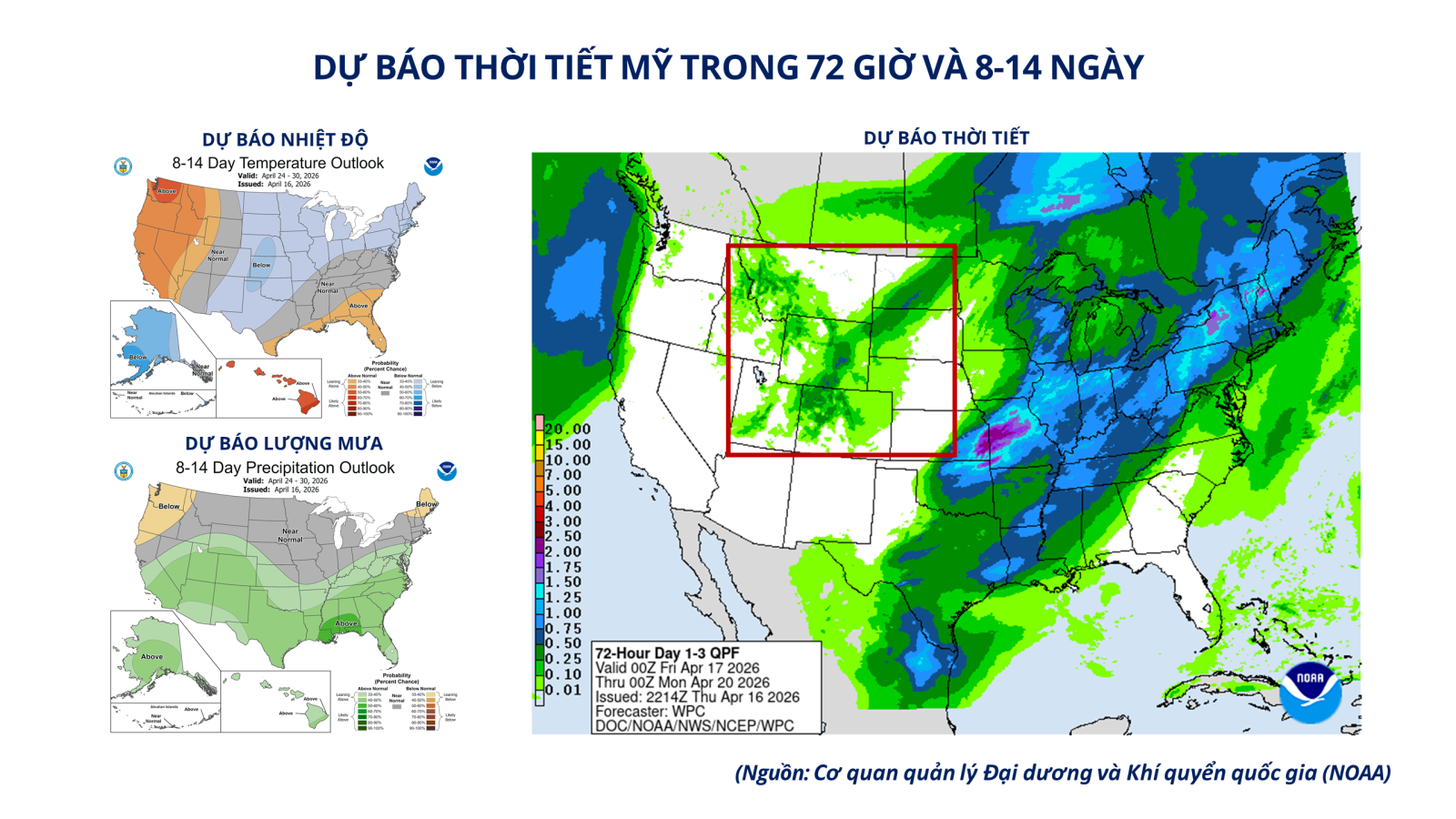
In the U.S., drought is spreading across the Western Plains and Nebraska due to a prolonged lack of rain. Simultaneously, warnings indicate temperatures could drop below 0°C in western Kansas – a key winter wheat growing region. During this period of rapid crop growth, the risk of frost can directly damage yields and production.
Weather concerns fueled buying in the market, particularly for Kansas wheat – a commodity directly impacted by severe conditions. As a result, prices rose more sharply than for Chicago wheat, as drought conditions in soft wheat-growing regions showed signs of improvement.
On the international market, demand remains high despite rising prices. Algeria has confirmed the purchase of approximately 400,000 tons of wheat at prices of $322-334 per ton, significantly higher than the $315 per ton level at the end of 2025, indicating that the market is still accepting higher price levels.
In the US, weekly export sales reports reached only about 231,000 tons, lower than expected. However, for the 2025-2026 crop year as a whole, committed exports of hard red wheat have increased by 59% year-on-year, far exceeding the initial forecast of the US Department of Agriculture (USDA).
This development indicates that the supply-demand balance is shifting towards tightening, thereby continuing to support prices in the short term.
Domestically, spot wheat prices at Cai Lan and Hai Phong ports fluctuate around 6,900 - 7,000 VND/kg, while April-June futures prices are at 7,000 - 7,300 VND/kg. Currently, approximately 92,000 tons of wheat are en route to Vietnam, expected to arrive at ports in the near future.
Source: https://baotintuc.vn/kinh-te/luc-mua-gianh-uu-the-mxvindex-noi-dai-da-tang-20260417100320229.htm



![[Photo] General Secretary and President visit the China-ASEAN AI Application Cooperation Center](https://vphoto.vietnam.vn/thumb/1200x675/vietnam/resource/IMAGE/2026/04/17/1776404277677_vna-potal-tong-bi-thu-chu-tich-nuoc-tham-trung-tam-hop-tac-ung-dung-ai-trung-quoc-asean-8706616-2286-jpg.webp)





























![[Photo] National Assembly Chairman Tran Thanh Man attends the policy seminar to promote Vietnam-Türkiye cooperation.](https://vphoto.vietnam.vn/thumb/1200x675/vietnam/resource/IMAGE/2026/04/16/1776351415367_vna-potal-chu-tich-quoc-hoi-tran-thanh-man-du-toa-dam-chinh-sach-thuc-day-hop-tac-viet-nam-tho-nhi-ky-8705791-jpg.webp)




































































Comment (0)