

After learning from and researching lotus cultivation models in China, in 2017, Mr. Doan Ba Hien in Que O village, Chi Lang commune, boldly consolidated 7 hectares of low-lying, unproductive rice paddies from other households in the village to plant lotus for tubers. After about 4 months of planting and caring for the plants, his family's lotus fields yielded a harvest of about 0.8-1 ton of tubers per sao (approximately 1000 square meters), with an average selling price of 12,000-15,000 VND/kg. After deducting expenses, each sao of lotus cultivation brought in an income of about 3-4 million VND.
|
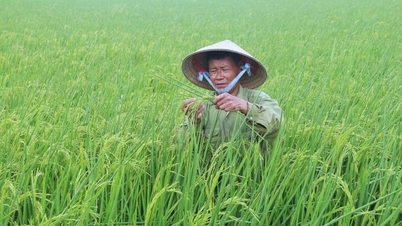
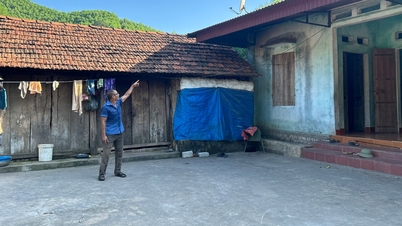
Mr. Doan Ba Hien inspects the growth and development of newly planted lotus plants. |

Recognizing the economic benefits of this model, Mr. Hien decided to expand the area to 10 hectares and invest in additional processing lines for lotus root products, including lotus tea and lotus starch, to increase value. Four of his family's products – sliced lotus tea, fresh lotus root, lotus root starch, and lotus root tea bags – have been recognized as 3-star OCOP products. From 10 hectares of lotus cultivation, Mr. Hien's family earns approximately 3-4 billion VND annually, with a profit of 800-900 million VND after deducting expenses. This also creates seasonal employment for 5-10 workers, providing them with an income of 400,000-450,000 VND per person per day.
Besides Mr. Hien's family, in recent years, many farmers have switched from rice cultivation to growing lotus for its tubers in low-lying fields because lotus tubers are a highly economically efficient crop, easy to care for, and have a stable market serving domestic consumption, food processing, pharmaceuticals, and export to markets in South Korea, Japan, China, etc.
According to Mr. Duong Duc Hong Tuan, Deputy Head of the Crop Production and Plant Protection Sub-Department (Department of Agriculture and Environment), in implementing the policy of shifting crop structure, in recent years, many farmers in the province have switched from rice cultivation to other crops that bring high economic efficiency. Among them, 30-50 households have boldly converted about 80-100 hectares from rice cultivation to lotus cultivation for tubers in low-lying areas where only one rice crop can be produced. Some households have boldly accumulated tens of hectares to cultivate lotus for tubers, such as Mr. Doan Ba Hien in Chi Lang commune; Mr. Nguyen Van Dien and Ms. Nguyen Thi Thuy in Nhan Thang commune; Mr. Nguyen Van Hoi in Yen Dung ward...
If the benefits of the lotus plant are fully exploited and it is planned as a raw material area, it can be one of the crops that brings high economic efficiency. In addition to growing lotus for its tubers, leaves, flowers, and seeds, farmers can also combine lotus cultivation with ecotourism .
Text and photos: Nguyen Tuan
Source: https://baobacninhtv.vn/lam-giau-tu-trong-sen-lay-cu-postid443485.bbg




![[Photo] General Secretary and President To Lam and the President of the Philippines hold talks.](https://vphoto.vietnam.vn/thumb/1200x675/vietnam/resource/IMAGE/2026/06/01/1780286997787_anh-man-hinh-2026-06-01-luc-11-09-43.png)












































































Comment (0)