

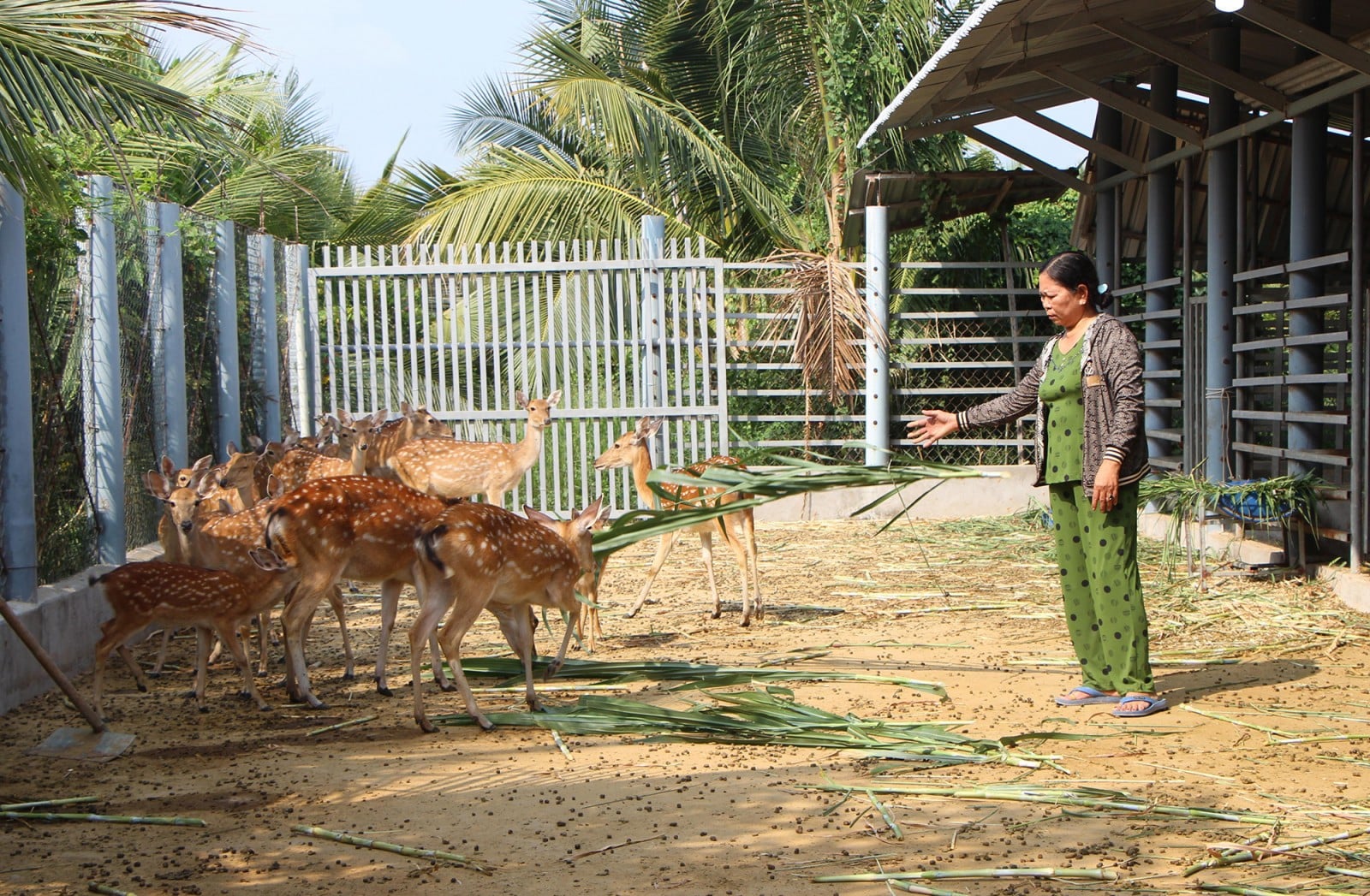
Ms. Cao Thi Leo is feeding the deer. Photo: CHAU AN
Previously, Mr. Thao's family mainly raised cattle and farmed rice, but their income was unstable. After researching through newspapers, radio, the internet, and visiting places in the field, he realized that deer were easy to care for, less susceptible to disease, and could utilize readily available local food sources, so he boldly switched to deer farming. “In 2022, I bought 15 deer for about 35 million VND each, repurposing old cattle sheds into separate enclosures to save costs. The deer herd reproduced naturally quite well, and now it has grown to about 50 deer, 20 of which are producing antlers,” Mr. Thao shared.
According to Mr. Thao, deer are easy to care for. They are domesticated wild animals with good resistance to disease and rarely suffer from outbreaks. Their main food sources are elephant grass, banana trees, corn stalks, various fruits, and agricultural by-products. Each day, the deer herd consumes over 300 kg of grass, with each deer eating an average of 7-10 kg of green fodder. By utilizing food from 15 acres of rented land and their own land, the cost of raising them is significantly reduced. Deer begin producing antlers after about two years and can be harvested for a long time, approximately 25 years. On average, they harvest twice a year, and the current selling price of fresh antlers is around 25 million VND/kg, providing a fairly stable income.
Compared to cattle or pig farming, deer farming offers many advantages. While cattle farming is heavily dependent on market prices and requires large areas, and pig farming often faces a high risk of disease, deer are less susceptible to disease, have a longer harvesting period, and yield higher economic value from antlers within the same farm area. Mr. Huynh Ngoc Cuong, Deputy Head of the Economic Department of Nhon My commune, assessed: "This is a model with relatively high economic value and is suitable for local conditions. In the future, the locality will continue to support breeding techniques and connect with markets to expand the model."
This model also reduces labor compared to many traditional livestock. The enclosures have less odor and don't require frequent cleaning, leaving breeders time for other work. "I only feed the deer breakfast, dinner, and water at noon. They mainly eat grass, and I only supplement their diet with potatoes or corn every few days to help them grow their antlers better," Mrs. Leo shared while feeding the deer.
Based on practical results, the deer farming model has been reorganized into a production-linked system through the My Phuoc Agricultural Cooperative. Besides selling breeding stock, the cooperative also develops many processed products from deer antlers, such as dried antlers, antlers soaked in honey, and antlers soaked in alcohol combined with ginseng, goji berries, and jujube, to serve health care needs. All products are certified safe and hygienic and are sold in many localities.
Mr. Thao also built a supply chain, guaranteeing the purchase of breeding stock and deer antler products for households participating in the model. Deer calves aged 5-6 months are purchased by the cooperative at a stable price of 10-13 million VND/calf; deer antlers are also guaranteed a market price of 10-13 million VND/kg, helping breeders confidently expand their herds.
Pointing to a pair of freshly harvested antlers, Mr. Nguyen Tan Loc, a member of the My Phuoc Agricultural Cooperative, said: “Many pairs of antlers have already been pre-ordered by customers before they are cut. Some pairs weigh nearly 900g and are priced at over 20 million VND. Deer must be raised for about 5-6 years to produce such beautiful antlers.”
Besides fresh deer antlers, processed products are also popular in the market. According to Mr. Loc, a bottle of deer antler wine combined with cordyceps and jujube costs about 1.8 million VND; dried deer antlers in jars cost about 1 million VND/5g.
Mr. Huynh Ngoc Cuong said that the commune is supporting My Phuoc Agricultural Cooperative in perfecting its products according to OCOP standards, while also strengthening market connections, promoting and replicating the model.
Deep processing not only increases the value of the product many times compared to selling fresh antlers, but also extends shelf life, facilitates transportation, and expands the consumer market. This is also a direction that helps farmers gradually participate more deeply in the value chain instead of just selling raw materials.
| “Deer antler velvet products have been quite well received by customers. I hope the local authorities will continue to support the product so that it can achieve OCOP certification, creating conditions for widespread promotion at trade fairs and supermarket chains,” Mr. Thai Van Thao expressed. |
Source: https://baoangiang.com.vn/lam-giau-tu-nuoi-huou-lay-nhung-a487395.html


![[Photo] General Secretary and President To Lam and the President of the Philippines hold talks.](https://vphoto.vietnam.vn/thumb/1200x675/vietnam/resource/IMAGE/2026/06/01/1780286997787_anh-man-hinh-2026-06-01-luc-11-09-43.png)































































Comment (0)