

This is not only a requirement to ensure people's right to access information, but also creates an important impetus for socio -economic development, gradually narrowing the gap between mountainous and lowland areas.
And in areas with weak signal.
Xuan Luong is a particularly disadvantaged commune located in the mountainous and ethnic minority region of the province. The commune comprises 36 villages, formed by the merger of former communes: Canh Nau, Dong Tien, and Xuan Luong, covering a total area of over 100 km² . However, the entire commune currently only has two BTS base transceiver stations.
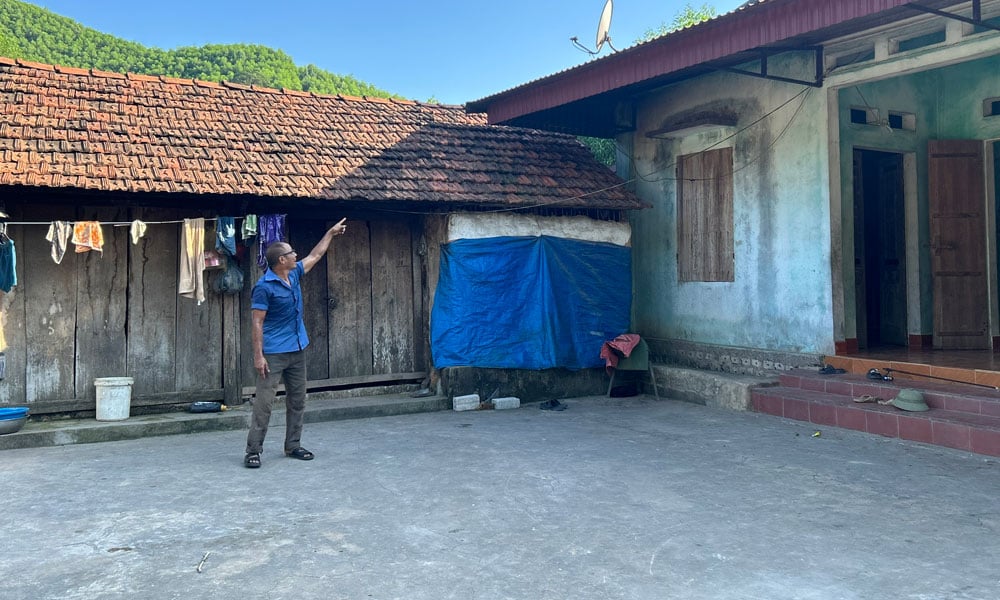 |
The family of Mr. Nguyen Van Huynh, in Dong An village, Xuan Luong commune, installed a satellite dish on their roof to receive telecommunication signals. |
As we traveled with commune officials from the Party Committee and People's Committee headquarters to villages such as Dong Cao, Khuon Dong, Con Trang, Goc Doi, Dong An, etc., our mobile phones constantly showed weak signal.
Mr. Nong Van Tam, an official at the Party Committee Office of the commune, said: “These are sparsely populated areas where people's lives are still very difficult. To maintain contact with these areas, I often have to change and switch between SIM cards from different network providers. However, there are many times when the signal is still intermittent, or even completely lost.”
Viewed from above, Khuon Dong village, with over 110 households, is nestled in a valley surrounded on all sides by mountains and hills. The majority of residents are ethnic minorities. The uneven terrain results in weak signal strength; residents who want to make calls or access the internet must move to more open areas or higher ground to get a connection.
In Dong An village, the quality of internet service is also not guaranteed. Mr. Nguyen Xuan Huynh shared that, in order to watch news programs from the central and provincial governments, his family had to install an additional satellite dish on the roof.
However, on rainy and windy days, the signal is still frequently interrupted. Not only in Xuan Luong commune, but also in several other communes such as Duong Huu, An Lac, Tuan Dao, etc., residents have reported unstable telecommunication networks, affecting their lives and production activities.
Bac Ninh province has 30 communes in ethnic minority and mountainous areas, accounting for over 30% of the total number of communes and wards; its natural area is approximately 2,737 km², equivalent to 58% of the province's total area. Of these, 19 communes are located in Zone III – a particularly difficult area. This is still considered the most difficult area in the province, and poverty reduction results are not yet sustainable. By the end of 2025, the poverty rate in these particularly difficult communes will be 4.7 times higher than the provincial average.
Increase telecommunications coverage
In recent years, the telecommunications infrastructure in mountainous areas has gradually improved, helping people access information, apply science and technology to production, and improve their living standards.
However, based on feedback from voters and the results of field surveys, by the end of May 2026, there were still more than 100 areas with poor signal coverage in the province. Most of these areas are located in remote, mountainous regions with complex terrain, sparse populations, and far from the commune centers. In the context of the ongoing digital transformation, unstable information connectivity limits people's access to digital services, e-commerce, and many other essential amenities.
| The Provincial Party Committee has issued Program No. 22-CT/TU dated March 28, 2026, on the development of ethnic minority and mountainous areas for the period 2026-2030, continuing to create strong momentum for all levels, sectors, localities, and businesses to overcome difficulties. The province will prioritize allocating budget resources for the development of essential infrastructure and improving the quality of public services in ethnic minority and mountainous areas. |
In response to this situation, the Department of Science and Technology, in coordination with telecommunications companies, conducted a review and assessment of the current coverage and service quality throughout the province. Based on this, they proposed remedial measures such as: increasing transmission power; adding more base stations; or implementing new technical solutions to expand coverage.
For example, Viettel Bac Ninh has reviewed and identified 58 areas with weak signal that need improvement. Based on on-site assessments and the development of technical plans, the unit has implemented 11 priority solutions for critical areas. In the last days of May, Viettel's technical staff urgently completed the telecommunications infrastructure in Linh Phu village, Tuan Dao commune.
To date, the system has been largely completed and is ready for broadcasting, serving the communication needs of more than 60 households in the area. For the remaining locations, the unit will continue to propose to the Military Telecommunications and Industry Group to allocate resources for deployment in the near future. The goal is to complete approximately 70% of the work for the 11 proposed plans before the end of 2026.
Bac Ninh province has issued numerous mechanisms and policies to remove obstacles for telecommunications businesses in the process of investing in infrastructure. In Directive No. 04/CT-UBND dated October 2, 2025, the Provincial People's Committee directed the development of shared telecommunications infrastructure, synchronized with other technical works, ensuring maximum efficiency in exploitation and saving investment costs.
Recently, the Provincial Party Committee issued Program No. 22-CT/TU dated March 28, 2026, on the development of ethnic minority and mountainous areas for the period 2026-2030, continuing to create strong momentum for all levels, sectors, localities, and businesses to overcome difficulties. Accordingly, priority will be given to allocating budget resources for the development of essential infrastructure and improving the quality of public services in ethnic minority and mountainous areas.
Comrade Duong Dai Lam, Deputy Director of the Department of Science and Technology, said: “From the beginning of the year, the Department issued a document requesting telecommunications businesses to coordinate with the People's Committees of communes to conduct on-site surveys in areas where there are complaints about weak signals or unsatisfactory service quality. Based on the survey results, businesses will clearly identify the causes, develop remediation plans, implementation schedules, and specific completion timelines.”
To date, Viettel and VNPT have reported their proposed solutions. The Department of Science and Technology continues to monitor, urge, and inspect the progress of eliminating signal blind spots by businesses, ensuring that solutions are implemented effectively and as committed. Along with the efforts of relevant agencies and businesses, localities are focusing on disseminating information to help people understand the benefits of developing telecommunications infrastructure, creating consensus in the process of installing antenna towers, technical equipment, and auxiliary facilities serving broadcasting.
Source: https://baobacninhtv.vn/bac-ninh-no-luc-xoa-diem-lom-song-vien-thong-postid446899.bbg





![[Photo] General Secretary and President To Lam and the President of the Philippines hold talks.](https://vphoto.vietnam.vn/thumb/1200x675/vietnam/resource/IMAGE/2026/06/01/1780286997787_anh-man-hinh-2026-06-01-luc-11-09-43.png)
























































































Comment (0)