

The province's coastal areas have favorable natural conditions, with abundant and diverse aquatic resources, large reserves, and a wide variety of species with high economic value. Over the past period, the province has implemented many programs and plans to maximize these advantages, moving closer to the goal of becoming a province with strong marine and island economic development in the Mekong Delta region as well as the whole country.
Affirming the position in exploitation and cultivation
In line with the spirit of the resolution, a series of specific tasks, solutions, programs, projects, and resources have been implemented and allocated to sustainably develop the province's marine economy. Currently, the marine fisheries sector makes a significant contribution to socio-economic development.
According to Mr. Chau Cong Bang, Deputy Director of the Department of Agriculture and Environment, for many years, fisheries have always held an important position in the fisheries sector. The average annual catch is over 230,000 tons, accounting for more than one-third of the total fisheries production. In particular, this industry also creates jobs for tens of thousands of workers inside and outside the province, as well as promoting the development of other related logistics services.
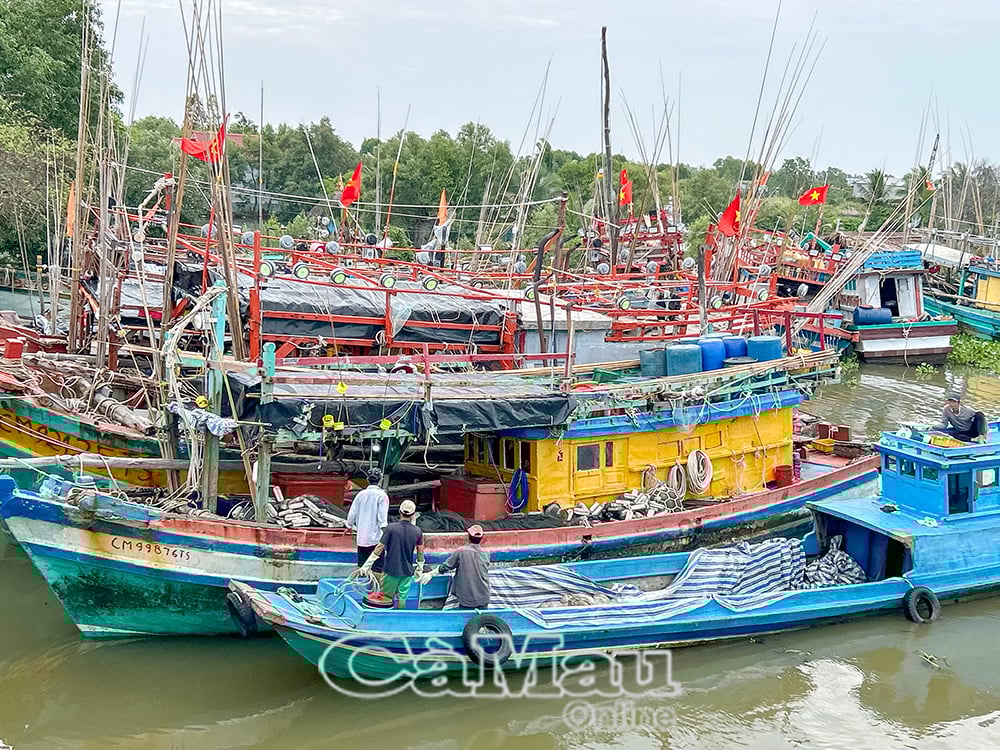
The fishing industry annually brings in approximately 230,000 tons of various seafood products, making a significant contribution to the socio-economic development of the province.
To facilitate economic development for the people, many fisheries infrastructure systems have been invested in and put into use. Currently, the province has 5 fishing ports, of which 2 have been designated by the Ministry of Agriculture and Environment as fishing ports with complete systems for verifying the origin of seafood from fishing. At the same time, with 4 mooring areas with a total capacity of nearly 1,400 fishing vessels, it basically meets the needs of fishing vessels to return to safe mooring and shelter during storms.
In Song Doc town (Tran Van Thoi district), the marine economy is one of the resources that has significantly contributed to building a bustling coastal urban area, with numerous factories and enterprises, especially processing, freezing, shipbuilding, and fisheries logistics service industries, having been invested in and built in the area. Furthermore, the potential and advantages of tourism here have been continuously exploited. Mr. Ho Song Toan, Vice Chairman of the District People's Committee, said that the district is continuing to plan and improve business, trading, and service activities to serve tourism. At the same time, it is building connections between tourist destinations in the district such as Da Bac Island, the Memorial Area of Folk Culture Artist Nguyen Long Phi (Uncle Ba Phi), Thi Tuong Lagoon; promoting the value of the Nghinh Ong Song Doc Festival, and the potential of marine and island tourism...
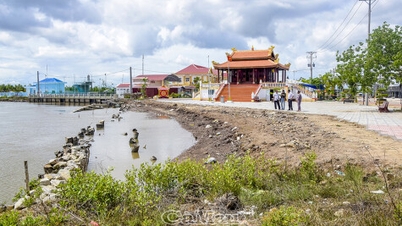
Currently, in Song Doc, the monument commemorating the 1954 Northward Relocation Journey has been completed. Combined with the Western sea dike, the Tac Thu - Vam Da Bac road, the Tac Thu - Song Doc road, the South bank road of Song Doc, the bridge over the Ong Doc river, etc., all these create a continuous network, providing favorable conditions for the development of tourism, ecotourism, coastal and island tourism, and goods transportation.
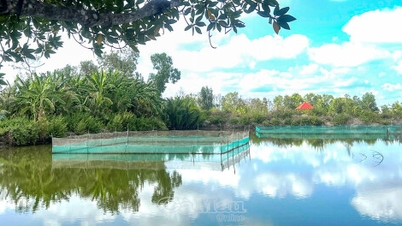
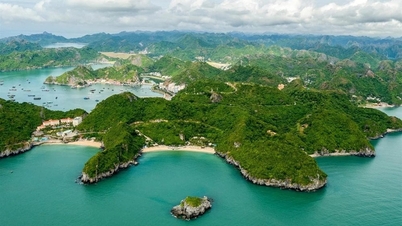
With a coastline stretching over 254 km and coastal land bordered by mangrove forests, forming a buffer zone between the sea and land, the province's coastal area has tidal flats suitable for cultivating mollusks. The island clusters of Hon Khoai, Hon Chuoi, and Hon Da Bac are suitable for developing marine aquaculture. In recent years, marine and coastal aquaculture has gradually received investment. Specifically, around Hon Chuoi Island, there are currently 33 households raising grouper with 75 rafts; the Dat Mui commune area has about 28 hectares of clam farming with a production of about 400 tons/year. In addition, there are about 1,150 oyster cages in rivers, canals, and along the coast, supplying the market with an annual output of 250-300 tons. Mr. Chau Cong Bang stated that the province is currently continuing to investigate marine species such as mollusks, marine fish, and brackish water fish living in the wild in coastal and island areas that are suitable for aquaculture. This aims to identify suitable species for cultivation, opening up more new aquaculture areas to help coastal fishermen develop their economy and protect aquatic resources sustainably.
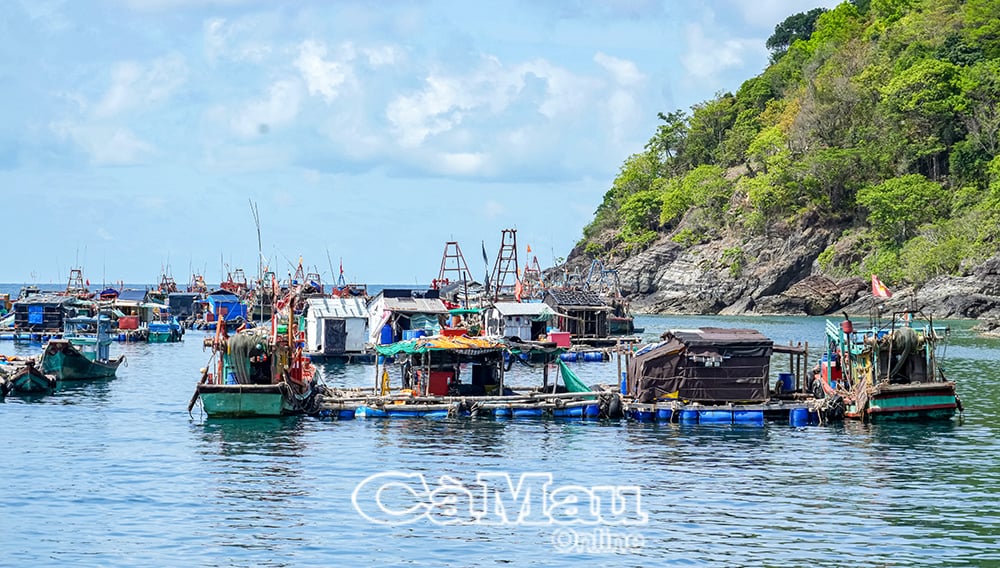
Cage fish farming is developing in the Hon Chuoi Island area.
Great potential for renewable energy
With its geographical location bordered by the sea on three sides, sea wind speeds of 6-6.7 meters per second, and approximately 2,000 hours of sunshine per year, the province has a significant advantage in exploiting renewable energy in coastal and offshore areas. Initially, this economic sector has yielded positive results and still holds considerable potential to attract investors from within and outside the province.
To date, 14 projects in the province have received investment approval, with a total capacity of 800 MW, of which 6 projects with a total capacity of 225 MW have commenced commercial operation. Regarding solar power, the province has 1,217 rooftop solar power installations with a total capacity of 111.564 MWp.
According to the plan for 2030, the province aims to attract investment in approximately 16,464 MW of electricity, with the projected power sources being solar and wind power. According to Mr. Nguyen Duc Thanh, Director of the Department of Finance, the province is currently developing a project to export electricity from its offshore waters, with plans to export to neighboring countries such as Singapore, Brunei, and Thailand.
Furthermore, the provincial planning also includes potential areas for nearshore and offshore grid-connected wind power development. Specifically, nearshore wind power with a total capacity of 3,562 MW is located in the districts of Dam Doi, Ngoc Hien, Nam Can, Tran Van Thoi, Phu Tan, and U Minh. Offshore wind power with a total capacity of 5,100 MW is located in the districts of Ngoc Hien, Dam Doi, and Tran Van Thoi. The abundant offshore wind power resources can be used for export to regional countries, bringing significant economic benefits to the province.
Despite its great potential, becoming a province with a strong marine and island economy in the region still faces many difficulties and challenges that need to be overcome. In particular, the impacts of climate change, the complex situation of coastal and riverbank erosion, and the consequences of overexploitation by humans, as well as environmental pollution, are significant challenges.
According to the Master Plan for the Development of Vietnam's Seaport System for the period 2021-2023, with a vision to 2050, Ca Mau province has Hon Khoai port, Nam Can port, and Song Doc port. These are considered key areas for creating breakthroughs in socio-economic development, as well as strongly promoting the development of the province's marine economy in particular and the Mekong Delta region in general.
Nguyen Phu
Source: https://baocamau.vn/manh-giau-tu-bien-a39638.html






































































Comment (0)