Meta recently announced that users would no longer be able to access the immersive worlds in Horizon Worlds via virtual reality (VR) headsets starting June 15th. The following day, the company partially retracted this announcement, stating that it would still support some existing VR applications but would not add any new ones. This was the final blow to the metaverse vision that Mark Zuckerberg had bet on in 2021.
Previously, Meta had laid off 10% of its metaverse development staff. Horizon Worlds, the flagship app where users interact via avatars in a virtual space, also shifted its focus away from virtual reality.
In total, the social media giant has poured approximately $80 billion into this project through its Reality Labs division. Metaverse and VR remain niche hobbies, never becoming mainstream. Roblox and Fortnite attract a wider audience without the need for headsets or grand pronouncements.
The trend started.
This journey began in 2014 when Zuckerberg spent $2 billion to acquire Oculus, a startup that manufactured VR headsets. He believed that this technology would eventually surpass smartphones to become the next generation of computing devices. Billions of dollars were poured into acquiring game studios, building a developer ecosystem, and manufacturing wearable devices.
At one point, Meta sold VR headsets at a loss. In 2019, Zuckerberg admitted to investors that VR "needed more time" than expected to recoup its investment.
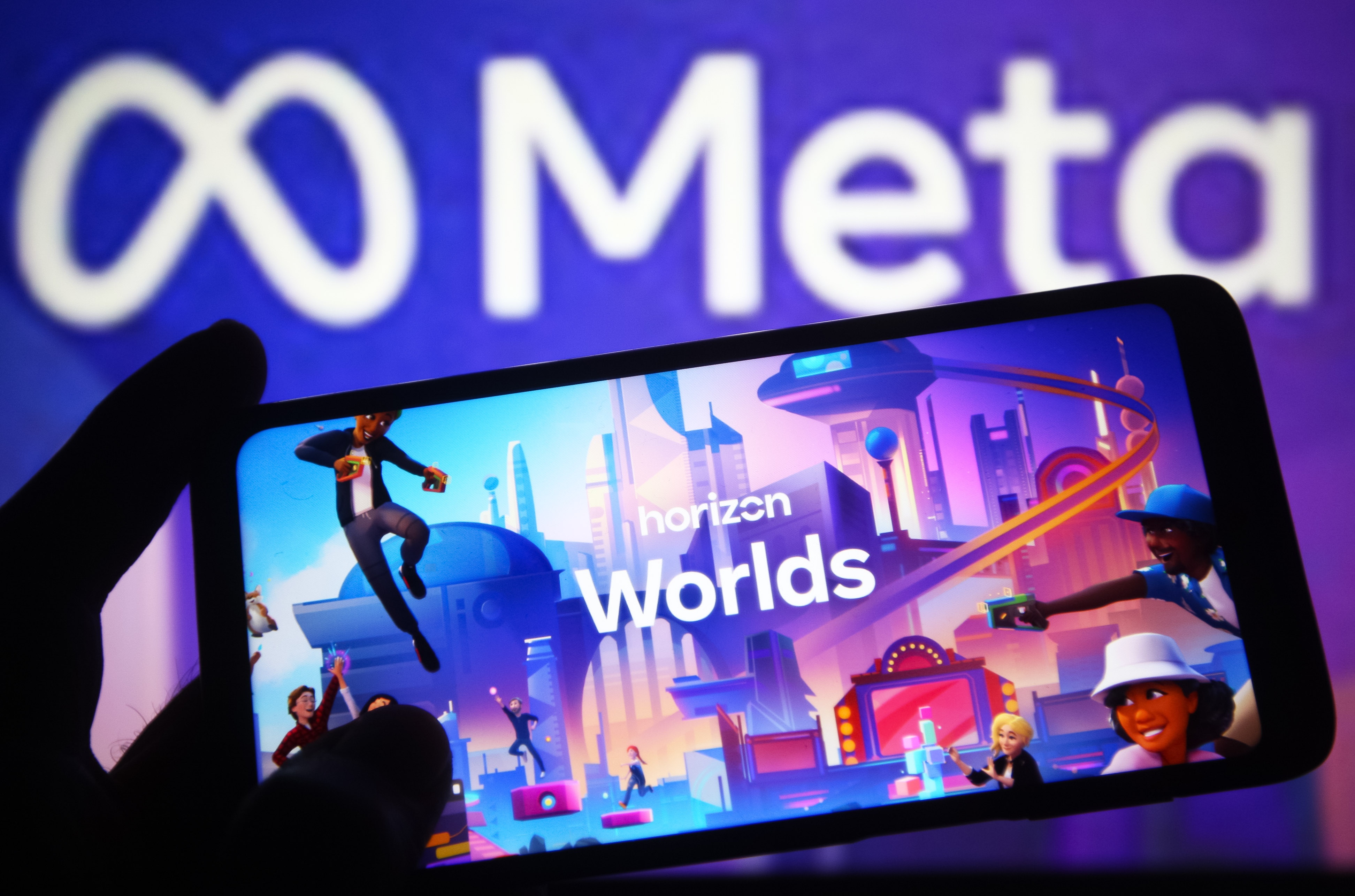 |
Meta started the trend of building metaverses five years ago. Photo: SOPA . |
The Covid-19 pandemic seemed like a golden opportunity for Meta. With the whole world working remotely, the idea of meeting in virtual avatars suddenly became logical. By 2021, the Meta team was convinced the time had come. In October 2021, Zuckerberg renamed Facebook to Meta and envisioned a future era combining virtual reality and augmented reality.
"Instantaneous movement in the virtual world will be like clicking a link on the internet. Eliminating daily commutes will save time in traffic jams. And that's good for the environment too," Zuckerberg said.
The market immediately followed the metaverse trend. Disney, Crate & Barrel, and a host of other large corporations quickly appointed "metaverse directors." A 2022 McKinsey report estimated that the metaverse could generate $5 trillion in value by 2030, and predicted that 15% of corporate revenue would come from the metaverse by 2027.
Rapid failure

However, the reality is that this field has many problems. The first version of Horizon Worlds was full of bugs. The player avatars were crude and flawed, as for a long time they were just floating torsos without legs, causing the platform to be widely ridiculed on social media.
VR games like Supernatural or Beat Saber haven't made a breakthrough enough to attract a mass audience.
 |
Metaverse was not well-received by users. Photo: Endgadget . |
"Essentially, they're ending that whole experiment because they've realized that trying to turn VR into a standalone platform would take years and involve significantly more hardware costs," said Eric Seufert, an independent mobile analyst.
Wagner James Au, author of the book Making a Metaverse That Matters, frankly observes that Meta clings to terminology without truly understanding the concept. The social media giant's efforts in metaverse strategy seem to be constantly making mistakes without learning from them.
Meta isn't the only case of failure with VR. Apple launched the Vision Pro in 2024 for $3,500 , equivalent to a monthly mortgage payment in San Francisco. That price tag made the product inaccessible to most mainstream consumers.
Shifting towards AI
Last year, Zuckerberg outlined a new future with "superintelligence," a form of AI that could become a companion for every user. Meta plans to spend at least $115 billion this year, largely on AI and data center construction.
 |
Meta is shifting its focus to the field of AI. Photo: Bloomberg . |
Despite focusing heavily on AI, the company maintains a degree of faith in the metaverse. Horizon Worlds remains available on mobile devices, and its augmented reality headsets with integrated cameras and AI assistants are performing well. A company spokesperson cited a February blog post asserting that Meta "remains the biggest investor in the VR industry with a robust roadmap for future augmented reality wearables."
"Sometimes we achieve resounding success. Other times, we make mistakes. And when that happens, we analyze the data, take feedback into account, decisively adjust our strategy, and keep building," Samantha Ryan, Vice President of Content at Reality Labs, wrote in a recent post.
Meta's story and the metaverse became the most expensive lesson in tech history about the gap between a leader's vision and what users actually want. After five years and over $80 billion in investment, CEO Zuckerberg quietly withdrew from the field.
Source: https://znews.vn/meta-tu-bo-tham-vong-ty-usd-post1636804.html

![[Photo] General Secretary and President To Lam receives Palestinian Ambassador Saadi Salama](https://vphoto.vietnam.vn/thumb/1200x675/vietnam/resource/IMAGE/2026/06/25/1782365384740_a1-bnd-9423-8322-jpg.webp)
![[Image] Schools organize meetings and introduce teaching models to students admitted to grade 10.](https://vphoto.vietnam.vn/thumb/1200x675/vietnam/resource/IMAGE/2026/06/25/1782368077271_ndo_br_z7970052192242-1ec8daeb77a6eed1a4e9f58c564ddd3e-jpg.webp)

![[Image] Ho Chi Minh City: Ma Lang area, Chicken-Rice Market about to change its appearance](https://vphoto.vietnam.vn/thumb/1200x675/vietnam/resource/IMAGE/2026/06/25/1782377698627_ndo_br_m1-jpg.webp)