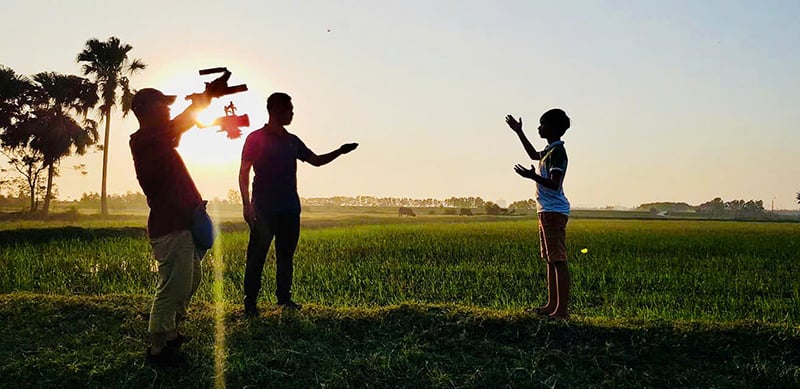
Each type of journalism has its own unique characteristics, requiring journalists to possess different professional skills. However, all aim for the common goal of providing information to readers, shaping public opinion, and offering readers a comprehensive and accurate perspective. To effectively fulfill its role as a "guiding light," Article 3 of the Code of Ethics for Journalists requires journalists to "practice their profession honestly, objectively, and respect the truth. Protect justice and righteousness. Do not distort, misrepresent, or conceal the truth..." This demands that journalists use their heart, intellect, and courage to create their work, whether it's a short news item or a feature story, a hot topic or a long-standing issue, or a local or national problem.
In every era, new challenges arise in journalism, and this period is no exception. The generation of journalists "on the front lines" during the period of accelerated industrialization and modernization of the country today is not only numerous and capable of traveling and writing, but also increasingly professional, possessing the sensitivity to confront and grasp reality, and the knowledge to concretize that reality on every page. It is this seriousness in approach, dedication to the profession, and sharpness in expression that has increasingly affirmed the role and position of journalism in the development of the country.
Along with the profound and comprehensive changes in the country, journalistic activities in general, and the work of journalists in particular, have also undergone many changes. In the context of journalism facing many new challenges, the issue of professional ethics for journalists is increasingly emphasized and valued. Society entrusts journalists with a great and honorable responsibility, but at the same time demands that they possess integrity, ethics, and professional conscience. Besides journalists who are dedicated, talented, and have a strong fighting spirit, the reality of journalistic activity over the years also shows that a decline in journalistic ethics is emerging among a segment of reporters and journalists; the situation of abusing the title of journalist to intimidate and harass for personal gain has not been thoroughly prevented and dealt with; and not a few journalists have "bent" their pens, succumbing to the temptations of everyday materialism. A moment of haste in publishing unverified information; A moment of yielding to the power of material temptation or a fleeting calculation of personal gain... can both lead to serious consequences, damaging one's image and ruining their professional reputation.
Therefore, "sharp eyes" are considered the first criterion in a journalist's professional work. This criterion requires journalists to have intelligence, political insight, and keen observation skills, enabling them to quickly identify issues and dedicate themselves to the profession. From there, they can fully and accurately reflect events, avoiding one-sided perspectives, ensuring the mission of journalism is to guide and shape public opinion. However, not every issue can be reported in the press, and not every truth can be fully exposed. This requires journalists to know how to choose their perspective and presentation style so that their articles do not go against the interests of the people and the nation. The late journalist Huu Tho, a towering figure in Vietnam's revolutionary journalism, once wrote: "A good article, a beautiful photograph, is not only about meticulous description, careful selection of sunlight and clouds, but also about what it conveys in the depth of thought of the professional, and how that moves hearts and persuades people." That "depth of thought" that the late journalist Huu Tho spoke of is what makes a journalist's "eyes sharp."
Every profession has its own ethical standards. The professional ethics of a journalist are conscience and responsibility in every activity. It is the "untainted heart," not viewing journalism as a means of getting rich, and not using the journalist's card as a tool to make money that constitutes the "pure heart" of a writer. Some say that "cultivating talent is difficult, but maintaining an untainted heart, always pure, honest, and straightforward, is even more difficult. Especially in a market economy, money and false fame are very tempting." To prevent the power of journalism from being abused and tainted, journalists must define their professional stance. Journalists must stand above all public opinion, fully reflecting the essence of events, not for the benefit of a group or personal gain. If a journalist "criticizes someone but with a sincere and compassionate heart," then the person being criticized will understand and reflect on their actions, unlike "some journalists who seek out negativity to perpetuate negativity."
A keen eye, a pure heart, and a sharp pen. A "sharp pen" represents each journalist's ability to create compelling journalistic works. A sharp pen is essential for a journalistic piece to be engaging and attract readers' attention. The power of an article lies in each word, impacting the public, changing lives, and altering society in either a positive or negative way. A "sharp pen" is a powerful weapon for journalists to fight against wrongdoing, combat evil, and spread positive values in society.
Vietnamese journalists deeply understand President Ho Chi Minh's words: "Journalism is a battlefront, and journalists are soldiers on that battlefront. The pen and paper are their weapons." Throughout its 100-year history, we are proud to have a revolutionary press built by honest, responsible, and dedicated professionals. They silently and tirelessly dedicate themselves to their profession, for the country, for the people, for justice, contributing to building a press that is human-centered and respects human beings.
The Fourth Industrial Revolution and the strong trend of integration have created a breakthrough in the development of communication technology, and consequently, the way journalism is practiced is changing rapidly. This development is creating both opportunities and challenges for media organizations and individual journalists. Faced with the multitude of information streams on social media, journalists must always be vigilant and discerning in accessing, exploiting, and evaluating sources and using information. They must resolutely fight against and eliminate harmful, distorted, reactionary, and subversive information against the Party and the State, contributing to maintaining political and social stability and creating a favorable environment for national development.
The social standing of journalism and its responsibility as a soldier on the ideological and cultural front in the current context demands that every journalist constantly cultivate their character and intellect, always maintaining integrity and honesty, and upholding justice and righteousness. "Sharp eyes, pure heart, incisive pen" is the ethics, conscience, and responsibility that every true journalist must "engrave in their heart" for the sake of a clean and strong press.
To Phuong
Source: https://baothanhhoa.vn/mat-sang-nbsp-long-trong-but-sac-252397.htm





























































































Comment (0)