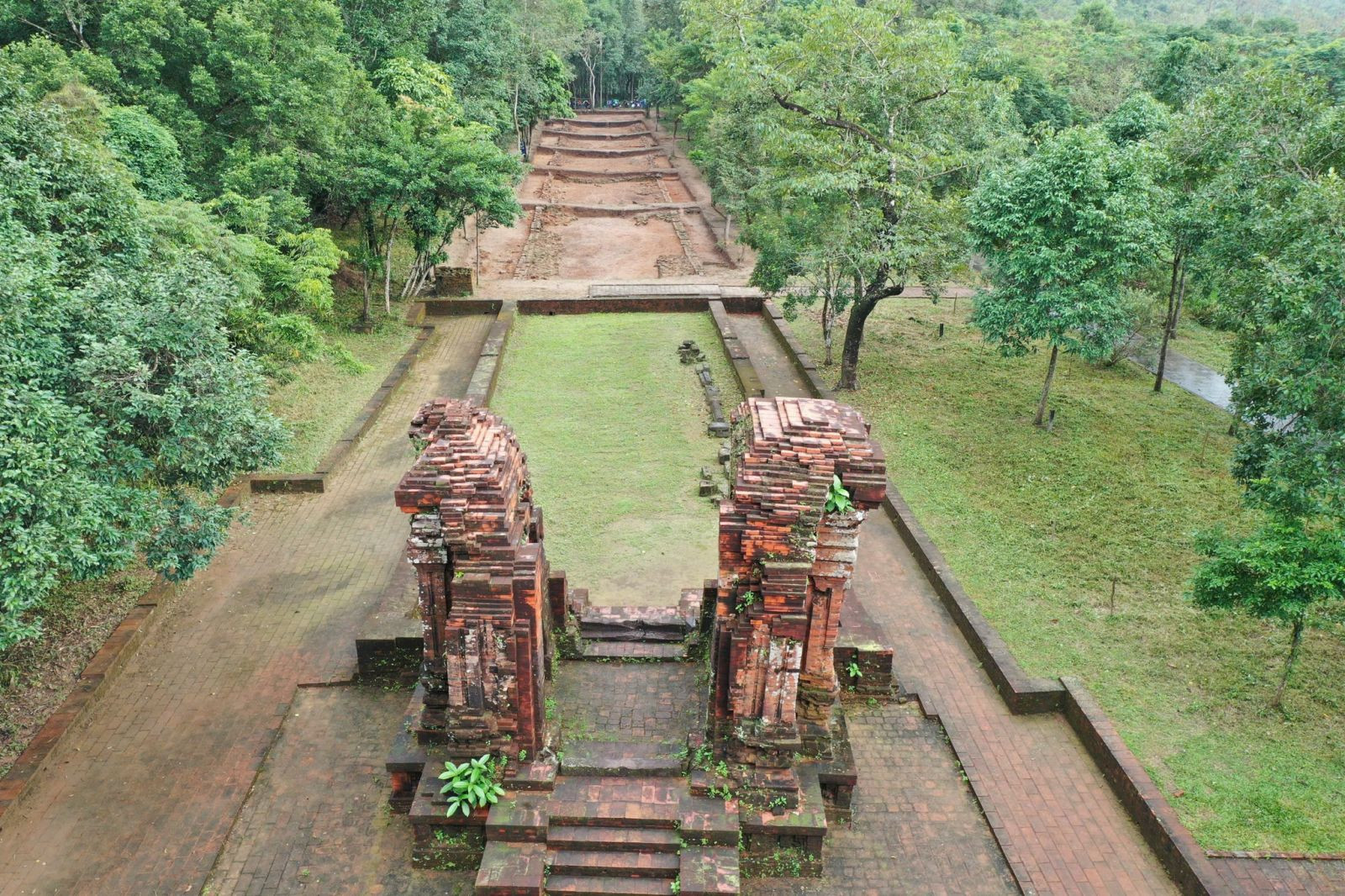
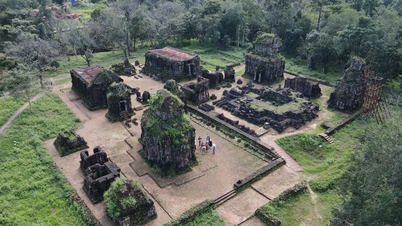
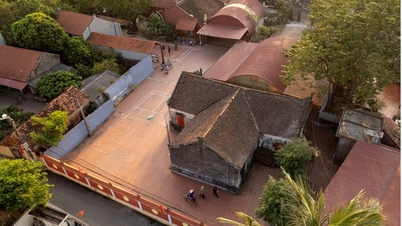
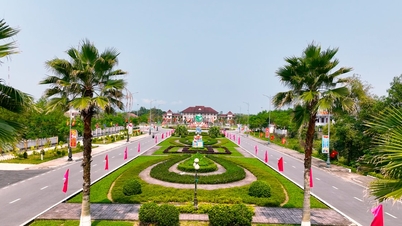
Panoramic view of Tower K and the access road from a drone perspective. Photo: Provided by the Institute of Archaeology.
This resulted in the entire site remaining, until recently, a chaotic, unplanned architectural complex, with no clear distinction between primary and secondary structures. My Son appeared as a collection of towers without any structure, a jumbled mess like a cemetery with tomb towers built quite haphazardly, according to each era and each king—they built wherever was convenient, and wherever there was an empty space, they constructed a tower or tomb to worship their patron deity.
Spanning nearly a thousand years from the 4th century AD, the dynasties of the Champa kingdom continuously built and added new towers. Without a common plan, which was a forte of Champa architects, we would never have understood what My Son was.
Therefore, the discovery of the entrance to the entire temple complex was an extremely important finding , helping researchers, after nearly 50 years of studying My Son, to initially visualize the layout and planning of this temple complex.
The gate tower has been discovered.
With funding from the Indian government , restoration experts from the Archaeological Survey of India (ASI) have been restoring tower complexes E and F, along with towers A, H, and K, since 2017. In tower complexes E and F, everything proceeded normally; the Indian experts primarily employed methods of reinforcing and preserving the original elements to ensure authenticity.
But the K tower was different. Initially, experts found it unusual; even the French, 100 years ago when it still had its roof and the two opposing entrances were still recognizable, didn't realize it was actually a gateway! Yes, a very large gateway, like the Arc de Triomphe in Paris or Patuxai in Vientiane!
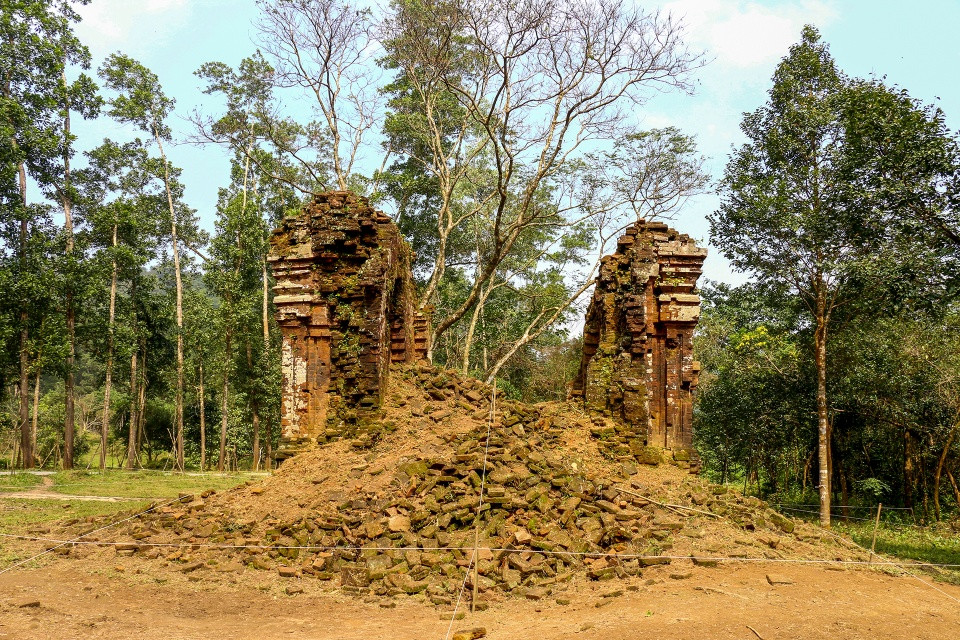
Tower K before restoration. Photo: Provided by the Institute of Archaeology.
Indian experts, with their experience in the architecture of ancient Hindu monuments, immediately understood they had stumbled upon a major discovery. They expanded their excavation towards the entrance and, without much effort, a 9-meter-wide road appeared, flanked by walls one meter high and over half a meter wide. From the gate tower to the surrounding walls, everything created a majestic, solid, and beautiful structure, reminiscent of the Arc de Triomphe on the day Napoleon returned victorious.
But this beauty is not the ostentatious beauty of victory, but the beauty of order and concept. This path is not opened to display power, but to lead people into a sacred space, where every step must slow, every sound must be lowered, and every worldly thought must be left behind.
A nine-meter-wide path is not merely for processions to enter the realm of the gods; it is truly a transitional space. From the outside world —forests, rivers, streams, and mundane life—to another world, where the gods reside. The two low but thick walls are not meant to obstruct, but to guide. They tell those who walk: from here, you are entering a sacred axis, a space that has been carefully chosen, measured, and arranged.
Archaeologists get involved.
Recognizing this as a significant discovery, the My Son World Cultural Heritage Management Board, together with the Institute of Archaeology (Vietnam Academy of Social Sciences), launched an excavation campaign lasting from June to December 2025. This excavation focused on the area between Tower K and the central group of towers at My Son.
The investigation revealed two sections of the road's perimeter wall extending eastward from Tower K towards Towers E and F, measuring 132 meters in length. The collected evidence confirmed the existence of a previously unknown access road to the My Son Sanctuary. This road is distinctly different from the current design intended for tourists.
Due to budget constraints and the onset of the rainy season, the excavation was halted in mid-December 2025. It was initially thought that the path extended more than 300 meters to reach the E and F towers, but the excavation pits indicated that the path stopped at Khe The. Beyond Khe The, the path may have been completely destroyed, or it could have led to a different space or structure.
Architect Le Tri Cong, while studying the layout of the temples and towers at My Son, noticed that the main tower clusters such as A, B, C, D, E, F, and G all had their main entrances facing each other. He hypothesized about a ceremonial path (Parikrama) hidden deep underground. According to architect Le Tri Cong, the archaeological discoveries are only a small part of the entire Parikrama ceremonial path at My Son. It's not a straight path, but a curved one, quite similar in shape to the Hindu cave system of Ellora.

The ceremonial route as envisioned by architect Le Tri Cong. Photo: Provided by the Institute of Archaeology.
When Tower K is correctly identified as a gateway tower, the entire temple complex begins to rearrange itself in our imagination. There is a beginning and an end. There is outside and inside. There is secondary and primary. There is the mundane and the sacred.
When the road emerged from beneath the alluvial soil, it marked the return of a part of Champa's planning philosophy. From then on, My Son was no longer a cemetery of tombs as we once mistakenly believed, but a temple complex with a clear spatial plan.
All the time is ripe for us to hope that archaeologists will restore the splendor, first and foremost the beautiful layout, of the My Son temples and towers in the excavations of the coming years. It is truly exciting and eagerly awaited for those who care about this sacred site.
Source: https://baodanang.vn/bo-cuc-my-son-da-dan-hien-ra-3324167.html






![[Photo] General Secretary and President To Lam receives Amazon's Senior Vice President David Zapolsky](https://vphoto.vietnam.vn/thumb/1200x675/vietnam/resource/IMAGE/2026/05/22/1779466547770_a1-bnd-3513-6601-jpg.webp)

















































Comment (0)