During daily garment care, irons often become covered in burnt-on residue. This occurs when the temperature of the metal soleplate exceeds the heat resistance limit of synthetic fibers such as polyester, nylon, foam, or stiffeners on the fabric surface. Under the influence of high heat, these fibers melt, then carbonize and adhere tightly to the metal surface, forming a hard, black, sticky film.
Many users instinctively unplug the iron and use a razor or steel wool scouring pad to scrape off the residue. However, this is a serious technical mistake. Most modern irons are coated with a very thin non-stick layer. Using external force from a hard object will permanently scratch and peel off this protective layer, causing the iron to lose its smooth gliding ability, distribute heat poorly, and easily burn heavier clothing in subsequent uses.
Tips for cleaning a burnt-out, blackened iron.
Instead of using mechanical force, applying basic biochemical and physical reactions with readily available materials at home will help you solve this problem completely.
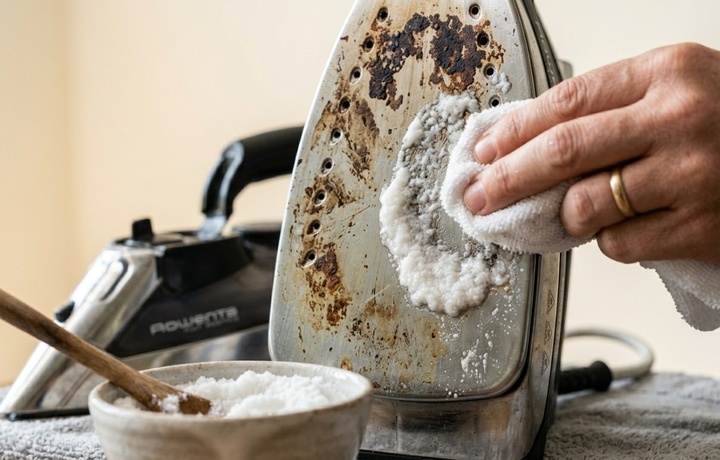
Cleaning your iron with a combination of baking soda and white vinegar is completely safe for the user. (Image: QQ)
Paracetamol
It may sound illogical, but the pain reliever and fever reducer Paracetamol (Acetaminophen) is actually the most effective and quickest biological solvent for removing burn marks from irons, highly praised by experts. When in contact with a hot metal surface, the Paracetamol tablet doesn't burn but melts into a liquid with solvent properties. This liquid immediately reacts with the burn mark on the clothing, loosening the adhesive bonds between the burn mark and the non-stick coating.
How to do it:
- Plug in the iron and turn it on to the highest temperature setting.
- Use medical tweezers to firmly grasp the paracetamol tablet; absolutely do not use your bare hands to avoid burns.
- Rub the tablet directly onto the black plaque. You will see that as the tablet melts, the black plaque will liquefy and slide off.
- Using a slightly damp, thick cotton cloth, carefully wipe away the dissolved solution. Repeat until the surface is completely shiny.
Use baking soda and white vinegar.



For stubborn, hardened burn marks, a cold cleaning method using a combination of baking soda and white vinegar is completely safe. When baking soda mixes with the acetic acid in vinegar, they create a reaction that releases effervescent CO2 gas. Millions of these bubbles penetrate the crevices of the burn mark, breaking down the chemical structure of the residue. At the same time, the fine powder structure of baking soda acts as a micro-abrasive, scrubbing away the dirt without being hard enough to scratch the metal surface.
How to do it:
- Unplug the iron, ensuring it has completely cooled down.
- Mix baking soda with a little water or white vinegar in a 2:1 ratio to form a paste.
- Apply this mixture to the charred areas and let it sit for about 10 to 15 minutes.
- Using a damp microfiber cloth, gently rub in a circular motion to loosen the buildup, then wipe the surface clean.
Use coarse salt and wax paper.
If you don't have those chemicals, the principle of physical friction combined with thermal energy from granular salt is also a smart option for cleaning burnt-on, blackened irons.
When a hot iron glides over a salt surface, the heat softens the buildup. At this point, the coarse, uniquely shaped salt crystals act like tiny serrated teeth, gripping the molten adhesive and pulling it away from the iron's soleplate. Importantly, the salt particles are softer than metal, so they don't cause scratches.
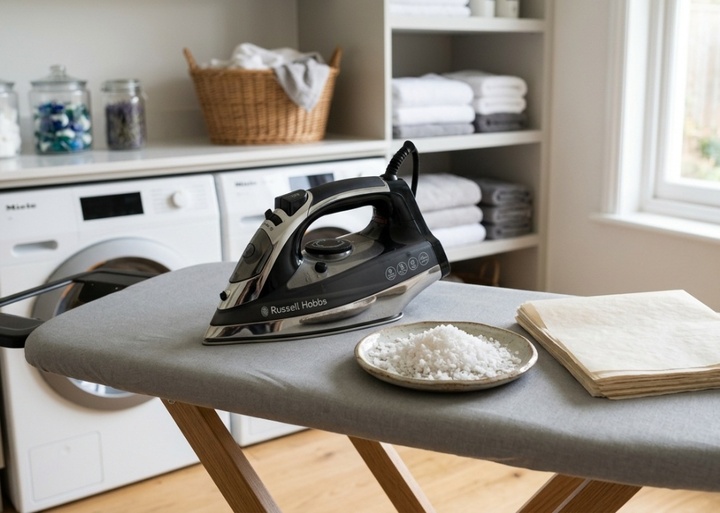
Coarse salt and wax paper are also readily available items that can help clean an iron. Photo: WH
How to do it:
- Lay a sheet of wax paper (baking parchment paper) or newspaper on the ironing surface.
- Sprinkle a layer of coarse salt (large-grained sea salt) onto the paper.
- Turn the iron to the highest heat setting and completely turn off the steam function.



- Move the iron back and forth over the salt in a circular motion with light pressure. The stains will gradually loosen and stick to the salt granules.
Notes on cleaning a burnt or blackened iron.
Cleaning the surface is only a temporary fix. To maintain optimal performance and prevent burn marks from recurring, you need to follow these operating principles after cleaning a burnt or blackened iron:
- During cleaning with baking soda or toothpaste, these materials can easily get into the steam vents. Use a cotton swab dipped in a little vinegar to clean the vents. If the vents are clogged, the pressure inside the compressor will increase, causing water leaks or spraying out dirt that stains white clothes.
- 90% of iron burnouts are caused by selecting the wrong heat setting. Make it a habit to sort your clothes before ironing. Start by ironing thin, heat-sensitive fabrics (silk, chiffon, synthetics) at the lowest heat setting, then gradually increase the temperature for thicker materials.
- After each ironing session, while the iron is still slightly warm after being unplugged, gently wipe the soleplate with a damp cloth. This step, which takes less than 10 seconds, will remove any tiny lint that hasn't yet carbonized, keeping the soleplate smooth.
Source: https://vtcnews.vn/meo-lam-sach-ban-ui-bi-chay-bam-den-ar1021937.html
![[Image] National conference summarizing one year of operation of the overall organizational model of the political system, the three-tiered government model.](https://vphoto.vietnam.vn/thumb/1200x675/vietnam/resource/IMAGE/2026/07/01/1782882811691_ndo_br_1-jpg.webp)