

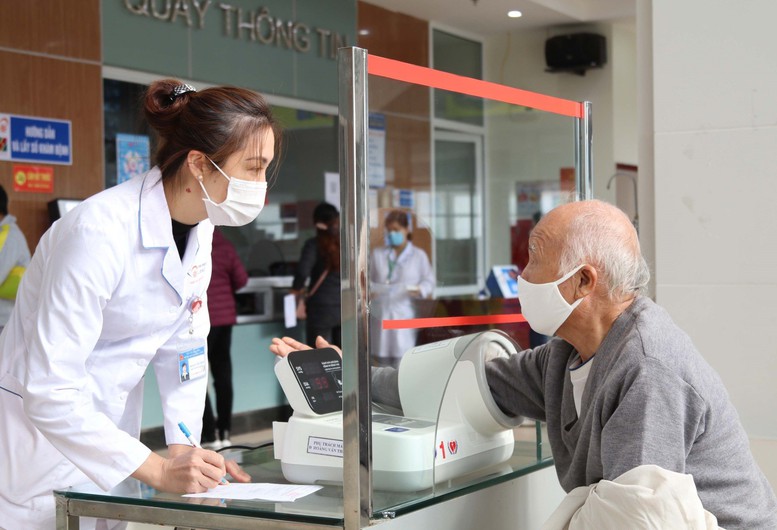
When routine check-ups are free, it will gradually become a habit, people will detect diseases early, receive treatment early, and reduce the financial burden later on.
If this is a roadmap, it is certainly a roadmap for the people. With very specific timelines, there is enough time to implement it, but it is also close enough for the people to see and evaluate the results.
From the General Secretary 's thought-provoking question at the meeting of the Party's 14th Congress Document Subcommittee to the issuance of Resolution 72, six months elapsed. This was a sufficient period for reflection, discussion, and maturation for a process that was by no means easy.
You may already know this.
Hospital fees account for a significant portion of healthcare spending in Vietnam.
Furthermore, although the proportion of out-of-pocket household spending in total healthcare expenditure has decreased from approximately 60–70% in the early 2000s to around 41–46% in the 2016–2022 period (source: WHO/WB), it remains a significant burden for many people, especially the poor and those with serious or chronic illnesses.
Only by looking at it from the perspective of empathy for the burdens faced by the people can we truly understand the significance of the policy of waiving/reducing hospital fees.
Because it truly represents a major turning point in Vietnam's social security system, where people genuinely benefit from development and feel a sense of shared responsibility from the State.
Setting the timelines for 2026 and 2030 shows that this is a calculated vision, with step-by-step implementation based on budgetary resources, health insurance funds, and administrative reforms; thereby instilling confidence in the people: "The idea of free hospital services is no longer just talk, but a resolution."
At the conference on September 16th to disseminate and implement four new resolutions of the Politburo , Deputy Prime Minister Le Thanh Long stated: "The Government has balanced the budget for major policies." 4,335 billion VND per year, to increase support to 70% or 100% for grassroots medical staff, preventive medicine, and those in disadvantaged areas. This is the "foundation" for the policy of free hospital care to extend beyond central hospitals, reaching down to the commune and village levels. Commune health stations – the first and closest point of contact with the people – will be the first "gateway" to the policy. This is the crucial step to ensure that free hospital care truly reaches the people, not just the central level.
That's 30 trillion VND for routine health checkups for 100 million people (minus 4.8 trillion VND paid by employers). The policy of waiving basic hospital fees under health insurance alone could add an extra 21.5 trillion VND to the budget annually, but with the current health insurance fund having a surplus of 49 trillion–50 trillion VND and a fee adjustment roadmap, the State is capable of balancing the budget in the initial phase and has long-term solutions in place.
From an economic and social perspective, Resolution 72 goes beyond simply providing free annual health checkups or reducing basic hospital fees; it also creates a "ripple effect." When regular checkups are free, it will gradually become a habit, leading people to detect diseases early, receive treatment early, and reduce the financial burden later on. For example, a cancer case, if detected early, will have treatment costs 5-7 times lower than if detected late, and early treatment is also more effective.
The budget of 30 trillion VND per year for routine health checkups for 100 million people is therefore not an "expense," but an "investment" in the future.
The idea of waiving hospital fees – even at the basic level – is neither easy nor cheap. As the Deputy Prime Minister said, this is a policy that needs to be implemented cautiously.
But with the support of the people and the determination of the Government, nothing is too difficult to achieve. Moreover, in the realm of people's health – there is no distinction between expensive and cheap. Because the Party and the State have determined that people are the center, the subject, the goal, the driving force, and the resource for development.
The rapid transition from idea (March 16) to resolution (September 9), coupled with specific budget figures, has given this policy substantial weight, building strong public confidence. After all, trust doesn't just come from promises, but from concrete plans, with funding, milestones, and solutions.
On social media – under every status update containing keywords like "free hospital fees" or "Resolution 72" – there are countless heart icons and expressions of agreement and approval. This is how people express their feelings and attitudes towards what the Party, State, and Government are doing for the people and by the people.
Dao Tuan
Source: https://baochinhphu.vn/mien-vien-phi-lo-trinh-vi-dan-1022509162313532.htm
![[Photo] Prime Minister Pham Minh Chinh receives the Chinese Ambassador to Vietnam](https://vphoto.vietnam.vn/thumb/1200x675/vietnam/resource/IMAGE/2026/04/05/1775397481797_ndo_br_dsc-5512-jpg.webp)






























































Comment (0)