Kim Ngan commune currently has 24 villages with 2,469 households and 9,717 inhabitants; of which over 65% are ethnic minorities. After the merger, the commune's natural area has expanded to nearly 90,000 hectares; of which, forested area accounts for more than 80,000 hectares (including: over 60,500 hectares of natural forest; nearly 21,000 hectares of planted forest), with a forest cover rate of 86.62%.
As a locality with a large total forest area in the province, for many years, forestry has been the main driving force helping Kim Ngan commune develop socio-economic aspects, reduce poverty, create jobs, and improve the ecological environment. Besides the positive achievements, forestry in Kim Ngan still faces some limitations and potential risks such as illegal logging, destruction of natural forests, encroachment on forest land for illegal reforestation, hunting and trapping wild animals, and illegal transportation of forest products.
 |
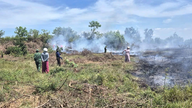
| Kim Ngan commune, in coordination with other units, is implementing a plan to allocate forest land to local communities - Photo: VL |
According to Nguyen Van Hung, Vice Chairman of the People's Committee of Kim Ngan commune, the development of a plan for forest allocation and leasing is a necessary requirement to concretize the Party and State's guidelines and policies on forest management, protection and development, and to implement the provisions of the 2017 Forestry Law and its guiding documents.


Through forest allocation and leasing, the State clearly establishes the entities responsible for managing and utilizing forests, linking the rights and responsibilities of organizations and communities in the management, protection, and sustainable use of forests. This also serves as a basis for mobilizing social resources to invest in forestry, improving the efficiency of forest land use, creating livelihoods, increasing income for people living near forests, contributing to poverty reduction, socio-economic development, and ensuring national defense and security.
According to the plan, the target recipients of forest land in Kim Ngan commune in 2026 are the communities of 10 villages, including: An Bai, Ha Lec, Bang, Ho-Rum, Trung Doan, Mit-Cat, Tan Ly, Tang Ky, Moi, and Bach Dan. The forest areas to be handed over in this phase are all natural forests currently managed and protected by the Kim Ngan Commune People's Committee.
Through a review of records and current management status, the forest areas slated for allocation, currently managed by the Commune People's Committee, have clearly defined boundaries and no disputes or overlaps with other organizations, households, individuals, or forest owners. To be allocated forest land, local communities must meet certain procedures, such as: having a need and submitting an application for forest allocation; having a community forest management regulation; and possessing the capacity to organize, manage, and protect the forest. In principle, the relevant authorities will carry out forest allocation in conjunction with land allocation; ensuring transparency, democracy, and community participation; guaranteeing no overlaps or disputes; and conforming to land use and forestry planning.
It is expected that the funding for the forest allocation project for these 10 villages will be provided by the Vietnam Nature Conservation Center and Vietnam Nature Conservation Company Limited (without using the State budget) according to the signed cooperation agreement. Upon successful implementation, the Kim Ngan Commune People's Committee will replicate this model in all remaining villages…
According to Nguyen Van Hung, Vice Chairman of the People's Committee of Kim Ngan commune: To ensure the effective handover of forests to local communities in the 10 villages of the commune, the surveying and assessment of forest reserves will be carried out clearly and accurately. During the forest handover process, the locality will strengthen coordination with specialized units and agencies to promptly resolve difficulties and obstacles, ensuring the participation and supervision of the local community throughout the implementation process; linking management responsibilities with benefits to enhance awareness and capacity for sustainable forest management...



Vinh Long
Source: https://baoquangtri.vn/xa-hoi/202606/mo-huong-giam-ngheo-ben-vung-4be57b3/



























![[Photo] Thousands of people participate in a run to show their support for the campaign "Sharing a common determination to build drug-free communes, wards, and special zones".](https://vphoto.vietnam.vn/thumb/1200x675/vietnam/resource/IMAGE/2026/06/27/1782554475933_0673e2a3df7b5e25076a-8283-jpg.webp)