


Beyond simply streamlining educational pathways, this document aims to build a flexible, learner-centered education system that is closely aligned with the practical needs of the labor market.
Empowering students to take initiative.
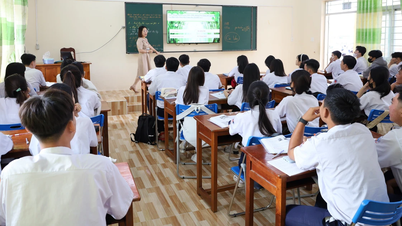
Ms. Phan Thi Thu Ha, Vice Principal of Thai Thuan High School (Bac Giang Ward, Bac Ninh Province), supports early career guidance, arguing that it helps students identify their interests, strengths, and weaknesses, thereby enabling them to make suitable career choices for the future. Based on the current implementation in her school, Ms. Ha stated that career guidance is integrated into weekly experiential learning sessions to create a vibrant learning environment and help students gradually develop clearer career orientations.
For many years, Thai Thuan High School has collaborated with universities and businesses to help students, especially 12th-grade students, understand the admission methods, academic fields, and specific requirements of each profession. This has gradually shifted their learning approach from focusing solely on exams to orienting themselves towards career choices that align with their abilities and interests.
This activity was also implemented by Phan Dinh Phung High School (Ba Dinh Ward, Hanoi) at the end of March to help students receive direct counseling and have their questions answered by admissions experts. However, not all educational institutions have easy access to businesses for career experience. In reality, in remote and rural areas, finding strategic partners to implement educational streaming in a practical way is a difficult problem in terms of both cost and resources. Therefore, Circular 16 has identified digital transformation as a mandatory content in career guidance activities to remove geographical barriers.
Currently, many solutions are being implemented by schools and teachers to make career guidance more widespread and effective. Ms. Hoang Thi Huyen, a teacher at Thanh Ha High School in Hai Phong, has researched and applied AI technology to support career guidance. By analyzing individual factors such as personality, interests, strengths, and weaknesses of each student, the system can suggest suitable fields of study and universities based on their abilities.
Educational institutions facing the need for innovation.
A key new feature of Circular 16/2026/TT-BGDĐT is its "open" approach. Previously, streaming was sometimes perceived as a rigid "branching out," but now students are given more choices. They are not "confined" to a single path but can flexibly switch between directions when circumstances permit.
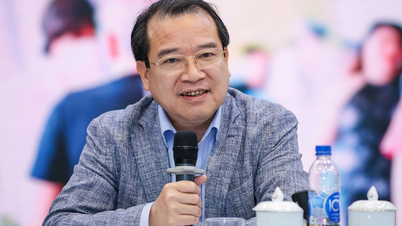
From the school's perspective, Dr. Pham Xuan Khanh, Principal of Hanoi High-Tech College, stated that statistics show most graduates find employment, but enrollment remains very difficult. Therefore, for career guidance to truly become an "open path" as expected, many challenges still need to be overcome. First and foremost is the issue of social awareness. The mentality of valuing degrees, especially university degrees, is still quite prevalent. Many parents and students still view university as the only path to success. Therefore, changing this mindset requires time, as well as the coordinated efforts of management agencies, schools, and the media.
Furthermore, the quality of vocational education training also needs to be improved. An open pathway is only truly meaningful when all options guarantee quality and development opportunities. If vocational training remains associated with outdated facilities and unupdated training programs, it will be difficult to attract learners. Conversely, when vocational training institutions are properly invested in, closely linked with businesses, and guarantee job placement for students, vocational training will become an attractive option, not a "last resort."
Source: https://daidoanket.vn/mo-loi-huong-nghiep.html

![[Image] Creating urban areas along the Dong Nai River](https://vphoto.vietnam.vn/thumb/1200x675/vietnam/resource/IMAGE/2026/03/31/1774936857389_ndo_br_z7673258220978-0364bf985edfd080118668ad3c015934-resize-5023-jpg.webp)


![[Photo] Da Nang: Exploring the inside of Vietnam's largest "sail" symbol.](https://vphoto.vietnam.vn/thumb/1200x675/vietnam/resource/IMAGE/2026/03/31/1774964764698_ndo_br_anhcau1-jpg.webp)
![[Photo] General Secretary To Lam attends the Conference summarizing the work of the election of deputies to the 16th National Assembly](https://vphoto.vietnam.vn/thumb/1200x675/vietnam/resource/IMAGE/2026/03/31/1774952471746_ndo_br_bnd-2315-6970-jpg.webp)






![[Video] Hanoi requests review of food suppliers for schools.](https://vphoto.vietnam.vn/thumb/402x226/vietnam/resource/IMAGE/2026/04/01/1775002576134_dung01-32-36-10still010-png.webp)



















































Comment (0)