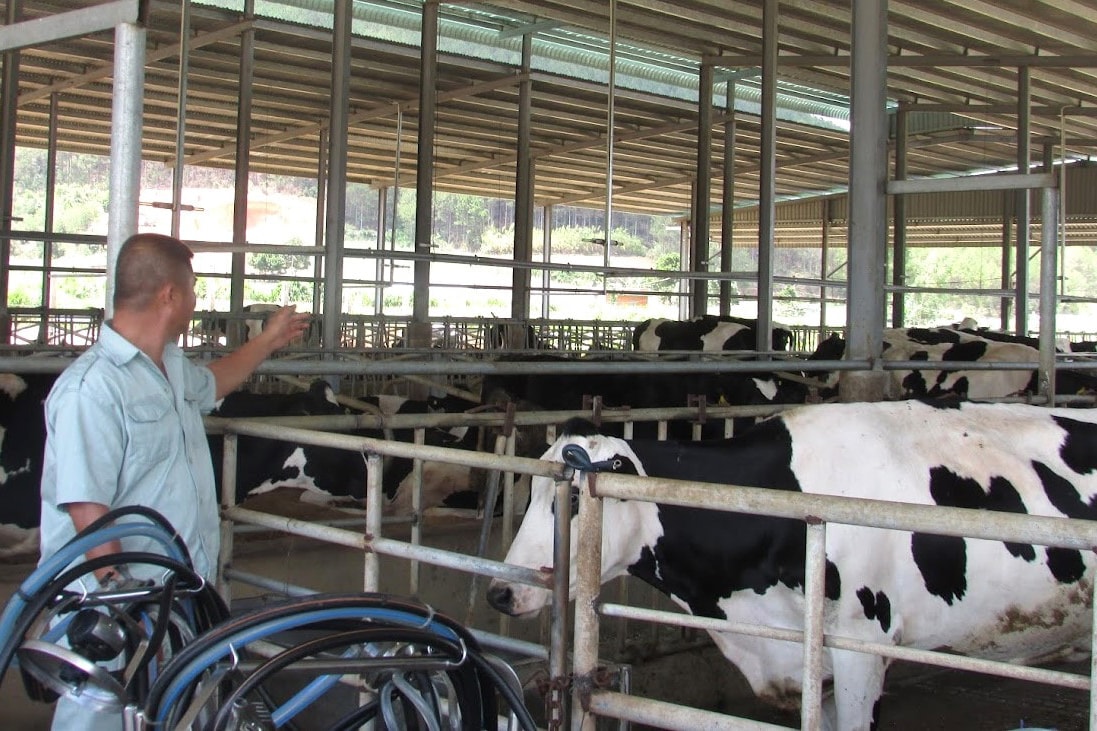
The dairy cow herd is increasing by an average of 7.3% per year.
According to the Department of Agriculture and Environment, over the next five years, the province will continue to develop dairy farming in key communes including Don Duong, D'ran, Ka Do, Quang Lap, Hiep Thanh, Duc Trong, Tan Hoi, Cat Tien, Cat Tien 2, and Cat Tien 3. Simultaneously, it will expand to communes with new potential and advantages such as Da Teh, Dinh Van Lam Ha, and Quang Son, aiming to maintain an average annual growth rate of 7.3% for the dairy herd. Specifically, the dairy herd in households is projected to increase by approximately 5.5%, and in businesses and farms by approximately 10.6%, reaching a total dairy herd size of approximately 41,170 cows by 2030. This will correspond to a total fresh milk production meeting safety and quality standards of approximately 161,758 tons per year, with over 95% of fresh milk consumed under value chain linkage contracts.
According to Mr. Pham Phi Long, Head of the Department of Livestock and Veterinary Medicine of Lam Dong province, under the program to expand dairy farming, the state budget supports the construction of 15 models applying advanced recirculating aquaculture techniques in 13 communes and wards. Specifically, small and medium-sized farms in 9 communes and wards are building 10 biogas production facilities. In addition, 50 livestock facilities in the communes and wards are also receiving support for livestock waste treatment products.
According to the Department of Agriculture and Environment, Lam Dong province encourages the establishment of dairy farms that apply advanced techniques, access new breeding technologies, practice circular processes for sustainable livestock development, and strengthen the activities of fresh milk consumption chains to stabilize productivity and profits for farmers. Accordingly, in the period 2026-2030, the Department of Agriculture and Environment will organize training for 22 artificial insemination technicians for local areas. At the same time, it will open 15 training courses to transfer new dairy farming techniques to farmers in wards and communes.


3 key solution groups
In addition, the Department of Agriculture and Environment, in coordination with relevant departments and agencies and the People's Committees of communes and wards, will implement three groups of solutions to expand dairy farming year by year. Firstly, encourage businesses to import high-yielding dairy cow breeds that are adapted to the province's natural conditions, prioritizing the selection and breeding of purebred Holstein Friesian (HF) dairy cows with high milk yield and quality, creating a source of fresh milk for the development of local milk processing. Secondly, using high-yielding and sex-sorted semen, develop herds through artificial insemination, record artificial insemination results, and monitor the production and reproductive capacity of each individual dairy cow.
Secondly, convert a portion of inefficient agricultural land to growing grass, biomass corn, and feed crops, while utilizing agricultural and food processing by-products to create balanced and nutritionally stable mixed feed rations for each group of cattle.
Thirdly, expand cooperation and linkages between businesses, cooperatives, and farmers in the production, processing, and consumption of fresh milk products, with businesses playing a core role in guiding production, applying science and technology, building and managing brands, and marketing products.
Implementing the three groups of solutions to expand dairy farming will contribute to achieving a 14-15% share of livestock production value in the overall agricultural structure of Lam Dong province by 2030.


Source: https://baolamdong.vn/mo-rong-dia-ban-chan-nuoi-bo-sua-421067.html