

A research team led by Flinders University (Australia) has successfully developed a process for recovering gold from complex sources such as computer circuit boards, old electronic equipment, ore concentrates, and mixed metal waste. Instead of using toxic cyanide or mercury, the new method uses trichloroisocyanuric acid (TCCA) – a common chemical in swimming pool water treatment – combined with a special sulfur-rich polymer to selectively absorb gold.
The extraction process takes place in mild saline solution, produces no toxic gases, and allows for the reuse of the polymer multiple times. Therefore, this method is not only safe for humans and the environment but also significantly less expensive than current techniques.
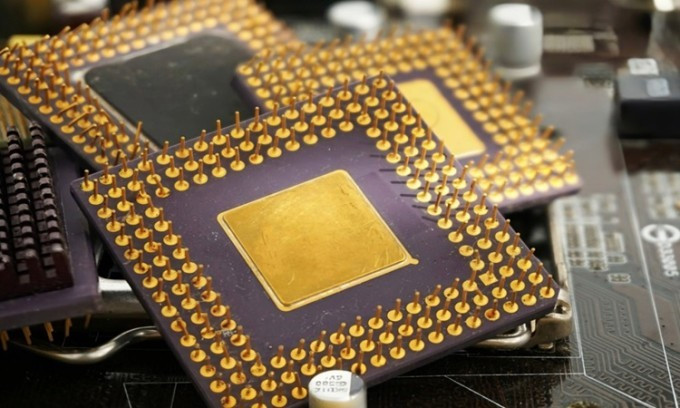
Notably, the new technique has been tested on CPU and RAM components made from real electronic waste. The research team is now collaborating with partners in the US and Peru to expand the technology's application to artisanal gold mining – where the use of mercury is causing serious pollution, particularly in small-scale mines in Asia and Latin America.
With global e-waste continuing to increase rapidly, clean recycling solutions like the one described above are expected to create positive change. The Global E-waste Monitor 2024 report, published by the United Nations, indicates that in 2022 alone, the world generated over 62 million tons of e-waste. This figure could reach 82 million tons by 2030 if effective disposal methods are not implemented. Less than 25% of that is properly recycled.
In Asia alone, where nearly half of the world's e-waste is generated, the majority of recycling processes still rely on informal systems, posing significant health and environmental risks. Vietnam is no exception. In areas like Nhat Tao Market (Ho Chi Minh City) and craft villages in Bac Ninh and Thai Nguyen, the collection, dismantling, and recycling of e-waste takes place daily but lacks protective equipment and safe processing technology.
According to experts, transferring safe gold extraction technology like the method described above will help Vietnam improve its recycling capacity, minimize pollution risks, and create additional economic value from valuable materials in used electronic devices.
Gold is not only highly valuable but also an indispensable material in the electronics, medicine, aerospace, and energy industries. Due to its superior electrical conductivity and resistance to oxidation, gold is often used as contacts, wires, and solders in telephones, computers, medical equipment, and more. However, the recycling rate of gold from old equipment remains very low, while demand continues to increase.
Besides gold, many other valuable rare earth elements and metals such as silver, palladium, and copper are also gradually being depleted. Applying new technologies to efficiently recover these materials not only helps protect the environment but also reduces dependence on the exploitation of raw resources.
Experts believe that, if supported and widely implemented, this new gold extraction method could become a breakthrough in the global electronics recycling industry, while also contributing to the promotion of the circular economy – a strategic priority for many countries, including Vietnam.
Source: https://khoahocdoisong.vn/mo-vang-trong-rac-dien-tu-post1551502.html


![[Image] National Assembly discusses the implementation of the socio-economic development plan.](https://vphoto.vietnam.vn/thumb/1200x675/vietnam/resource/IMAGE/2026/04/20/1776696707422_ndo_br_img-20260420-185419-jpg.webp)


![[Photo] General Secretary and President To Lam meets with National Assembly delegates from ethnic minorities.](https://vphoto.vietnam.vn/thumb/1200x675/vietnam/resource/IMAGE/2026/04/20/1776696701056_a1-bnd-8331-3342-jpg.webp)















































































Comment (0)