Mr. Lam is over sixty, an age when he should be enjoying leisure, yet he remains at the company of fire and iron. A lifetime of operating a welding machine has left his hands calloused, like the clumsy welds he's made. People often say he's as dry and cold as the metal he holds. At those times, he doesn't argue, only offers a gentle smile hidden behind his smudged protective mask. This profession, it's so strange...
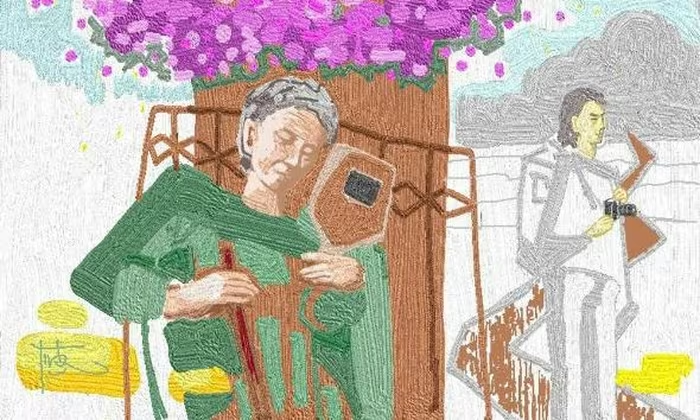
Illustration: Văn Tĩnh.
Outside, summer had arrived. The old crape myrtle tree in front of the factory gate began to sprout its first delicate purple blossoms. That elegant, fragile purple seemed completely out of place in the thick, rusty atmosphere and the deafening noise of the cutting machines inside. Every summer, the small street corner in front of the factory would become lively. The neighborhood children would gather at the base of the tree to play pretend, their laughter drowning out the sound of hammers. Occasionally, a few young women would stop their vehicles, dressed in their finest clothes, to take photos beside the crape myrtle trees.
During his rare moments of rest, Mr. Lam would sit quietly beside a cup of strong tea. The bitter, astringent taste on his tongue, followed by a delicate sweetness, was inexplicably addictive—perhaps it was because it mirrored the lingering taste of his own life? In the swirling smoke, Dung's face reappeared—his only son, who had been away from home for three years after a heated argument between father and son. For a man who had revered the strength of steel his whole life, Dung's photography career was nothing more than a frivolous game of "chasing butterflies."
The rift reached its peak that summer afternoon, when he was carrying his metal cutting machine to trim the crape myrtle tree's branches, fearing it would obscure the welding workshop's sign. Dung stood blocking the tree's base, his eyes bloodshot. His words, spoken then, still pierced his heart more sharply than a sharp piece of metal: "Dad, you don't just want to cut down the tree, you want to cut off the last bit of warmth Mom left behind, don't you?"
Dung's mother passed away when he was just ten years old. When they first moved in together, Mr. Lam had nothing but his bare hands and a small, newly built welding workshop. To please his wife, who loved the color purple, he personally welded a sturdy iron frame around the tiny crape myrtle tree he had just planted in front of the gate, as a way to protect their love from the storms. But now, that iron frame has rusted with time, and she has gone to be with the heavens.
Since Dung left with his camera, the only link between father and son has been the postcards sent from all over the country. They depict ancient forests, mist-shrouded mountain peaks, and unfamiliar streets that Dung had visited. Mr. Lam flips through each postcard, searching, but there isn't a single message.
"He probably doesn't remember this old man anymore..." Mr. Lam muttered, removing his welding mask covered in iron dust. Bitter drops of sweat trickled down the crooked wrinkles on his weathered face, disappearing into his stained work clothes. He awkwardly pulled out of his pocket the old smartphone he'd patiently spent a whole week learning how to use with the help of his neighbor's son.
His hands, accustomed only to gripping heavy pliers and hammers, now trembled strangely as he touched the fragile touchscreen. He raised the camera, trying to capture the vibrant purple hue outside. Click! A blurry image appeared. Instead of the elegant lilac blossoms, the lens focused on the iron bars of the welding workshop's fence. Without looking closely, he pressed the send button to Dung's number and quickly turned off the screen.
A week later, that familiar figure appeared at the workshop door. Dung was thinner than before, his long, romantic hair falling over his weathered face, and a worn-out camera bag slung over his shoulder. Mr. Lam had seen his son from the very first moment, but he didn't stop working. The metal-cutting machine roared, sparks from the welding sparks flying in clusters like fireworks, harsh and cold, a silent greeting. In the thick, metallic air, he only slightly raised his head, revealing his red-rimmed eyes behind his protective mask.
- Are you going back there?
"Yes..." Dung hesitated, standing silently amidst the jumbled pile of steel.


That evening's meal included braised goby fish with pepper. This was Dung's favorite dish when he was a child. The tiny goby fish were braised by Mr. Lam in an earthenware pot; their bodies were firm, glistening amber in color, and fragrant with the aroma of pepper. Just looking at the thick, shimmering sauce surrounding the slices of bright red chili peppers, one could understand why he was so famous for his cooking in the past. People said that if he had pursued a career as a chef, he would surely be a renowned figure by now.
The father and son sat opposite each other, the silence so profound that the clinking of dishes was louder than the rustling of the wind through the crape myrtle trees outside the window. Dung intended to ask about the faded old photograph, but upon meeting his father's cold expression, he silently swallowed the words he was about to say.
That night, Dung tossed and turned, unable to sleep. He went out into the yard and stood silently under the old crape myrtle tree. The pale moonlight cast a melancholic glow on the dark purple petals. Under this tree, he and his mother had taught him how to appreciate the simplest things. Suddenly, Dung was struck by the sight of a new iron frame, intricately welded with graceful curves like grapevines, gently embracing the old tree trunk as if offering protection.
On those iron bars, Mr. Lam meticulously designed small stands to hold the portulaca pots. Although the flowers had already closed their petals and fallen asleep, Dung could still picture the vibrant scene under the morning sun. He was stunned to realize that, behind his father's cold demeanor, he was still secretly cherishing the memories his mother had left behind.
- It used to be infested with termites!
Dũng turned around in surprise. Mr. Lâm had been standing there for some time, his thin hands holding a cup of strong tea, steam rising in thick plumes through the night mist.
- When you first left, this tree almost died. I had to stay up for several nights chipping away at each and every woodworm. This type of crape myrtle may look fragile, but if you know how to nurture it, it's very resilient.
Mr. Lam slowly sat down on the worn stone bench and took a sip of bitter tea.
- It's true that years ago I considered cutting it down, not because I hated the tree, but because every time he saw the flowers bloom, he would cry, missing his mother. At that time, I just wanted him to forget about it and move on with his life. But now that I'm old, I realize I was wrong. Sometimes, people survive thanks to the memories they hold onto, right?
Dũng fell silent, his feet unconsciously moving closer to the iron frame. He turned on his phone's flashlight, the flickering light illuminating a detail that made his heart tremble: At the joints, there were no rough or uneven welds. Mr. Lâm had meticulously polished and shaped them into tiny lilac flower petals, painted with a gentle pale purple. Strangely, the man who had spent his life accustomed to straight lines and right angles, the welder often considered dry and uninteresting, had now taught himself how to create art on scrap metal.
"Where did Dad learn to paint like this?" Dung's voice choked up.
- Well… I just looked at the real flowers and tried to imitate them. This shade of purple is very difficult to mix; I had to go back and forth to the paint shop for several days, mixing and remixing until I found the exact shade of purple that your mother likes.
Dũng's hands trembled as he touched the cool, iron petals of the flowers. A photographer like him, who had long been engrossed in chasing vibrant images in distant lands, had been unaware of the true beauty hidden within the calluses right beneath this house. His father didn't know how to speak eloquently; he simply silently forged his love into the iron and steel, entrusted it to the land, and nurtured it through each blooming season.



***
The next morning, as the early morning sun poured down on the yard, Dung took out his camera. This time, he wasn't searching for distant beauties, but wanted to capture the most precious thing right before his eyes. He told his father to put on his familiar dark blue welder's uniform, holding a protective mask, and stand leaning against the curved iron frame under the crape myrtle tree. At that moment, Dung understood that true art wasn't far away. Today, the tree seemed to bloom more brilliantly and proudly than ever before, its most radiant flowering season in history.
Through Dung's lens, the gentle purple of the flowers blended with the cool gray tones of steel and the weathered, silvery hair of his father. That photograph later won first prize at a major exhibition titled: "The Welds of Time" - where the cracks in people's hearts are healed by patience.
Many years later, after Mr. Lam had passed away, the old crape myrtle tree still stood there, proud and steadfast within the protective embrace of its sturdy iron frame. Every flowering season, the people of the small town would see a middle-aged man standing silently beneath the tree. He would pick up a fallen purple petal, gently placing it in his calloused hand, as if cherishing an eternal promise between fire and flower.
According to Bac Ninh Newspaper
Source: https://baoangiang.com.vn/moi-han-cua-thoi-gian-a485150.html
![[Image] A look back at the capital's preparations for the century-long master plan.](https://vphoto.vietnam.vn/thumb/1200x675/vietnam/resource/IMAGE/2026/06/29/1782750453122_quy-hoach-100-nam-minh-duy-1-2118-jpg.webp)

![[Photo] General Secretary and President To Lam works with the Party Committee of the Government on the work of preventing and combating storms, floods, extreme natural disasters and climate change.](https://vphoto.vietnam.vn/thumb/1200x675/vietnam/resource/IMAGE/2026/06/29/1782729441945_a1-bnd-0385-9454-jpg.webp)

![[Photo] National Assembly Chairman Tran Thanh Man attends the Conference to announce the Master Plan for Hanoi Capital City with a 100-year vision.](https://vphoto.vietnam.vn/thumb/1200x675/vietnam/resource/IMAGE/2026/06/29/1782709639728_ndo_br_1-jpg.webp)





















































![[Image] Building an elevated road through the Ma Da forest.](https://vphoto.vietnam.vn/thumb/402x226/vietnam/resource/IMAGE/2026/06/29/1782724737750_anh-man-hinh-2026-06-29-luc-16-18-43.png)