

You shouldn't carry luggage for others if you don't know the contents.
The Ministry of Public Security has just addressed public concerns regarding numerous cases where people ask others to carry or watch over their luggage at train stations, bus stations, airports, etc., but when law enforcement officers inspect the luggage, they discover prohibited items such as drugs, antiquities, and wild animals.
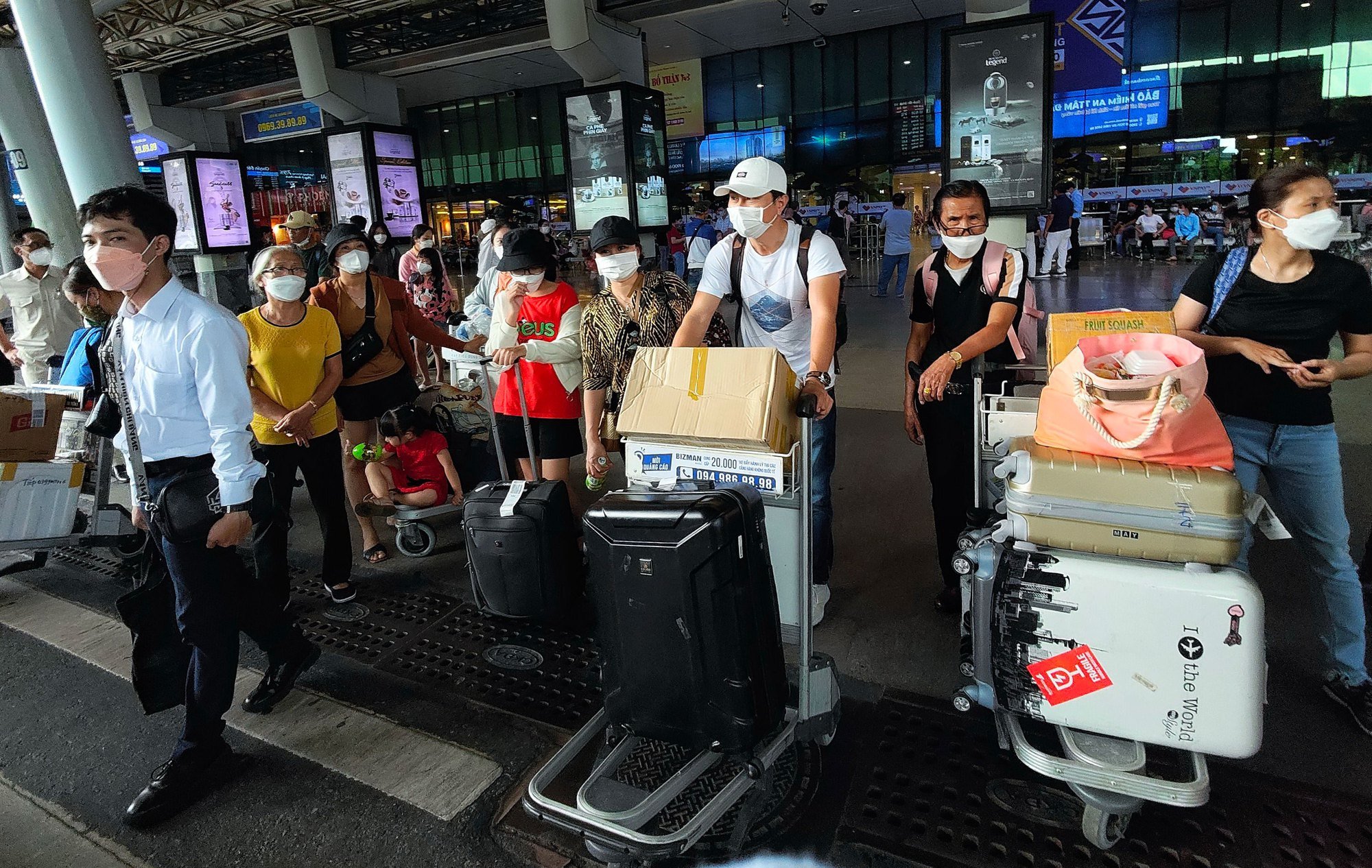
Airports are extremely sensitive transportation hubs; passengers should absolutely not carry items for strangers.
According to the Ministry of Public Security, many people believe that it's perfectly normal to be asked to carry goods across borders or at airports, seaports, or bus stations. However, in many cases, helping others carry/transport goods can lead to serious legal consequences if the goods are on the list of prohibited items according to the law. Therefore, the Ministry of Public Security advises citizens, when asked to carry goods, especially across borders, to check and determine whether the act violates the law. When traveling at airports, seaports, bus stations, or public places, be wary of strange or unusual behavior and do not carry items for strangers without knowing the contents of their luggage.
Carrying and watching luggage: The fine line between kindness and danger.
In fact, the Ministry of Public Security's proposal also reflects recommendations that the customs and aviation sectors have been disseminating to the public for many years. However, there have been many cases where airline passengers, especially those traveling abroad, have agreed to help carry or transport items through customs or simply carry luggage without realizing that they are assisting criminals in transporting contraband. In some exceptional cases, individuals have even received the death penalty.
A typical example is the case that occurred in April 2017, when the Ho Chi Minh City High People's Court upheld the death sentence for defendant Pham Trung Dung (40 years old, an Australian citizen of Vietnamese origin) for the crime of "illegally transporting narcotics." According to the initial verdict, on April 17, 2013, Dung and his wife and children returned from Australia to Vietnam to visit family in Binh Thanh District (Ho Chi Minh City). During their stay in Vietnam, a man named Kien (whose identity is unknown) asked Dung to carry two suitcases back to Australia for a fee of 40,000 Australian dollars, which Dung accepted. More than a month later, when Dung was going through immigration procedures to return to Australia, customs officers at Tan Son Nhat Airport inspected the suitcases and discovered two plastic bags containing nearly 3.5 kg of narcotics wrapped in aluminum foil and pressed thinly around the sides. During the investigation and at the trials, Dung claimed that he did not know it was narcotics and was only helping to carry and transport them. However, Dung failed to prove his innocence.
Previously, the Ho Chi Minh City People's Court, in its first-instance trial, sentenced defendant Pimtanatanasuk Kettawan (Thai nationality) to life imprisonment for the crime of "illegally transporting narcotics." According to the indictment, on the afternoon of April 20, 2016, Kettawan entered Vietnam and was discovered by customs officers at Tan Son Nhat Airport to have suspected narcotics hidden in the soles of a pair of shoes in his luggage. Customs officers, in coordination with the police, determined that the narcotics found in the shoe soles weighed 2.4 kg.
During the investigation, Kettawan confessed that he worked as a driver and frequently visited casinos in Cambodia, where he met an African man named John. John then hired Kettawan to transport goods from South Africa to Thailand. In mid-April 2016, John gave Kettawan $500 and flew to South Africa. There, a group of people gave Kettawan a pair of shoes and a briefcase, instructing him to bring them back to Thailand with a planned itinerary: South Africa - Qatar - Vietnam - Thailand.
When Kettawan was transiting through Vietnam, he was discovered by authorities. Although Kettawan claimed he didn't know about the drugs in his shoes and bag, he couldn't prove who hired him to carry them, so he was held responsible for the drugs. Kettawan paid the price with a life sentence.
Ho Chi Minh City police explain the release of four Vietnam Airlines flight attendants.
The fine line between kindness and danger.
"I know you shouldn't carry other people's luggage at the airport, but there are some situations where it's really hard to refuse. The other day, I flew from Ho Chi Minh City to Hanoi , and at Tan Son Nhat airport, I saw a woman carrying a small child in one arm, with two plastic bags of belongings dangling from her other arm, and a medium-sized suitcase underneath. She was struggling to get up the escalator to the security check area on the upper floor, so she asked some people to help carry the two bags, explaining that she was taking her child to Hai Phong to see the father and had no one to accompany her. After one or two people shook their heads and refused, I felt sorry for her, but she looked so pitiful that I went to help push the suitcase up the escalator to a height that was within her reach, instead of carrying the two bags. Now, thinking back, I feel uneasy. If I hadn't thought it through and had helped carry the bags containing contraband, it would have been a case of doing a favor and getting into trouble. Now I don't know if I should help people on the street or not," said Ms. Hai Anh (resident of Hanoi). Q.3, Ho Chi Minh City) shared.
Hai Anh's story reflects the feelings of many people who frequently travel through airports, bus stations, or train stations. There was even a heated debate on the popular Reddit forum when a passenger complained that at an airport in the US, he asked a stranger sitting next to him in the waiting area to watch his luggage while he went to the restroom, but she refused.
Below the post, thousands of comments were left, expressing two opposing viewpoints. Some argued that the girl was being overly cautious, suggesting she should have simply watched the boy's luggage. The majority criticized the male passenger for his lack of experience flying and entrusting his belongings to a stranger.
The Ministry of Public Security issues a warning.
People traveling at airports, train stations, bus stations, and public places need to keep their luggage and personal documents safe; they are responsible for notifying security personnel or the nearest police station if they discover or are found to have luggage suspected of containing prohibited substances or goods, and for cooperating in verifying and investigating the intentional or unintentional elements of the act of transporting prohibited goods or substances.
Mr. TH, who has over 20 years of experience in the aviation industry, supports the girl's refusal. According to Mr. H., there are currently no regulations prohibiting passengers from looking after or carrying luggage for other passengers at the airport. However, this advice has almost become an unwritten rule. Dangerous criminals often exploit people's kindness and desire to help those in need to commit crimes. Posing as disabled individuals, taking advantage of the elderly, pregnant women, or women with young children who have to carry heavy luggage, or pretending to carry overweight luggage to seek help from others... are common tactics used.
On the other hand, they are capable of very cleverly disguising drugs and contraband in ordinary items such as clothing buttons, belts, or packaged in blister packs like pharmaceuticals… even inside water bottles. Therefore, even with prior checks, it would be very difficult to detect them unless you are a professional. "Normal people naturally want to help those in need, sometimes without them even asking. However, in cases like this, the line between kindness and danger is very thin," Mr. TH said.
According to Mr. H., at some airports, such as Japan and Australia, if an acquaintance of yours is an airline employee, border police officer, or health check officer who comes to pick you up and helps carry your luggage, their work permit will be immediately confiscated. Only ground service staff have the right and duty to assist customers in such situations.
Even retrieving luggage from the baggage claim conveyor belt, unless done by ground staff, carries responsibility for prohibited items. This is why airlines have regulations limiting checked baggage to 23 kg and carry-on baggage to 7 kg. These figures have been carefully calculated to ensure that most people can handle the situation themselves.
You have to protect yourself.
According to airline advice, if a stranger asks you to hold or carry their luggage, passengers should not directly help them but instead assist by contacting airport staff, such as airport security, airline staff, or ground handling personnel. Airlines and ground handling staff are usually stationed throughout the airport to guide and assist passengers when needed. They are also trained professionals who know how to best handle situations involving malicious individuals attempting to trick passengers.
However, in an interview with Thanh Nien newspaper , a representative of a ground handling service company serving three major airports in Vietnam confirmed that, according to contracts signed with airlines, ground staff are not authorized to assist passengers with carry-on baggage. Even on VIP flights, if passengers need to carry suitcases or bags, the airline will assign the task to its own staff.
"In reality, assisting passengers is something all airport staff are willing to do, but there are no regulations requiring them to do so. In fact, airport and airline staff are sometimes the most vulnerable to exploitation because they often have priority access or connections, making it easier to handle luggage. There are cases where relatives or acquaintances ask them to carry luggage from the south to the north, and a moment of carelessness or reluctance can easily lead to being scammed. Therefore, not only passengers but also ground service employees like us are strictly instructed not to carry or hold luggage for anyone at the airport. Ideally, everyone should be vigilant to protect themselves. Airports have full passenger support services such as wheelchairs for the disabled, luggage trolleys, etc. If everyone adheres to baggage regulations, they will minimize the need to ask for help from others," this person said.
Quick overview at 8 PM on March 26th: Ms. Han Ni's lawyer license suspended | ATM vandalized to steal money to pay off debts
Airport staff know what to do to prove they are just assisting.
It's impossible to require or mandate in regulations that ground staff, airport security, airport personnel, or airline staff must assist passengers, but this is a very normal and natural practice. Not only at airports, but all service-oriented businesses must proactively assist passengers. For example, at a restaurant, you might not ask a stranger to carry your heavy bags, but the restaurant staff will certainly offer to help. The same applies at airports; each stage and area has its own unit to guide and assist passengers, from check-in to security procedures, screening, passing through departure gates, boarding buses, and boarding planes. Furthermore, while not all, important areas at the airport have CCTV cameras. Airport staff will know what to do to prove they are only assisting passengers and not the owner of the luggage containing prohibited substances.
Representatives of Tan Son Nhat International Airport
A transporter who is unaware of the drugs will not be held criminally liable.
"Illegal trafficking of narcotics" is the unlawful movement of narcotics from one place to another in any form without the intention of illegally buying, possessing, or producing other narcotics. A person who holds or illegally transports narcotics for another person, if aware of the other person's intention to illegally buy or sell narcotics, will be prosecuted for the crime of illegal trafficking of narcotics as an accomplice. Basically, this crime is only committed if the person transporting the narcotics intentionally knows that the "package" contains narcotics and is aware that it is not permitted to be transported. If the transporter has evidence that they were unaware of the narcotics inside, they will not be prosecuted for this crime.
Lawyer Nguyen Van Duong, Director of Duong Gia Law Firm
Source link



































































































Comment (0)