"Reintegration"
A passenger ship visiting the islands usually speeds by with hundreds of people. Visits are fleeting, sometimes just a quick handshake before departure. Finding the time to properly research and write an article is a real challenge. Longer trips are usually during the Lunar New Year celebrations, when reporters can spend more time on the islands and develop their topics more thoroughly. However, this often comes with long days of almost complete loss of contact with the mainland.
In early 2015, we participated in a Tet (Lunar New Year) trip to Truong Sa (Spratly Islands) that lasted over 20 days, arriving back just before the Kitchen God Festival. Upon arriving at Noi Bai Airport, a group of reporters hailed a taxi to downtown Hanoi . Suddenly, a colleague looked bewildered: "Why are we going this way into the city? We're going the wrong way!" The driver looked at us as if we were "people from the forest": "If not this way, then which way?" At that moment, everyone burst out laughing, because while we were away, the Nhat Tan Bridge had been inaugurated, and no one had yet caught up with the news; the route from Noi Bai Airport to the city center had changed. It was then that we realized how long we had been "isolated" from the mainland.
That was only 20 days. I wonder how much more bewildered those who serve on the islands feel compared to us, those who are away for months, a year, or even several years. Each time we return, we joke about "reintegrating." It's easy for reporters to reintegrate, after all, it's only a dozen or twenty days, but the soldiers have so many stories to tell. That's why there's the "island syndrome" or "offshore platform syndrome." At the DK1 Battalion, Naval Region 2, if you see a soldier spending all day just wandering around in a small courtyard of a few dozen meters, you can be sure he's just come back from his barracks. Living in such a confined space for so long, they've developed a reflex to only move around within that space.
A few years ago, we spent 15 days at sea visiting the DK1 offshore platform for Tet (Lunar New Year), and the waves were very rough the whole time. We were practically constantly moving around in a "squatting" position, making it very difficult to maintain balance in those conditions. Tung, the cameraman from the National Defense Television channel, was as big as an elephant and never got seasick. Yet, when we reached shore, the cameraman suddenly started to... tilt. Panicked, we rushed to help him, but Tung looked bewildered: "Oh, did I fall?" He didn't even realize it himself. Accustomed to the rocking motion of the ship, once on shore, Tung got seasick and his body just kept swaying. It took him several minutes to regain his balance.
 |
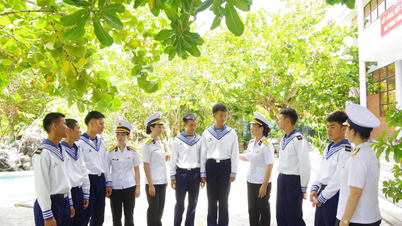
| Officers and soldiers at the offshore platform welcome visitors from the mainland. (Photo: THANH DAT) |
Just recently, during a 15-day trip at sea for early elections of National Assembly and People's Council representatives, we were also in a state of disorientation for almost the last week. At times, we were almost unable to do anything, just lying there watching the grapefruit roll around with each wave. Our belongings, even though they were securely fastened, would just fall over without us having to push them. After all, reporters can't possibly have the same experience as the sailors who are used to the waves. And that was the March sea, they say. With climate change these past few years, even in March, if a ship is passing through rough seas, it's easy to end up "feeding the fish" a few times.
Working at sea isn't just about interviewing and writing articles; it's also about navigating the rope ladders from the boat to the ship, to the island, to the offshore platform; about sitting securely on the ropes while being pulled up to the platform; and about staying calm after seasickness. Going out to sea occasionally, besides working, is also an experience of living on the sea and islands. Seeing flashing green and red lights or large cars speeding by, even if you feel a little bewildered, you can still empathize with the fishermen out there. It's also an experience of eating and sleeping on the waves, or being suspended in mid-air while being pulled up to the offshore platform.
The ordinary becomes the strange.
Writing stories about the islands is difficult. Every year, dozens of ships bring tourists to visit the islands. Even though each ship might have a different story, there are many stories that could be told endlessly without ever running out. There were years when we went to Truong Sa (Spratly Islands) during the Party Congress at all levels, and each island we visited was scheduled for 5 or even 7 days. We woke up at 5 a.m. to the loudspeaker announcements, followed the schedule precisely, and at 7:30 a.m. we toured the islands, chatting and drinking tea with everyone we met. After several rounds around the islands, we ran out of things to talk about and tea to drink, and when we looked at the clock, it was only 9:30 a.m. While the islands were busy, no one... entertained us. The islands were bustling, and visitors like us became superfluous. There were many tasks that even journalists couldn't participate in to ensure safety. Throughout the morning, we looked at each other, joking that the only thing missing was talking to the dogs and cats around the islands.
 |
Staying on the island for a long time, aside from the inherent boredom, also gives you the right to do everything meticulously. The more you talk, the more you discover life stories there that you would never hear if you only visited for a few hours. It's accurate to call them stories of the sea, both new and strange. Because even the people I've met on the island countless times over the past decade or so, each time they tell me different experiences. Suddenly, I deeply understand the value of those who guard the island. It's not simply a matter of time.
A few years ago, while searching for the origins of names on the southern continental shelf, after Quế Đường, Huyền Trân, Phúc Nguyên, Phúc Tần, I got stuck on Tư Chính and Ba Kè. I rushed to the National Library to find the book "Phủ biên tạp lục," located the entry for "Tứ Chính thôn, Bình Thuận phủ," and carefully asked several Hán Nôm (classical Chinese and Vietnamese) experts to verify it. When I confirmed that this was the correct page, even though it was only for a single line in an article, I felt like Archimedes about to leap into the bathtub and shout "Eureka!"
Many ordinary things, like the appearance of a mouse or the crowing of a rooster in the middle of the sea, can be unusual material for us to recount to the mainland. A colleague of mine, after 10 days in the Spratly Islands, wrote an entire article about the cats and rats on the islands.
During a mission to participate in early voting at sea, I was aboard the TS04 vessel of the 2nd Naval Region. At that time, the TS04 encountered several fishing boats operating in the Ba Kè shoal area. The head of the election delegation, Colonel Lê Hồng Quang - Deputy Head of Political Affairs of the 2nd Naval Region - ordered a boat to be lowered to bring voters aboard so they could exercise their right to vote. However, seeing the naval boat approaching, the fishing boats immediately turned around and fled. A lengthy "chase" ensued, involving both loudspeaker announcements and walkie-talkies from the DK1 platform, before the boat finally approached the fishermen to explain its purpose. Lieutenant Colonel Nguyễn Quang Thuật, Deputy Commander of Squadron 1, Brigade 125, 2nd Naval Region, had to stay on the boat to talk to the fishermen for a while longer before they believed him, because some of them were just waiting for the navy to leave before paddling their small boats and continuing to flee.
 |
It wasn't until the voting was complete and the fishermen were brought back to their boats that the atmosphere eased a little. They brought out a lot of food to offer us. And their explanation for running away was: "We didn't know what was going on, so we just ran when we saw people coming." Therefore, persuading fishermen to participate in the vote is not simply a matter of a few words, and it's not always easy. Many of them barely understand their rights and obligations on the ballot. Some of these fishermen were casting their ballots for the first time after many years of only being able to delegate it to family members. They read the candidate information carefully and meticulously, and had their own opinions.
The voting process was brief, but from the moment the boat turned around to the moment the fishermen offered their best cakes, despite sacrificing half a day's work at sea, it was a laborious process, a part of the duty of ships like TS04 and the soldiers out at sea. These are things that are not mentioned in the reports.
According to Nhan Dan newspaper
Source: https://baotuyenquang.com.vn/xa-hoi/202606/moi-nhu-di-bien-bdd1f3d/
![[Photo] Opening Ceremony of the 13th National Congress of the Ho Chi Minh Communist Youth Union](https://vphoto.vietnam.vn/thumb/1200x675/vietnam/resource/IMAGE/2026/06/24/1782286753905_ndo_br_1-8510-jpg.webp)
![[Photo] The 13th National Congress of the Youth Union conducts personnel work.](https://vphoto.vietnam.vn/thumb/1200x675/vietnam/resource/IMAGE/2026/06/24/1782299943080_ndo_br_1-6868-jpg.webp)
![[Photo] General Secretary and President To Lam attends the Central Public Security Party Committee Conference](https://vphoto.vietnam.vn/thumb/1200x675/vietnam/resource/IMAGE/2026/06/24/1782302063612_a1-bnd-9302-9166-jpg.webp)