

Hidden talents are awakened.
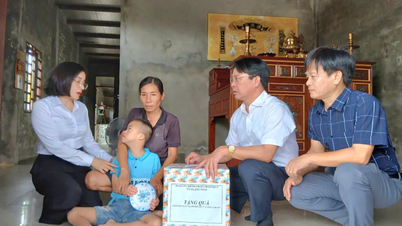
The first impression of Bui Thien Phu, a student in class 3A, is his quick wit and confidence. During a visit by provincial leaders to give gifts for the Lunar New Year, this small student surprised everyone with his clear and articulate responses. Few know that behind this intelligence lies a journey full of hardship. Born prematurely at only 28 weeks, weighing just 1,500 grams, Phu faced many complications, the most serious of which was blindness, forcing him to live in darkness from a young age.
Nevertheless, she still demonstrated outstanding abilities. In 2025, Phu won third prize in the "Online History Quiz in Three Regions" competition and an honorable mention in the "Singing Contest for People with Disabilities in the Central and Central Highlands Regions". In early April 2026, she continued her excellence by winning a gold medal at the National Piano Talent Festival.
Phu's mother, Nguyen Thi Van Anh, recalled: "At the age of 5, seeing that my son was sensitive to music , I let him try learning the piano. At the music center, I wrote down the notes, and we both learned together." It was this perseverance that opened up a unique path for Phu.
 |
| Bui Thien Phu performing at the National Piano Talent Festival - Photo: Provided by the artist. |
At the age of six, Phu was taken by his mother to study at the Dong Hoi Center for the Gifted and Disabled. In this specialized educational environment, he gradually became more confident and sociable. “Here, there’s a library, playrooms, and I learn math and Vietnamese. The teachers care for and guide me, and I get to meet friends, which is a lot of fun,” Phu shared playfully.
In another corner of the classroom, 13-year-old Nhu Ngoc, who has autism, finds joy in her skillful hands. Once withdrawn and struggling to communicate, Ngoc gradually changed when encouraged to be creative. The flowers she makes from toilet paper, seemingly simple, actually represent a journey of self-discovery.
However, not all students possess the outstanding abilities of Thien Phu or Nhu Ngoc. For many, "progress" begins with very small things: sitting still for a few minutes, attending class, listening attentively, or simply no longer shouting or rebelling as before.
 |
| The progress of students with disabilities, however small, is due to the tremendous efforts of their teachers - Photo: HL |
Love has no lesson plan.
There is no single curriculum for these special needs classes. Each child is a unique "problem," requiring each teacher to possess not only expertise but also patience and empathy.
Ms. Ha Thi Huong Giang, currently a primary school teacher in the area, struggled to find a way forward for her autistic daughter. After trying various treatments and inclusive education options without success, she decided to enroll her daughter at the Dong Hoi Center for People with Autism. There, her daughter showed remarkable progress: she learned to read, do arithmetic, cooperated, and most importantly, felt safe and respected. "If I had known sooner, I would have enrolled her here earlier," she shared.
 |
| Teachers must learn to "read" students' emotions through their eyes and gestures - Photo: HL |
Teacher Luong Thi Phuong Thao, homeroom teacher of class 1A, said that some students take months to get used to the classroom. Initially, they are withdrawn, uncommunicative, and uncooperative. Teachers have to patiently befriend them, build trust, and only then can they "draw" them into the routine. Especially with autistic or hyperactive children, controlling their behavior is a long journey. Some cannot sit still, constantly running, jumping, and shouting; others are completely withdrawn. Just knowing how to sit at a desk and look at the teacher when called by name is already a big step forward.
“Children with disabilities are often sensitive and vulnerable, but they don't easily express themselves. Therefore, teachers must learn to ‘read’ students’ emotions through their eyes and gestures. A turn away, a repeated action… all can be signals that the children are uncomfortable, anxious, or need support. From there, teachers adjust their methods and patiently accompany them so they gradually adapt. Here, teachers are not just instructors, but also friends, caregivers, and ‘second mothers’,” said Ms. Nguyen Ngoc Dung, Deputy Director of the center.
 |
| Teaching children with disabilities requires patience and love from the teachers - Photo: HL |
To make the integration process less difficult.
The Dong Hoi Center for Children with Disabilities currently cares for and educates 82 students with various disabilities, including visual impairment, hearing impairment, autism, ADHD, motor disabilities, Down syndrome, etc., with the majority having severe disabilities. According to Ms. Nguyen Thi Hoang Anh, Director of the Center, doing this work well requires great effort from the teaching staff, the support of parents, and the attention and assistance from all levels of government, relevant agencies, and society.
“In reality, the care and education of children with disabilities still face many difficulties. Early detection and intervention have not received adequate attention, especially for children under 6 years old. There is a shortage of specialized facilities and learning materials; most students in inclusive education programs have weak academic abilities or are overage. Many have not had the opportunity to pursue higher education, vocational training, or find employment. Furthermore, the center's operating budget remains limited,” said Ms. Nguyen Thi Hoang Anh.
 |
| These paper flowers represent the journey of autistic children opening up - Photo: HL |
From a parent's perspective, Ms. Nguyen Thi Van Anh believes that the important thing is not just learning knowledge, but also equipping children with skills so they can be independent and integrate into society. "I really hope there will be more activities and classes teaching life skills and career guidance more appropriately for children with disabilities. I also hope that in the future, there will be more specialized educational models for children with disabilities, including visually impaired children, so that they have better opportunities to develop," Ms. Van Anh expressed.
As for Ms. Huong Giang, from her own story, she hopes that parents of children with disabilities will learn to accept their children's condition and enroll them in special schools early to receive timely intervention, giving them a better chance to progress.
Huong Le
Source: https://baoquangtri.vn/xa-hoi/202604/moi-tien-bo-la-mot-ky-tich-9730827/







































































Comment (0)