

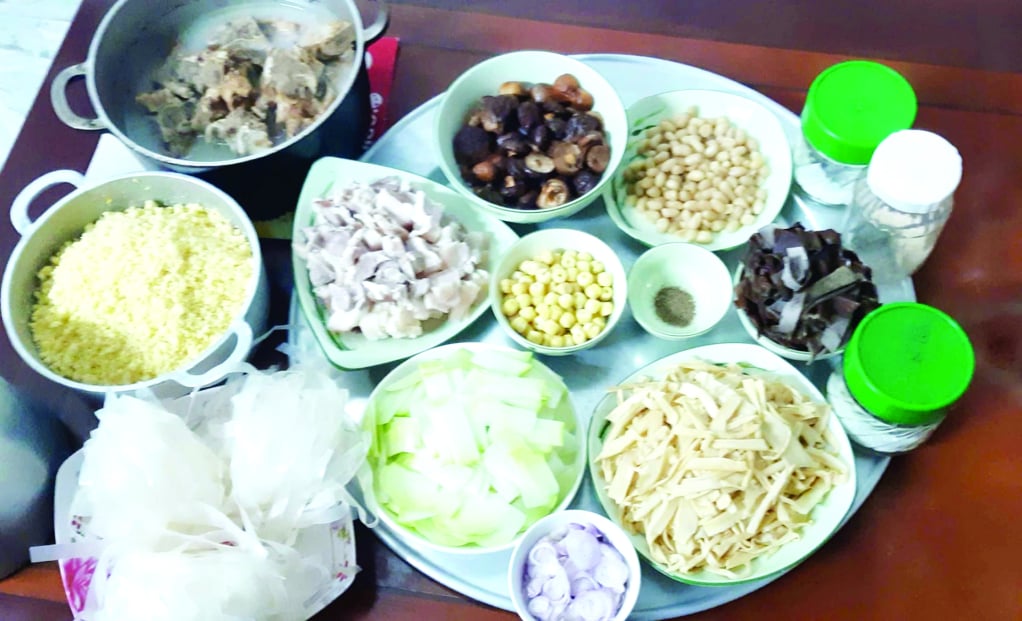
My mother's "mixed stew" is not as simple as its rustic name suggests. To make a pot of stew with the authentic taste of Xuan Dinh, from the early morning mist, she would go to Dong Tao market to select the freshest ingredients. For her, the meticulousness and attention to detail in the selection process, right from the market, is what creates the distinctive soul of our hometown's "mixed stew." It must be said that the ingredients for this dish are an artistic convergence of local agricultural and forestry products. Under my mother's hands, there are soft, nutty mung beans, rich peanuts, and creamy white lotus seeds arranged alongside chewy dried bamboo shoots. The delicate white of winter melon contrasts with the dark black of finely chopped wood ear mushrooms, garnished with fragrant shiitake mushrooms and rolled rice noodles. And, of course, there are the meticulously sliced pieces of fresh pork belly, mixed with a touch of rich pork fat. The heart and soul of the dish lies in the fragrant aroma of fried shallots, perfectly blended with the rich, savory fish sauce and salt, creating a symphony of flavors that are both familiar and novel, awakening all the senses of the diner.
As the fire began to crackle, my mother started the crucial, bustling process. Without any haste, she added each ingredient to the pot according to a strict procedure, as if performing a ritual. First, a handful of dried onions were dropped into the hot lard, filling the kitchen with their fragrant aroma. Next came the tender, pinkish slices of pork belly, tender shredded dried bamboo shoots, peeled boiled peanuts, delicious, white lotus seeds, and fragrant shiitake mushrooms. The rich aroma permeated the small kitchen before she leisurely added the perfect amount of broth. Finally, the soft, creamy mung beans, refreshing winter melon, and the crisp, white rice noodles were added last, slowly blending together under her skillful stirring, awaiting their perfect cooking moment.
After a leisurely wait over the simmering fire, the "messy" dish was finally cooked. When my mother took it off the stove, a wave of hot steam rose, carrying with it a rich, fragrant aroma that enveloped her hands and spread throughout the space. The lingering kitchen smoke mingled with the steaming food, creating a scene that was both real and dreamlike. My mother gently scooped spoonfuls of the dish into bowls, carefully ensuring each bowl contained the perfect balance of the chewy texture of the rice noodles and bamboo shoots, the nutty flavor of the beans, peanuts, and lotus seeds, the refreshing coolness of the winter melon, the rich fattiness of the lard and glistening pork belly, the savory aroma of shiitake mushrooms, and various spices... Looking at the white steam rising from the steaming bowl of "messy" dish, I suddenly felt a surge of nostalgia, seeing all of my mother's care and hard work encapsulated in this rustic dish.
When I was little, I often wondered and asked my mother:
Why is this dish called "chaotic" or "hodgepodge"?
My mother looked at me and smiled gently:
- You'll understand when you grow up.
My question grew with the years, and now, having experienced enough ups and downs, I understand why the dish is called "ho lon" (a hodgepodge). My mother called it "ho lon" not arbitrarily, but because it reflects the boundless compassion of her heart. Just as the "ho lon" pot readily accepts all sorts of different ingredients and then molds them into a harmonious, rich flavor, my mother uses her love to embrace the diverse personalities of her children, nurturing shortcomings into a complete and harmonious home. It turns out that this "chaos" is the essence of togetherness, the flavor of a woman's hands that always knows how to transform simple things into sacred treasures. Thus, my mother's cooking taught me that the pinnacle of sophistication sometimes lies in the simplest things. And the greatest wealth in a person's life is the abundance of family love, found in the flavorful dishes of home cooked by my mother's hands.
Source: https://baohungyen.vn/mon-lao-nhao-cua-me-3190452.html


![OCOP during Tet season: [Part 3] Ultra-thin rice paper takes off.](/_next/image?url=https%3A%2F%2Fvphoto.vietnam.vn%2Fthumb%2F402x226%2Fvietnam%2Fresource%2FIMAGE%2F2026%2F01%2F28%2F1769562783429_004-194121_651-081010.jpeg&w=3840&q=75)


Comment (0)