

According to Mr. Do Van Bao, a teacher at Vinschool and the online learning platform Tuyensinh247, the structure of this year's 10th grade entrance exam in Hanoi for mathematics remains largely unchanged from last year, and is somewhat "easier." The exam effectively differentiates students but is still manageable, and there will likely be many scores of 8 and 9.

Candidates embrace their loved ones after completing the math exam on the morning of June 11.
Overall, the exam met the requirements for assessing students and had a differentiating factor. The level of testing basic knowledge and skills was high, but not overly challenging. Students only needed time to review, practice solving basic math problems, and work carefully to complete 75-80% of the exam quickly. Although there were some differentiating questions, they were not too difficult, and candidates could still think critically to find solutions.
Students with above-average abilities can do well on the first three exercises.
Lesson 1, simplifying expressions and calculating their values, is part of the basic knowledge of calculating and simplifying expressions with known results. It's quite simple, allowing for meticulousness from students to easily earn points. Students only need to work carefully and present their answers fully in the first part.
Secondly, the question asks to simplify the expression given the result, making it difficult for students to make a mistake. Thirdly, the question tests the skill of solving equations by reducing them to quadratic form, which is easier than other types, so most students can easily score full marks on this question.
Lesson 2, solving a problem by setting up a system of equations, is a practical problem. Question 1 is a type of problem-solving using equations or systems of equations, related to work productivity. Students can easily analyze the problem, set up a system of equations or systems of equations, and solve the equation/system of equations, achieving maximum points for this question. In quality assessment tests and mock exams of some schools, question type 1 is also frequently included, giving students good opportunities to practice.
Question 2 is a simple practical problem related to the concept of spheres. Students only need to remember the formula for calculating the volume of a sphere and carefully substitute the numbers to get points.
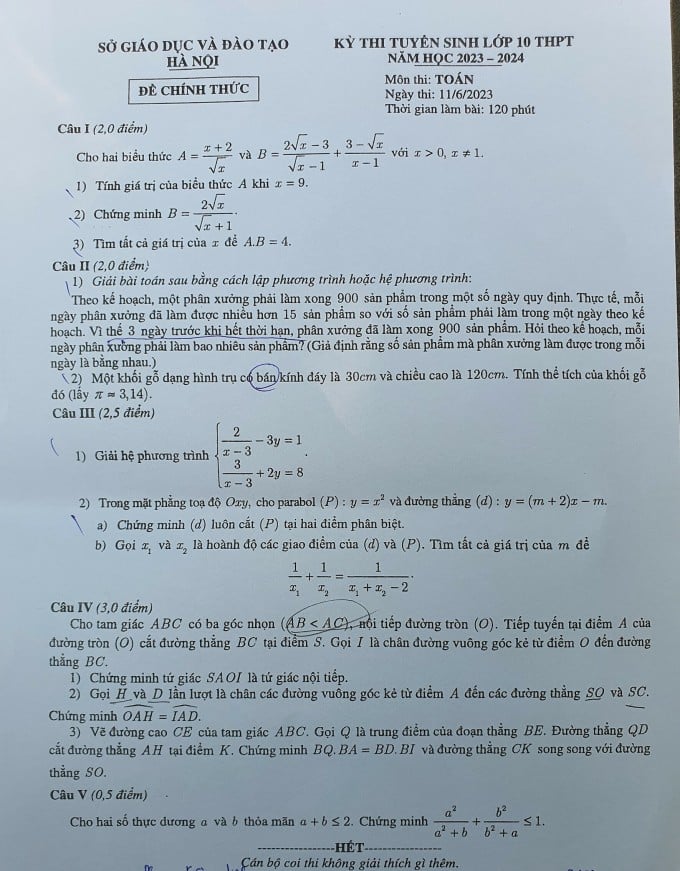
Mathematics exam paper for the 2023 10th grade entrance exam organized by the Hanoi Department of Education and Training.
Lesson 3 involves systems of equations and graph functions. This is a relatively simple lesson, easy to score points on. In question 1, students often solve it using the substitution method. Students should also pay attention to presentation, considering the conditions of the variables, and concluding the final solution to achieve maximum points. Students of average to above-average ability can do well on this question.
Question 2 of exercise 3 relates to the familiar concept of the intersection between a parabola and a straight line. Students of average to above-average ability can score well on part a of this question, while above-average students can do well on part b because the expression satisfies the condition of symmetry between the two roots, allowing for the application of Vieta's theorem to reduce it to the sum and product of the two roots. However, to achieve maximum points, careful presentation and rigorous reasoning are essential.
The differentiation of students' learning is concentrated in lessons 4 and 5.
Lesson 4 is a geometry problem, a rather good geometry exercise that effectively differentiates students, especially in the final part. The geometry problem doesn't start with the familiar given circle or semicircle, but instead provides many clues to help solve questions 1 and 2. Students who carefully read the problem requirements and meticulously draw the figure can solve question 1, as this part is a fairly familiar piece of basic knowledge covered during preparation and appears frequently in mock exams and tests from various schools.
Part 2 requires further critical thinking from students; they must reason to prove that the angles are equal based on parallel relationships and inscribed quadrilaterals.
Point 3 clearly categorizes students. Students need to pay attention to applying the midpoint principle to deduce the median of a triangle, from which they can deduce that corresponding angles are equal to form a cyclic quadrilateral, and then prove triangle similarity to deduce that products are equal. In the sub-point of parallel proof, students must reduce it to proving a cyclic quadrilateral based on equal angles to complete this point. In this section, students can rely on an intermediate proof, using the property that angles equal to the sum of equal angles are equal.
Lesson 5 is a fairly interesting but not overly difficult problem about extrema. The type of problem is quite familiar to advanced students; the expression and conditions are symmetrical between a and b, and the problem also provides the maximum value of the left side to encourage students to focus on proving it. However, this is a type of problem involving finding the maximum value of a sum, which is somewhat "reverse" to the approach of directly applying the Cauchy inequality. Students can approach it in various ways.
Teacher Bao commented: "This year's math exam differentiated students well but was still relatively easy. There will likely be many scores of 8 and 9 this year, but scores between 6.5 and 8 will be the most common. If students manage their time well, calculate carefully, and present their work thoroughly, they can score 8 or higher. Because the exam was 'easier,' teachers paid more attention to deducting points for presentation errors, so the scores will be slightly lower."
Source link










































































































Comment (0)