ANCIENT CRAFTS ALONG THE SOUND RIVER
According to the elders in the village, the craft of making printed cakes in An Lac has existed for hundreds of years. Initially, printed cakes were only made to offer to ancestors during the three days of Tet (Lunar New Year) as a way of showing respect and gratitude to one's origins. Gradually, the sweet and delicate flavor, the simple yet refined way of making An Lac printed cakes, has captivated consumers, becoming a familiar Tet gift for the people of Quang Nam province.
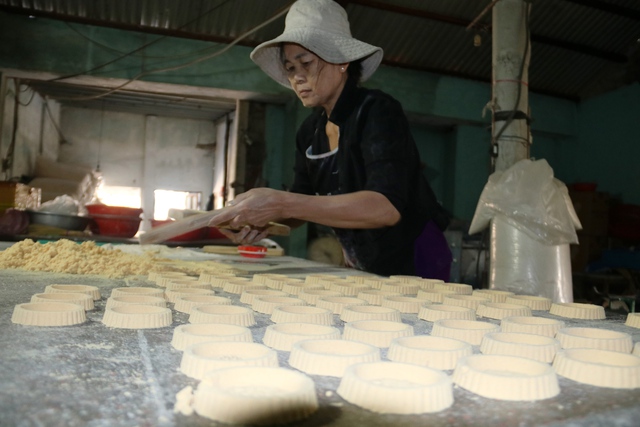
The finished cakes are ready to be put into the oven.
PHOTO: MANH CUONG
Despite the passage of time and the gradual decline of many traditional crafts, An Lac rice cakes have maintained their unique position. The cakes here are true to their balanced sweetness from sugar, the rich aroma of glutinous rice, the nutty flavor of mung beans, and a touch of warm spiciness from ginger. It is this simplicity that sets An Lac rice cakes apart from those in many other regions.
In the final days of the year, along the Ly Ly River, a bustling atmosphere of work permeates the entire village. From the early morning, when the mist still obscures the water's surface, the houses are filled with the sounds of people and machinery. Some roast sticky rice, others grind flour, some make sugar, and others make molds—everyone is busy, but everyone's face lights up with joy because another Tet (Lunar New Year) season is approaching.
An Lac rice cakes may not be elaborate in appearance, but to make a batch of delicious cakes, the baker must go through many meticulous steps, requiring attention to detail and experience accumulated over the years. The ingredients are familiar, such as glutinous rice, mung beans, sugar, ginger, etc., but the selection process is always paramount. The glutinous rice must be fresh, with even, fragrant grains; the mung beans are carefully selected, plump, and thoroughly peeled.
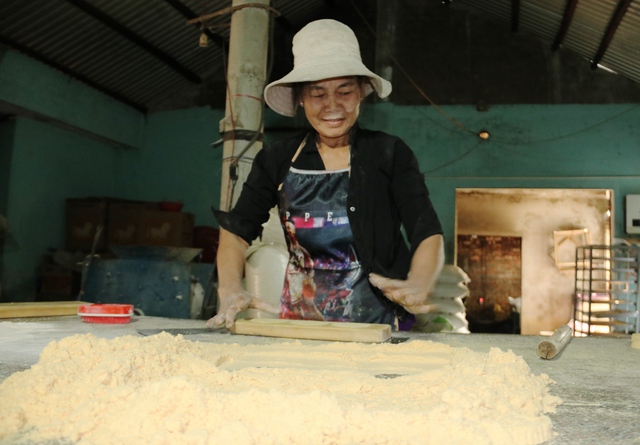
Ms. Duong Thi Tuyen is preparing the molds to make mung bean paste cakes.
PHOTO: MANH CUONG
After washing the glutinous rice thoroughly, it is dried and then roasted over a low heat. This step may seem simple, but it greatly determines the quality of the cake. The heat must be just right, and the rice must be stirred constantly so that the grains expand evenly, release their aroma, and don't burn. After roasting, the rice is ground into a fine powder and sifted several times to make the powder very loose. Mung beans are also roasted until golden brown and then ground into a fine powder.


The sugar is melted to the right consistency, neither too runny nor too thick, then mixed thoroughly with glutinous rice flour and mung bean flour. Depending on each family's secret recipe, a little grated ginger may be added to create a warm, spicy flavor, preventing the cake from being too rich. After mixing, the batter is poured into pre-carved wooden molds with patterns or characters, pressed firmly, and then gently tapped to release the cake, resulting in a square, sharp shape.
The finished printed cakes are neatly arranged on shelves and dried before packaging. When eaten, the cakes melt gently in the mouth, leaving a delicate sweetness and rich, creamy flavor, quite different from the overly sweet taste of many mass-produced cakes.
THE FLAVOR OF TET AMIDST MODERN LIFE
Ms. Duong Thi Tuyen (62 years old), owner of a long-standing traditional rice cake production facility in An Lac, said that during each Lunar New Year, her facility produces about 1.5 tons of mung bean rice cakes. The rice cake production season usually starts at the beginning of the twelfth lunar month and lasts until just before the New Year. "There are so many orders that the whole family has to work from early morning until late at night. Sometimes we even have to eat meals quickly," Ms. Tuyen shared.
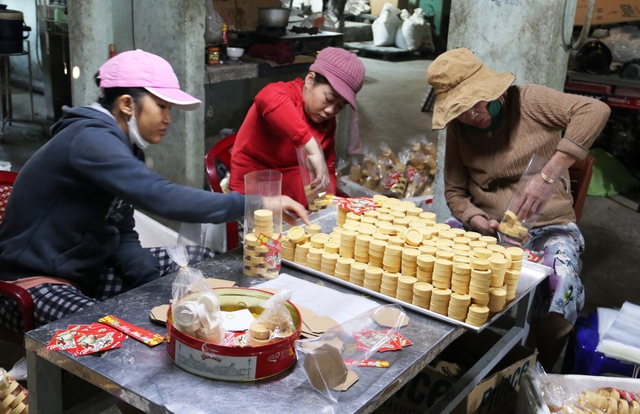
An Lac traditional cake village is bustling in the last days of the year.
PHOTO: MANH CUONG
According to Ms. Tuyen, while the technique for making printed rice cakes isn't overly complicated, producing delicious, uniform, and beautiful cakes is not easy at all. The baker must be skilled, mastering the heat control when roasting the glutinous rice, the consistency of the sugar syrup, and the pressure needed when pressing the mold. Even a small mistake can result in a cake that is dry, broken, or loses its characteristic aroma.
Although it only lasts about a month, the rice cake season brings a significant income to many households in the village. Those who take advantage of their free time during the agricultural off-season to help with tasks such as printing molds and packaging can earn between 200,000 and 300,000 VND per day. For small-scale producers utilizing family labor, each Tet season can bring in an additional 10-15 million VND.
"This job is incredibly hard. My hands and feet are always covered in flour and sugar, working from morning till night. But I can't bring myself to quit, because it's a craft passed down from my ancestors. As long as I have the strength, I'll keep doing it so that my children and grandchildren will know about the traditional craft of my hometown," Mrs. Tuyen confided.
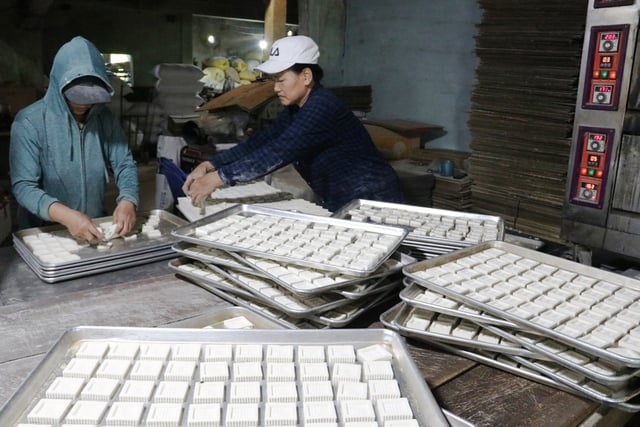
Besides mung bean cakes, An Lac village also makes many other types of cakes to serve the Tet market.
PHOTO: MANH CUONG



Currently, An Lac has more than 20 households regularly involved in the production of printed rice cakes. In addition, during the off-season at the end of the year, many other families also take advantage of the opportunity to participate in production, taking on subcontracting work for larger establishments, or making them on a small scale to supplement their income.
Mr. Huynh Quang An (68 years old), who has been involved in the traditional rice cake making profession for over 35 years, said that in recent years, the consumption of traditional rice cakes has increased significantly, especially in large cities. Not only sold locally, An Lac rice cakes are also purchased by customers as gifts to send to Ho Chi Minh City, Hanoi , and many other provinces and cities. "People who eat the cakes not only enjoy the sweetness but also taste the warmth of home. That's what has helped An Lac rice cakes overcome the harsh market conditions and stand strong through many Tet seasons," Mr. An shared.
Amidst the modern pace of life and the competition from countless new types of confectionery, An Lac rice cakes still maintain their unique place thanks to their traditional flavor and the skillful hands of village artisans. For them, making rice cakes to sell, to display on the altar during Tet (Lunar New Year), and to preserve family and village traditions, is a way to retain a part of the cultural memory of their homeland. (to be continued)
Source: https://thanhnien.vn/mua-banh-in-ben-song-ly-ly-185260125214747226.htm