When the crape myrtle tree first bloomed, the neighborhood children would excitedly come to play in its shade. Some were well-behaved, but others were mischievous, sometimes picking clusters of blooming crape myrtle blossoms to play with. Grandpa felt sorry for it. He built a gate, absolutely forbidding anyone from getting near the tree, and Grandma had to keep nagging him:
- You must choose your words carefully so that the children learn to appreciate trees and flowers. Trees provide shade for everyone. Beautiful flowers are for everyone to admire. That way, the village will be happier and more close-knit.
He thought about it, then listened to his wife. He built a chair, bought a chessboard, and placed it on the stone table under the tree. Every afternoon, he and the older people in the neighborhood would play chess, or neighbors would go for a walk and sit on the chairs around to enjoy the cool breeze. The children, seeing him open the fence, sometimes came to play and help him water the plants and tend to them.
She passed away a few years ago. Since then, every summer, he would sit under the crape myrtle tree and talk about old age with her.


***
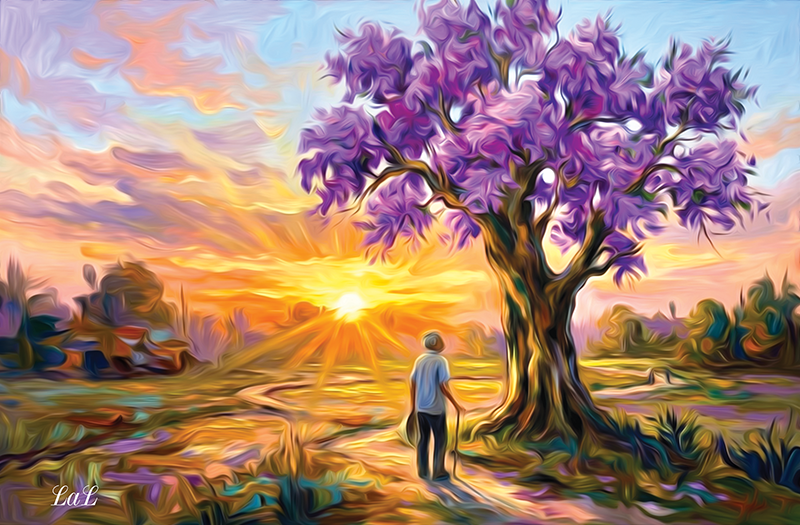
The couple had two sons, Minh and Huong. In the past, the whole family lived together in a small house on the plot of land to the right of the crape myrtle tree. In recent years, with urbanization, a large park was built in front of their house, so the surrounding land has become valuable. When Minh and Huong first got married, they both moved to the city to work because they didn't want to live in the boring countryside. Now that land prices have increased, the sons asked their father to divide the land so they could settle down and start a family. He agreed. The land was divided into three parts; he still lives on the plot on the right where the house he'd lived in for decades, while the remaining land with the crape myrtle tree in the middle is divided between his two sons, with the tree as the boundary marker. Following their wives' advice, the sons built a fence around the base of the tree. The crape myrtle tree was now as if it had been split in two. There was no longer a bench, no more open space around it. But at least the crape myrtle tree was still there, he thought.
After a few more years, Minh decided to sell his house and return to the city. He asked Mr. Tranh to cut down the crape myrtle tree because the new owner didn't want the old tree interfering with Huong's land. Mr. Tranh reluctantly sold a portion of his land, giving the money to Minh, essentially buying a small piece of land around the crape myrtle tree to add to Huong's property. Huong, of course, had no objections to having more land.
Later, due to business losses, Huong discussed with his father the idea of selling the crape myrtle tree, as it was large and beautiful and would fetch a good price. Otherwise, Huong would sell the land, and the tree would be lost. Hearing his son's words, Mr. Tranh fell ill for several days. In his dream, he suddenly remembered the days when his wife was still alive, and how his children, like her, loved the crape myrtle flowering season. Every early summer, the whole family would sit under the tree, Mr. and Mrs. Tranh drinking tea and chatting while the two children played chase under its cool shade. Later, his two children would even press the crape myrtle flowers dry every summer to give to their classmates. On the day his wife passed away, his children told him:
Every time I see a crape myrtle tree, I'm reminded of Mom.
The tree was nurtured with love, so it bloomed beautifully, and people had many aspirations. Until the children grew up, left their hometown for the city, and became obsessed with getting rich quickly, having to get rich at all costs...
***
After a serious illness, he called his two children home and instructed them: "The crape myrtle tree I planted is for your mother. It's been here since you grew up, witnessing our family's happiness and holding so many memories of this small village. If you can't keep it, at least don't destroy it. I'll take care of your business capital..."


Minh and Huong looked at their father, who had loved his wife and children his whole life, now speaking as if he were about to leave. They suddenly realized how their schemes to exploit his love and force him to worry about their finances had repeatedly backfired, like being exposed to the scorching summer sun.
So Mr. Tranh decided to sell his house and divide the inheritance between his two children. His children eventually reconsidered and kept the plot of land with the crape myrtle tree. He entrusted his long-saved pension to the village's temple committee, asking them to care for the crape myrtle tree after his death. The villagers refused the money and promised him they would take good care of the tree, as each flowering season represented a season of memories that had existed in the village for a long time; they would cherish and preserve the tree.
He passed away one summer afternoon, when the crape myrtle blossoms were in full bloom, their purple flowers beautiful and melancholic. The villagers built a small, beautiful fence around the base of the crape myrtle. His summer had ended, but the summer of the crape myrtle tree remained. Every May and June, anyone passing through Chua village would see the large crape myrtle tree in full bloom. Whenever someone inquired about the tree, the villagers would tell the story of Mr. Tranh planting it out of love for his wife...
Source: https://baocantho.com.vn/mua-hoa-bang-lang-no-a207117.html
![[Photo] The 13th National Congress of the Youth Union conducts personnel work.](https://vphoto.vietnam.vn/thumb/1200x675/vietnam/resource/IMAGE/2026/06/24/1782299943080_ndo_br_1-6868-jpg.webp)
![[Photo] General Secretary and President To Lam attends the Central Public Security Party Committee Conference](https://vphoto.vietnam.vn/thumb/1200x675/vietnam/resource/IMAGE/2026/06/24/1782302063612_a1-bnd-9302-9166-jpg.webp)
![[Photo] Opening Ceremony of the 13th National Congress of the Ho Chi Minh Communist Youth Union](https://vphoto.vietnam.vn/thumb/1200x675/vietnam/resource/IMAGE/2026/06/24/1782286753905_ndo_br_1-8510-jpg.webp)