They take advantage of the peak season to increase revenue while creating a flexible service network.
The "earning a living" season
For many locals and people from surrounding areas, the 3-4 summer months in Hai Phong's tourist hotspots are a golden opportunity to gain experience and increase their income.
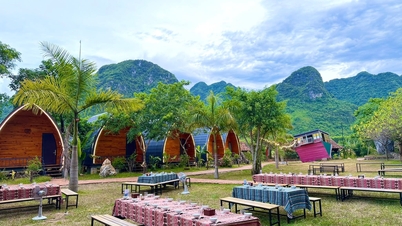
Instead of choosing an air-conditioned office internship, for the past two years, Nguyen Van Nam (22 years old), a student at Vietnam Maritime University, has been working as a waiter and stand-up paddleboard (SUP) assistant at a homestay in Lan Ha Bay on Cat Ba Island. "Summer here is so busy that my feet barely touch the ground, but it's fun and the income is worth the effort," Nam shared with a sun-tanned smile typical of people from coastal areas.
The biggest advantage of seasonal tourism workers in Hai Phong is the large market demand and attractive income. With the strong development of transportation infrastructure (tourist cable cars, synchronized ferry routes) and food tour promotional campaigns, the number of tourists flocking to Hai Phong has grown exponentially.



Not only students, but also middle-aged workers are finding opportunities to increase their short-term income. Ms. Hoang Thi Tham (42 years old, Kien Thuy commune) shared that normally she works in the fields and does garment manufacturing at home, earning an unstable income of only about 4 million VND/month. But every May, she goes to Do Son to apply for a job as an assistant chef at a seafood restaurant. Thanks to her skillful hands and hard work, Ms. Tham earns nearly 11 million VND each month - an amount equal to the total income of an entire rice planting season.
Drops of sweat fell

However, the "travel bread" is not easy at all. Behind the dream income lies a harsh reality.
On weekends or holidays, Hai Phong's beaches become overcrowded. Ms. Tham's workday typically starts at 5 a.m. and ends late at night when the last customers leave their tables. "There are days when I stand in the kitchen for hours, my feet swell up so much I can't even wear sandals. My hands are always burning from the heat and the smell of oil and grease," Ms. Tham said.
For those who work outdoors like Nam, the biggest risk comes from the weather. The scorching 38°C - 39°C heat of Hai Phong's coastal region can overwhelm anyone due to heatstroke or sunstroke. Not to mention, guiding tourists in SUP paddling or beach rescue always carries the risk of water accidents, rough waves, or jellyfish stings causing allergic reactions.
Because they are seasonal workers, most agreements between workers and employers are verbal, with no employment contracts or health insurance.



Nam recounted his experience from his first year: "That year, I worked at a beach bar. The owner promised to pay me 8 million VND per month, but at the end of the season, citing heavy rain and storms and a lack of customers, they deducted some of the amount, only paying me half, and then subtly fired me. Since there was no written agreement, I had no choice but to swallow my pride."
Despite facing numerous risks, it is undeniable that seasonal tourism has been and continues to be an important economic driver, helping to improve the lives of thousands of workers and bringing a youthful vitality to the tourism industry in Hai Phong.
THU HUONGSource: https://baohaiphong.vn/mua-lam-an-cua-lao-dong-thoi-vu-544653.html




![[Photo] Strengthening character and expertise: Intense training for artillery soldiers.](https://vphoto.vietnam.vn/thumb/1200x675/vietnam/resource/IMAGE/2026/06/30/1782815602541_lu-368-1875-4571-jpg.webp)