

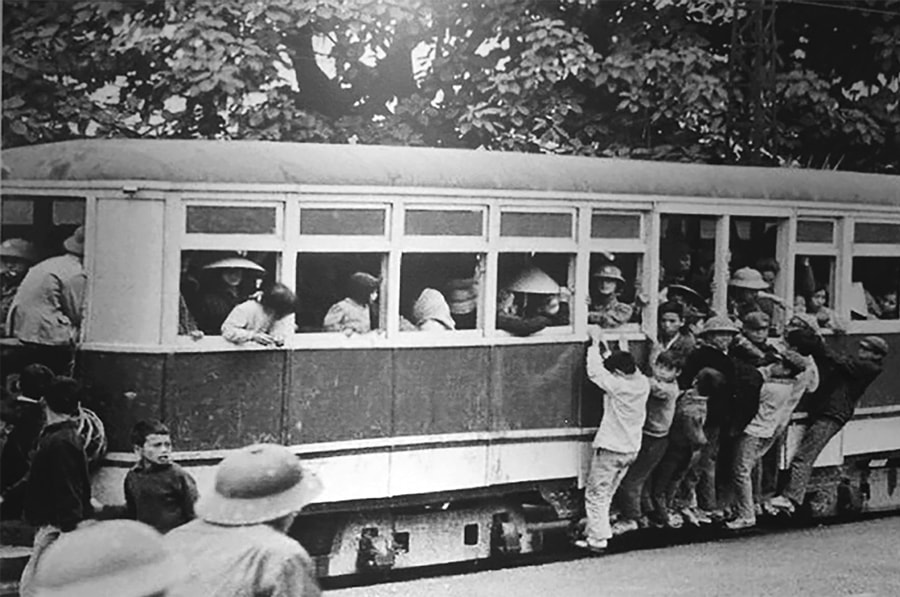
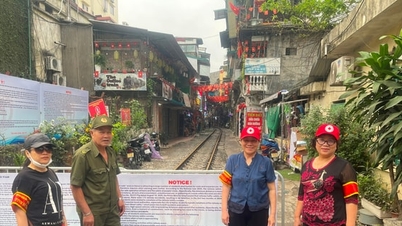
1. Forty years ago today, I stood by Hoan Kiem Lake after returning from a long journey. Hanoi was very poor then. The tram from Cho Mo market, heading up Hang Dao street, was crowded with people, their carrying poles piled high. The image of men in their faded, old army uniforms and women huddled in their worn-out cloth trousers haunted me. The country was going through difficult times after the war. The crape myrtle trees still bloomed green to welcome spring, but the ancient Turtle Tower seemed more subdued on the water's surface.
Earlier, during my trip to Quang Tri , I revisited Vinh Linh, Gio Linh, Hien Luong Bridge, and the Ben Hai River. Ten years after reunification, the place that was once divided has changed considerably. White egrets have returned to the fields still littered with unexploded bombs and mines. Families separated have reunited. Children born in the Vinh Moc tunnels are now attending school. But in this land that once suffered so much, poverty still clings to every person and every village. I walked from Ho Xa to Trung Hai to visit Ms. Hoang Thi Cham, a famous female sniper guerrilla fighter from the former perimeter, and I was truly concerned about her impoverished family living in thatched huts.
That time, while talking with Mr. Phan Chung, Secretary of the Ben Hai District Party Committee, I understood more about the concerns of the local leaders. Peace is what everyone longs for. But how to escape poverty and achieve a prosperous life is a major question. The wartime subsidy system is hindering development. Infrastructure is weak and outdated. The district still relies mainly on subsidies from the central government...
Having been closely associated with this place throughout the war years, Mr. Phan Chung shared: "In this new era, we need new development models and mechanisms. Meanwhile, the difficulties faced by each family and the entire community are immense. These thoughts are also common concerns in many other places across the country."
During those years, I traveled extensively and witnessed many unforgettable events. Fire continued to burn and blood was shed at both ends of the country. The economy, which had not yet recovered after 1975, faced further difficulties due to blockades and embargoes from the West. The centralized, subsidized economic model revealed many shortcomings. Inflation skyrocketed, reaching 587% in 1986 compared to 1985. Production stagnated. Life was extremely difficult.
I returned to the Cambodian front when the first volunteer soldiers withdrew. I visited border checkpoints in Meo Vac (Ha Giang), Trung Khanh (Cao Bang)... I went back to the hometown of Hero Nup at the foot of An Khe Pass, witnessing emaciated, hungry, and poorly clothed children. I went to Bac Son town, where the "indigo hues mingled with the wind" lacked electricity, with only the sound of loudspeakers broadcasting at night. I visited villages where people longed for roads to transport oranges for sale. I went to U Minh Thuong, which was still very wild after liberation. I went to Phu Quoc, deserted and desolate amidst a sea rich in shrimp and fish... After these trips, I wrote the article "Please Don't Forget the Old War Zones" as a plea to the managers when planning development directions.
2. At the end of 2025, I was given the photo book "Hanoi 1987". The author, Jean-Charles Sarrazin, a French photographer, captured many images of everyday life in the capital at that time. The trams, rickshaws, bicycles, shops, and portraits of Hanoians from all walks of life in the late 1980s evoked many emotions. The book paints a "portrait of Hanoi" at the beginning of the country's Doi Moi (Renovation) period.
Life in Hanoi back then remains vividly etched in my memory. Monthly salaries were barely enough to last a week. The currency depreciated rapidly. Reforms to prices, wages, and currency, due to their shortcomings, only exacerbated the situation. Life was so stressful that each person and family had to find ways to survive. People raised pigs and chickens in cramped apartments. My wife's simple wish was to have chicken eggs for our two young children. Goods were extremely scarce. Every day, the "battle" of queuing to buy rice, vegetables, fish sauce, salt, kerosene, and cloth (using ration coupons) drained everyone's energy. A class of people emerged who made a living trading goods and ration coupons, known as "speculators."
Some stories have become legendary: The sign at the state-run store that read "Children's meat for sale today" startled readers. Some families had to use scissors to chop chicken, afraid of making noise that would incite curious and angry neighbors... A professor humorously remarked, "It's not the professors who raise pigs, but the pigs who raise the professors." The funny rhyme, "First, I love you because you have a tank top / Second, I love you because you have dried fish to eat gradually..." in the "ten standards of love" of Hanoi girls back then, is laugh-out-loud funny. A bowl of rice with a single grain of rice "carrying" a few grains of sorghum or a few slices of dried cassava. State-run food stores sold pho "without a driver" (no meat). The rhyme, "Dong Xuan belongs to the merchants / The sidewalk belongs to the heroic people," was born when people rushed out into the streets to make a living. A colleague of mine, because of his many children, would go to Hang Co train station at night to pump up his bicycle tires. In the workplaces, each time the union distributed bicycle tires, razors, cigarettes, or even the small electric fans from the Electric Machinery Factory (like mouse-ear fans)... the selection process was a headache. But in times of hardship, this sharing and mutual support left behind beautiful memories of human kindness.
The social unrest in the "eve of the Renovation" also left its mark through moving journalistic works, such as "What Kind of Night Was That?" (by Phung Gia Loc), "The Procedure for Remaining Alive" (Minh Chuyen), "The Woman Kneeling" (Le Van Ba), "The Story of the Tire King" (Tran Huy Quang)... A multifaceted picture of a period full of challenges and hardships, but one that nurtured aspirations for progress and prepared the ground for a historical turning point for the country.
3. Difficulties in social life and inadequacies in the centralized, subsidized economic model paved the way for revolutionary changes. Prior to this, in Vinh Phu, Provincial Party Secretary Kim Ngoc, with his intelligence, courage, and determination, implemented the "household contract" model: allocating land to peasant families for independent production. In the early 1980s, this method was supplemented with the introduction of the "contract 100" system (Directive 100 of the Party Central Committee). This policy was later perfected in "contract 10" (Resolution 10 of the Politburo), opening the way for a revolution in agricultural and rural production.
Along with changes in agriculture came the policy of "breaking the mold" with new management models in Ho Chi Minh City and Hai Phong; experiments in price, wage, and currency reform in Long An... All these explorations contributed to laying the groundwork for the formation of the Doi Moi (Renovation) policy. Fortunately, during the most difficult period, the will of the Party and the aspirations of the people converged to open a turning point that fundamentally changed the management mechanism, exploiting internal strengths, potential, and opportunities to overcome difficulties. The country's leaders at that time, with their wisdom, dedication, and courage, listened to the urgent calls from reality, from cadres, Party members, and the people, to make historical decisions.
The Doi Moi (Renovation) policy of the 6th Party Congress in 1986 paved the way for a historical period. General Secretary Truong Chinh, the main "architect" of the Doi Moi process, affirmed: "We will end the period of controlling the economy through administrative orders and move to a period of controlling the economy on the basis of correctly applying objective laws."
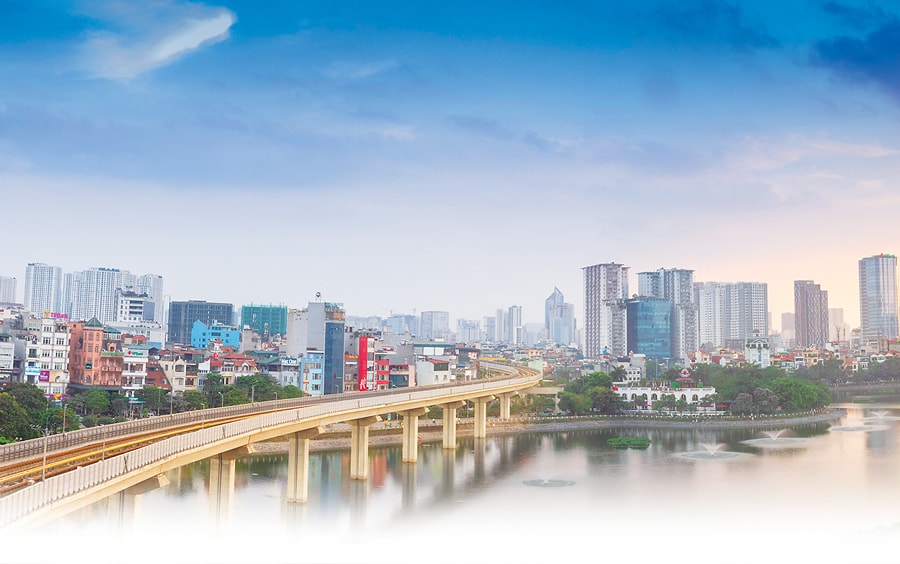
Forty springs have passed on the wings of time. The years are long enough for several generations to be born and grow up. The country has undergone many changes, achieving many great and historically significant accomplishments that those who experienced those difficult times could hardly have imagined. The economy has developed continuously with a growth rate of nearly 7% per year.
From a poor country with a backward socio-economic situation, Vietnam has become a developing country, deeply integrated into the global economy, and among the top 40 economies in the world. Gross domestic product per capita has increased nearly 25 times in three decades. The Human Development Index (HDI) has steadily and continuously increased. The material and spiritual lives of the people have continuously improved. National security and defense are ensured. Vietnam has expanded its foreign relations with 193 countries and territories, becoming an active member of over 70 regional and international organizations.
In 2025 alone, the whole country implemented 564 major projects with a total investment of 5.14 million billion VND, creating momentum and strength for a new development cycle. Among these, many large projects were launched in Hanoi, such as the Olympic sports urban area, the Red River scenic boulevard, and a series of bridges crossing the river... which will change the economic structure and appearance of the capital city.
A new spring is coming. A new era is dawning. The lessons of the Doi Moi (Renovation) process will forever remain a valuable asset, a foundation for Vietnam and its people to move towards the future!
Source: https://hanoimoi.vn/mua-xuan-tren-doi-canh-thoi-gian-734248.html


![[Photo] General Secretary and President visit the China-ASEAN AI Application Cooperation Center](https://vphoto.vietnam.vn/thumb/1200x675/vietnam/resource/IMAGE/2026/04/17/1776404277677_vna-potal-tong-bi-thu-chu-tich-nuoc-tham-trung-tam-hop-tac-ung-dung-ai-trung-quoc-asean-8706616-2286-jpg.webp)















![[Photo] National Assembly Chairman Tran Thanh Man attends the policy seminar to promote Vietnam-Türkiye cooperation.](https://vphoto.vietnam.vn/thumb/1200x675/vietnam/resource/IMAGE/2026/04/16/1776351415367_vna-potal-chu-tich-quoc-hoi-tran-thanh-man-du-toa-dam-chinh-sach-thuc-day-hop-tac-viet-nam-tho-nhi-ky-8705791-jpg.webp)




































Comment (0)