Notably, there was a clear shift in capital flow on the MXV towards agricultural commodities, with trading value increasing by over 22% compared to the previous session. Wheat, in particular, became one of the most actively traded commodities, reflecting growing investor concern about global supply risks.
Wheat prices surged amid supply risks.
According to the Vietnam Commodity Exchange (MXV), agricultural products continued to be the focus of investment in the last trading session, with trading value increasing by more than 22%. Wheat alone accounted for nearly 14% of the total market trading value.
At the close of trading yesterday, CBOT July wheat futures rose nearly 3% to $225.1 per ton. Similarly, Kansas wheat futures for July delivery also increased to $239.8 per ton.
According to MXV, escalating geopolitical tensions in the Black Sea region and concerns about adverse weather in the US are the main factors driving the rise in global wheat prices.
Market attention is currently focused on the Russian port city of Novorossiysk—one of the most important grain export hubs in the Black Sea region. Military developments in the area have significantly increased concerns about the risk of disruptions to the wheat trade flow from the world's largest supplier, thereby driving up geopolitical risk premiums.
Meanwhile, in the US, weather forecasts indicate that heavy rains could occur in the soft red winter wheat (SRW) growing region right as the harvest is about to begin. Prolonged high humidity not only hinders harvesting progress but also risks degrading wheat quality, thereby negatively impacting future supply.
According to some MXV traders, after weeks of market focus on the prospect of abundant supply from the Black Sea and North American regions, new information regarding weather and export activities is causing traders to begin reassessing potential short-term supply risks. This is contributing to buying to close short positions and bringing capital back into the wheat market.
Concerns about supply prospects quickly triggered a wave of technical buying and short-covering activity from investment funds. Technically, wheat prices are showing clear signs of recovery after a prolonged period of decline.
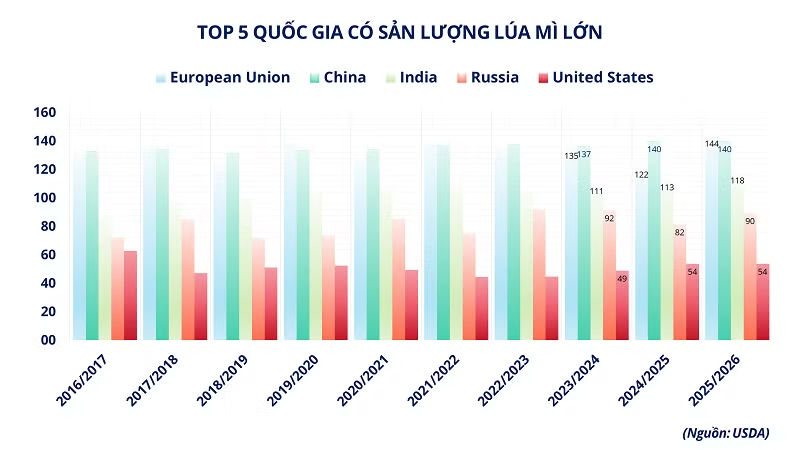
The market's upward momentum also received further support from the U.S. Department of Agriculture's (USDA) June World Agricultural Supply and Demand Report (WASDE). The report further revised down U.S. wheat yields, bringing the end-of-season inventory forecast down to approximately 20.25 million tons, reinforcing expectations of tighter supply in the current crop year.



Furthermore, demand for physical goods in the international market remains positive. Recently, South Korea completed a purchase of 60,000 tons of feed wheat originating from the European Union or the Black Sea region at a price below US$278/ton under C&F delivery terms. This active purchasing by major importing countries indicates that the need to ensure food security continues to strongly support global wheat prices.
In the domestic market, wheat prices in the northern region remain stable at around 7,000 VND/kg delivered to Cai Lan and Hai Phong ports. For the southern region, prices fluctuate between 7,000 and 7,320 VND/kg for shipments in June and July.
Silver prices continue to rise thanks to long-term demand prospects.
In the metals market, silver prices maintained their upward momentum in yesterday's trading session as new developments on the geopolitical front and monetary policy continued to support investor sentiment.
At the close of trading, the price of silver for July delivery rose more than 1%, to $70.77 per ounce.
According to MXV, silver continues to be among the commodities attracting significant interest from domestic investors due to its high volatility and positive long-term growth prospects. After a sharp correction in early June, capital is trending back into the silver market as many unfavorable factors have been partially reflected in the price.
According to MXV, the formal peace agreement signed after nearly four months of conflict has helped normalize shipping through the Strait of Hormuz, causing crude oil prices to plummet in recent sessions. This development contributes to easing global inflationary pressures and reducing the burden of energy costs on many economies.
Furthermore, as predicted by the market, the US Federal Reserve (Fed) kept the benchmark interest rate unchanged at its recent meeting. The cooling of energy prices and the less tense inflation outlook have significantly reduced the likelihood of the Fed having to raise interest rates again in the near future.
As a result, pressure from US government bond yields and the US dollar was somewhat eased, creating a more favorable environment for precious metal assets such as silver.
According to Mr. Nguyen Dai Hao, CEO of Asia Commodity Trading Joint Stock Company SPS (Business Member No. 081 of MXV), although the Fed continued to keep interest rates unchanged in the recent meeting, the agency still maintains a cautious stance, leaving open the possibility of further interest rate increases if inflation is not controlled as expected.
“This means silver prices continue to be affected by conflicting factors. While prolonged inflation and slowing economic growth prospects may support safe-haven demand for the precious metal, pressure from high interest rates and US bond yields remains a restraining factor for silver's upward momentum,” Hao said.
However, according to Mr. Hao, from a technical perspective, silver is gradually forming an accumulation zone as selling pressure is no longer too strong and most of the hawkish messages from the Fed have already been reflected in the price. If the important support zone of 65-70 USD/ounce continues to hold, the price of silver could head towards the 82-85 USD/ounce range in the coming period, before expanding its upside potential in the medium and long term.


In addition to financial factors, the long-term outlook for physical demand continues to support the silver market. According to the latest survey by the World Gold Council (WGC) as of May 14th, 45% of central banks surveyed expect to continue increasing their gold reserves within the next 12 months, higher than the 43% of the previous year. The trend of central banks accumulating precious metals is considered a positive supporting factor for the entire group of precious metals, including silver.
Regarding industrial demand, the Silver Institute and Oxford Economics forecast continued strong growth in demand for silver in strategic technology sectors. Currently, the solar energy sector accounts for approximately 29% of total global industrial silver demand, a significant increase from 11% in 2014. The European Union's goal of reaching 700 GW of solar power capacity by 2030 is expected to create a stable and sustainable demand for this commodity for many years to come.
In addition, demand for silver from the automotive industry is projected to grow at a compound annual rate of approximately 3.4% until 2031. Notably, electric vehicles are expected to surpass internal combustion engine vehicles to become the largest source of silver demand for the automotive industry from 2027, accounting for approximately 59% of total industry demand by 2031.
In the domestic market, the listed price of silver this morning ranged from 69.9-72 million VND/kg (buying price - selling price), a decrease of about 1.3-1.6 million VND/kg compared to the previous day.
Source: https://nhandan.vn/mxv-index-phuc-hoi-dong-tien-tim-den-lua-mi-va-bac-post969859.html
![[Photo] General Secretary and President To Lam receives Palestinian Ambassador Saadi Salama](https://vphoto.vietnam.vn/thumb/1200x675/vietnam/resource/IMAGE/2026/06/25/1782365384740_a1-bnd-9423-8322-jpg.webp)
![[Photo] General Secretary and President To Lam attends the 13th National Congress of the Ho Chi Minh Communist Youth Union](https://vphoto.vietnam.vn/thumb/1200x675/vietnam/resource/IMAGE/2026/06/25/1782356968989_ndo_br_1-jpg.webp)



























![[Photo] General Secretary and President To Lam receives Palestinian Ambassador Saadi Salama](https://vphoto.vietnam.vn/thumb/402x226/vietnam/resource/IMAGE/2026/06/25/1782365384740_a1-bnd-9423-8322-jpg.webp)