 |
The price of Bitcoin has fallen 50% from its peak. Photo: Overearth . |
Bitcoin's price has yet to form a sustainable recovery and is trading more than 50% lower than its all-time high set last October.
According to Bloomberg , while some experts remain cautious about whether the market has bottomed out, strong selling pressure from long-term Bitcoin holders could signal that the market is approaching a "capitulation" phase at the end of the cycle.
Individual investors are disappearing.
In a report published on June 22nd, Ed Engel, an analyst at Compass Point, stated that the amount of Bitcoin being sold by investors holding it for more than six months continues to increase, a typical sign of the "capitulation" phase at the end of a market cycle.
Investor sentiment was also pressured by a wave of withdrawals from spot Bitcoin ETFs, while money increasingly shifted towards artificial intelligence (AI)-related investments, resulting in a less-than-positive trading year for Bitcoin.
“The recent Bitcoin sell-off reflects a combination of factors including a more hawkish monetary policy stance from the Fed, record outflows from ETFs, and declining market liquidity,” said Marion Laboure, strategist at Deutsche Bank.
Since hitting a financial market bottom on March 30th, Bitcoin has underperformed significantly compared to many other asset classes. The world's largest cryptocurrency even fell to around $60,000 in early June, its lowest level since late 2024.
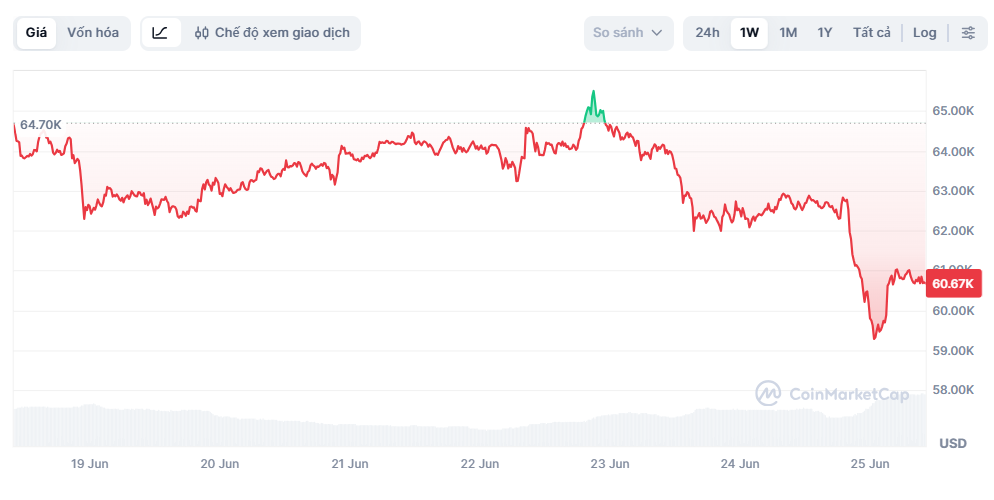 |
Bitcoin price broke below $60,000 on the night of June 24th. Photo: CoinMarketCap. |
Since the beginning of the year, the price of Bitcoin has fallen by approximately 28% and is nearly 50% lower than its all-time high set in October last year.
For years, Bitcoin has strived to shed its image as a speculative playground for individual investors. However, the current price drop is revealing the dark side of the "Wall Street-ization" of the cryptocurrency market, where institutional capital has helped Bitcoin grow in size and gain wider recognition, but buying power from individual investors – the group that once absorbed sharp sell-offs – is now almost nonexistent.
According to Deutsche Bank, this downturn differs from previous cycles because the source of new individual investors has almost dried up precisely when demand from institutional investors began to weaken. Instead of withdrawing money to a defensive position, many investors are shifting their focus to AI-related opportunities, causing capital to flow out of the digital asset market.



“Bitcoin buyers are no longer individual investors but rather ETF fund managers or corporate treasury management departments. Increasingly, many of them are having to weigh the pros and cons of Bitcoin versus AI,” Laboure observed.
Therefore, when this group of investors withdraws capital or moves to other assets, the decline in Bitcoin occurs much faster and is more mechanical than in previous cycles that were led by individual investors.
The shift in capital flows is occurring against the backdrop of the Fed adopting a more hawkish stance. Some economists now predict the Fed may raise interest rates two more times this year. This risks reversing the abundant liquidity environment that has supported risky assets for many years.
AI is becoming a rival to Bitcoin.
According to Deutsche Bank, investors have withdrawn more than $6 billion from Bitcoin ETFs, marking the longest streak of outflows since 2024. As ETFs become a major driver of Bitcoin price fluctuations, these current outflows are amplifying the downward momentum in a similar way to how inflows fueled previous rallies.
This shift has also made the market more sensitive to negative news. Strategy's sale of 32 Bitcoin earlier this month – its first sale since 2022 – raised concerns that businesses holding Bitcoin with high financial leverage could switch from buying to selling.
Although the amount of Bitcoin sold was insignificant compared to Strategy's total holdings, the event still held great symbolic significance for the market.
Deutsche Bank argues that even though Strategy later resumed buying Bitcoin, the incident still demonstrates the market's increasing sensitivity to moves from institutional investors.
“Bitcoin is trading below Strategy’s average cost of $75,699 /BTC, and the market has begun to consider the possibility that leveraged businesses may be forced to sell. We believe this question will continue to exist,” Laboure stated.
When confidence declines, risk tolerance decreases across the entire group of highly volatile asset classes.
Marion Laboure, strategist at Deutsche Bank
The bank also suggests that the money being withdrawn from cryptocurrencies is now finding new destinations instead of remaining on the sidelines. The largest tech corporations in the US are projected to spend over $700 billion on AI infrastructure this year. If this trend is structural rather than temporary, pressure on demand for cryptocurrencies could last longer than previous downturn cycles.
“Cryptocurrencies and growth stocks share a common buyer base—investors seeking returns from highly volatile assets. So when confidence declines, risk appetite decreases across the entire asset class,” Laboure said.
As a result, the Bitcoin market is now driven more by portfolio allocation decisions than by individual investor enthusiasm. Wall Street contributed to Bitcoin's increased popularity, but as demand from retail investors weakens, Bitcoin's price is increasingly dependent on institutional capital flows, macroeconomic expectations, and competition from AI in attracting investment. This also makes the market more vulnerable to large-scale capital outflows.



Conversely, Steve Kurtz, co-global head of digital assets at Galaxy, suggests that Bitcoin's next upward price momentum could come from positive signals from the White House.
Observers are currently paying particular attention to the Transparency Act. If passed, this bill would give the Commodity Futures Trading Commission (CFTC) the primary regulatory role for much of the cryptocurrency industry, while the U.S. Securities and Exchange Commission (SEC) continues to oversee digital assets classified as securities.
“Everything happening in Washington right now is highly tactical. Many people like to assign probabilities to the likelihood of the bill passing. The reality is that lawmakers are determined to push this bill forward and build a specific legislative agenda. Those two factors are clashing, and it’s highly likely the policy environment will continue to be highly volatile in the coming period,” Kurtz said.
Source: https://znews.vn/gia-bitcoin-chim-nghim-post1662987.html

![[Photo] General Secretary and President To Lam attends the 13th National Congress of the Ho Chi Minh Communist Youth Union](https://vphoto.vietnam.vn/thumb/1200x675/vietnam/resource/IMAGE/2026/06/25/1782356968989_ndo_br_1-jpg.webp)





































![[Photo] General Secretary and President To Lam attends the Central Public Security Party Committee Conference](https://vphoto.vietnam.vn/thumb/1200x675/vietnam/resource/IMAGE/2026/06/24/1782302063612_a1-bnd-9302-9166-jpg.webp)