

The glorious history of nation-building and national defense, from the time of the Hung Kings to the era of Ho Chi Minh, is an immortal epic preserved in timeless declarations of heroism.
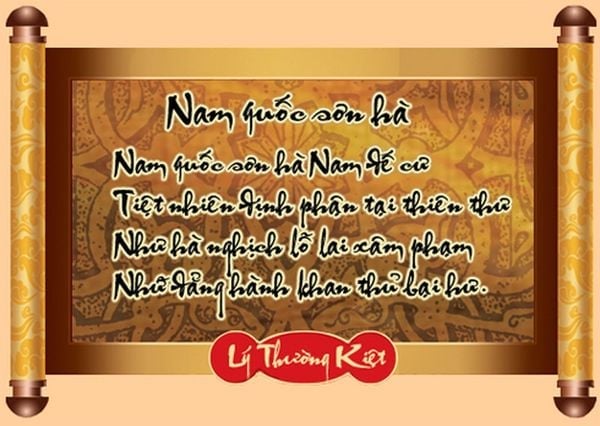
The poem "Nam Quoc Son Ha" is considered the first declaration of independence of the Dai Co Viet state. (Image: Internet)
1. The "divine" poem by Ly Thuong Kiet, resounding on the Nhu Nguyet River during the resistance against the Song army, is considered the first declaration of independence of the Dai Co Viet state after a thousand years of Northern domination.
"The mountains and rivers of the Southern Kingdom belong to the Southern Emperor."
Fate is absolutely determined in the Book of Heaven.
As the river flows, the barbarians come to invade.
Those who act recklessly will surely suffer defeat and ruin.
(The rivers and mountains of the South belong to the Southern king)
Destiny is clearly ordained in the book of heaven.
Why did the invaders come to trespass?
They will be beaten to a pulp.
(Translated by Tran Trong Kim)
The poem affirms that the rivers and mountains of Vietnam belong to the Vietnamese people, a sovereign nation with its own political system, territorial boundaries, and the home of the descendants of the Dragon and the Immortal. This is an undeniable truth, a righteous principle, confirmed by practice, as clear as a "heavenly book," as bright as the sun, moon, and stars. All conspiracies and schemes of foreign enemies to invade and assimilate are immoral, unjust, and inevitably lead to failure.
Written in the seven-syllable four-line stanza form, the poem resonates like a resolute declaration of the independence of Dai Viet, with the king and people united in purpose and strength, ready to confront and defeat the invading enemy.
The indomitable spirit of the national culture and the will to survive of the Vietnamese people, despite enduring a thousand years of Northern domination and the establishment of a vast and insidious ruling apparatus, could not suppress the will to survive of a nation determined to maintain its independence. This historical milestone ushered in the periods of self-rule under the Ly, Tran, and Le dynasties... hundreds of years later, the nation remained strong, its integrity preserved, and its people secure.
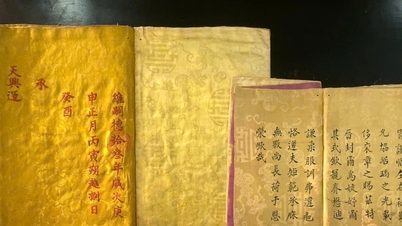
2. After more than 10 years of resistance against the invading Ming army (1418-1428), Nguyen Trai wrote the epic "Binh Ngo Dai Cao" (Proclamation of Victory over the Ming), praising the great victory of the nation and once again affirming the unshakeable independence of Vietnam.
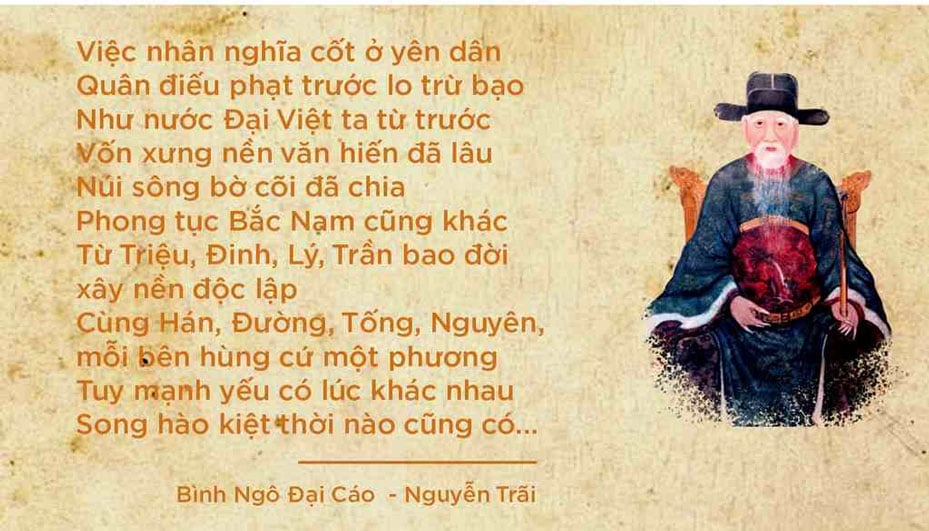
"Proclamation of Victory over the Wu" - an epic poem. (Image: Internet).
At the beginning of the "Proclamation of Victory over the Wu," Nguyen Trai wrote:
"As in our Great Viet nation from the past."
A nation that has long claimed to be a civilized land.
Mountains and rivers have divided the land.
Customs in the North and South are also different.
From the dynasties of Trieu, Dinh, Ly, and Tran, generations built the foundation of independence.
"Along with the Han, Tang, Song, and Yuan dynasties, each side held sway over a region."
In conclusion, the proclamation affirms the bright future of the nation:
"From this point on, the nation will be stable and secure."
The country will be transformed from here on.
The universe goes through a period of decline, then returns to prosperity.
The sun and moon dim then shine again.
A thousand years of shame wiped clean.
"May peace and prosperity last forever."
The Proclamation of Victory over the Wu, as a declaration of independence, holds the significance of a legal document (on par with the Northern dynasty), written in a eloquent, confident, spirited, forceful, and proud style befitting a victor. "The Proclamation of Victory over the Wu" deserves to be recognized as a documentary heritage not only of the Vietnamese nation but also of global significance.
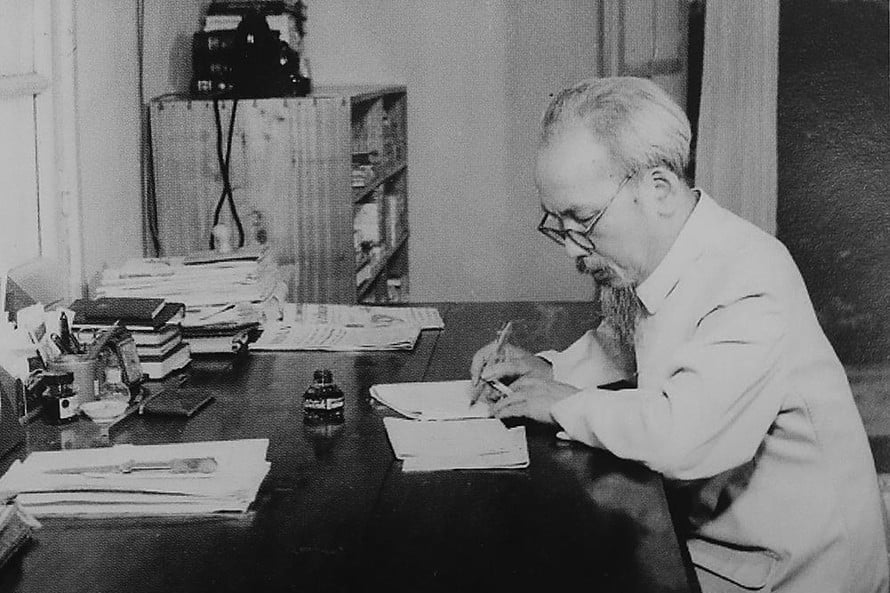
3. On September 2, 1945, in the historic Ba Dinh Square, President Ho Chi Minh, on behalf of the Vietnamese people, read the Declaration of Independence, giving birth to the Democratic Republic of Vietnam. 78 years since its creation, the Declaration of Independence has become a great heroic document in the history of the nation and an outstanding work in the history of Vietnamese literature, shining with the highest and most beautiful values, inspiring generations of Vietnamese people.
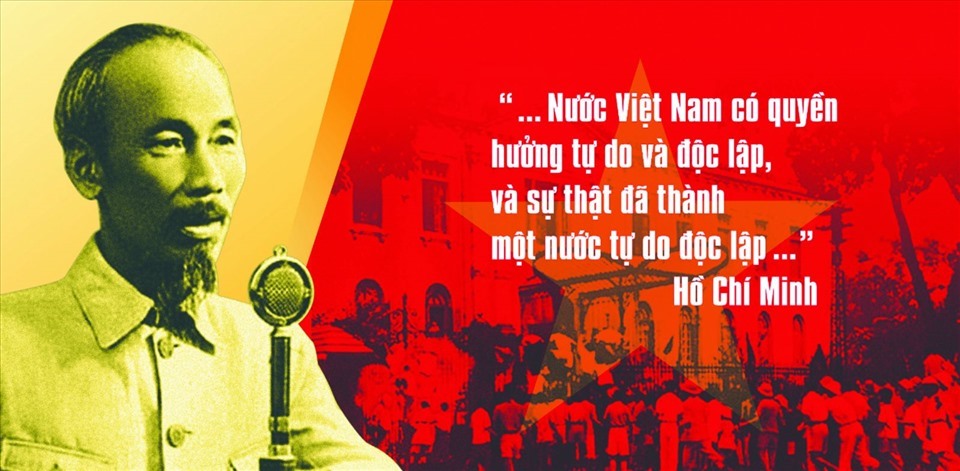
On September 2, 1945, President Ho Chi Minh read the Declaration of Independence, giving birth to the Democratic Republic of Vietnam. (Photo: archival material).
The Declaration of Independence begins with an eternal and universal truth: “All men are created equal. They are endowed by their Creator with certain unalienable rights; among these are the right to life, liberty, and the pursuit of happiness,” “All the peoples of the world are born equal; every people has the right to life, happiness, and liberty,” “These are undeniable truths.”
Next, the Declaration of Independence denounced and condemned the crimes of French colonialism. They had "taken advantage of the banner of freedom, equality, and fraternity to seize our country and oppress our people," implementing an extremely reactionary policy in all aspects: political, economic, cultural, and social... In the autumn of 1940, when the Japanese fascists invaded Indochina, the French colonialists knelt in surrender, not "protecting" us but "selling" our country to Japan. From then on, our people suffered under two layers of shackles: French and Japanese.
After analyzing the situation in our country from the autumn of 1940 until the Vietnamese people rose up to seize power, the Declaration of Independence emphasized: “The truth is that our people have reclaimed Vietnam from the Japanese, not from the French. The French fled, the Japanese surrendered, and Emperor Bao Dai abdicated. Our people have overthrown the colonial shackles of nearly 100 years to build an independent Vietnam. Our people have also overthrown the monarchy of several centuries to establish a Democratic Republic.”
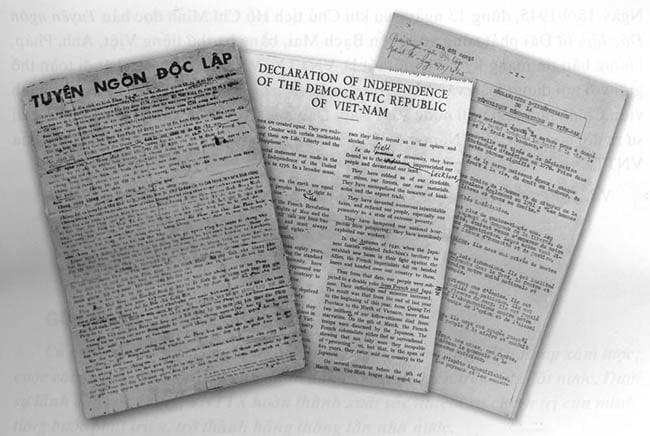
The Declaration of Independence, read by President Ho Chi Minh at the historic Ba Dinh Square on September 2, 1945, was broadcast worldwide by the Vietnam News Agency in three languages—Vietnamese, English, and French—on September 15, 1945. (Archival photo).
The Declaration of Independence solemnly proclaimed the birth of the Democratic Republic of Vietnam; completely abolishing the colonial and feudal regimes, affirming the freedom and independence of the Vietnamese nation before the entire Vietnamese people and the whole world. “A nation that has bravely resisted French enslavement for over 80 years, a nation that has bravely stood with the Allies against fascism for several years, that nation must be free! That nation must be independent!”
The Declaration of Independence affirms: “The Vietnamese nation has the right to enjoy freedom and independence and has in fact become a free and independent nation. The entire Vietnamese people are determined to dedicate all their spirit and strength, lives and property to safeguard that right to freedom and independence.”
With its tight structure, concise and succinct language, simple yet sharp expression, and eloquent, concrete examples, the Declaration stirred patriotic feelings, national pride, and encouraged the spirit of independence in every Vietnamese citizen. The Declaration is the culmination of fervent patriotism, a burning desire for national independence, and a resolute oath to safeguard that sacred independence...
Every word in the Declaration contains the overflowing emotions from the heart of the leader and every citizen, sacred like the alluvial soil of the Red River flowing for a thousand years, inheriting the tradition from the Hung Kings who founded the nation, through the dynasties of Trieu, Dinh, Ly, Tran, Le... building and defending the nation to the glorious era of Ho Chi Minh today.
The heroic spirit of ancient literature continues to resonate, urging and beckoning our nation to embark on the long march to defend the country with unparalleled strength, shining with righteousness, overcoming countless hardships and sacrifices, and building a lasting foundation of independence for all time.
Bui Duc Hanh
Source
![[Image] National Assembly discusses the implementation of the socio-economic development plan.](https://vphoto.vietnam.vn/thumb/1200x675/vietnam/resource/IMAGE/2026/04/20/1776696707422_ndo_br_img-20260420-185419-jpg.webp)

![[Photo] General Secretary and President To Lam meets with National Assembly delegates from ethnic minorities.](https://vphoto.vietnam.vn/thumb/1200x675/vietnam/resource/IMAGE/2026/04/20/1776696701056_a1-bnd-8331-3342-jpg.webp)











![[QUIZ] When did Vietnam's National Book and Reading Culture Day originate?](https://vphoto.vietnam.vn/thumb/402x226/vietnam/resource/IMAGE/2026/04/20/1776647849937_fb_anh-dai-dien-infographic-khanh-phuong-jpg.webp)




























































Comment (0)