The Hanoi People's Committee's approval of the plan for the first underground parking lot in the Old Quarter is seen as an important step in addressing one of the city's biggest bottlenecks: a severe shortage of parking space.
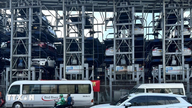
According to the plan recently approved by the Hanoi People's Committee, the underground parking lot at Phung Hung - Bat Dan flower garden, Hoan Kiem ward, will cover approximately 2,160 m2, comprising two basement levels with a capacity of nearly 270 cars and over 100 motorbikes. Basement level 1 will house motorbike parking and commercial/technical service areas; basement level 2 will be an automated car parking system. The space above will remain a flower garden, green space, walking paths, playgrounds, etc., with added amenities such as electric vehicle charging stations.
Notably, this project aims for a "2-in-1" goal – addressing parking needs while preserving and upgrading public spaces. This is crucial in the Old Quarter, an area with high population density and significant cultural and historical value that needs to be preserved.
In reality, parking has long been a challenging problem for Hanoi, given the ever-increasing number of private vehicles. The city currently has approximately 8 million vehicles, with nearly 1.5 million being cars. The number of cars increases by an average of 10% annually, but parking infrastructure remains virtually unchanged. The land allocated for public parking lots only meets 8-10% of the demand. This forces many vehicle owners to park on the road, sidewalks, or occupy public spaces, putting significant pressure on traffic and urban order.



It's worth noting that Hanoi once set a target of building over 1,600 parking lots, but so far only a few dozen have been completed. Meanwhile, 74 underground parking lots remain only on paper. The large gap between planning and reality shows that the obstacles lie not in the vision, but in the implementation process.
One of the biggest obstacles is the financial aspect. Although Hanoi has issued many preferential policies for underground parking projects, from waiving land lease fees to allowing commercial services, with current parking fees, the payback period for these projects can extend to decades. This makes many investors uninterested, or even leads them to give up.
The above reality shows that the socialization of investment in the construction of underground parking lots will be difficult to succeed if the old mechanism is still applied. To practically implement the undergrounding of static traffic, Hanoi needs stronger and more flexible policies. In this, the state plays a leading role in investing in infrastructure and then entrusting it to professional units for management and operation; at the same time, it should develop a service pricing mechanism that is appropriate to the investment costs and the affordability of the people.
The Phung Hung - Bat Dan underground parking lot is therefore not just a standalone project, but also a test of Hanoi's determination to realize its planned development. If successful, this will be an important foundation for the capital to gradually solve the problem of static traffic, restore public space, and move towards a civilized and sustainable city.


Source: https://nld.com.vn/ngam-hoa-bai-do-xe-196251225203749257.htm
![[Photo] Opening Ceremony of the 13th National Congress of the Ho Chi Minh Communist Youth Union](https://vphoto.vietnam.vn/thumb/1200x675/vietnam/resource/IMAGE/2026/06/24/1782286753905_ndo_br_1-8510-jpg.webp)


![[Photo] The 13th National Congress of the Youth Union conducts personnel work.](https://vphoto.vietnam.vn/thumb/1200x675/vietnam/resource/IMAGE/2026/06/24/1782299943080_ndo_br_1-6868-jpg.webp)
![[Photo] General Secretary and President To Lam attends the Central Public Security Party Committee Conference](https://vphoto.vietnam.vn/thumb/1200x675/vietnam/resource/IMAGE/2026/06/24/1782302063612_a1-bnd-9302-9166-jpg.webp)